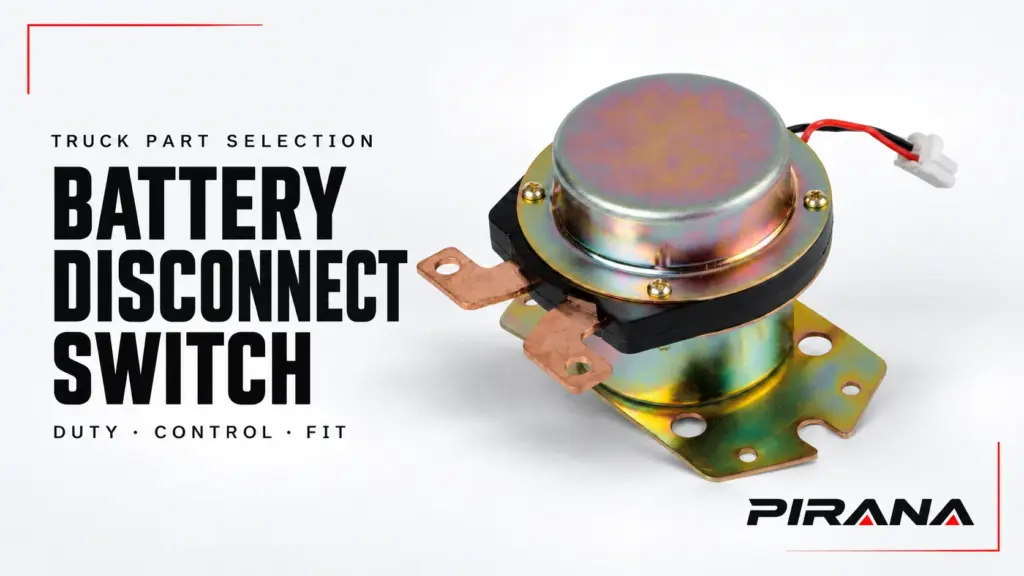
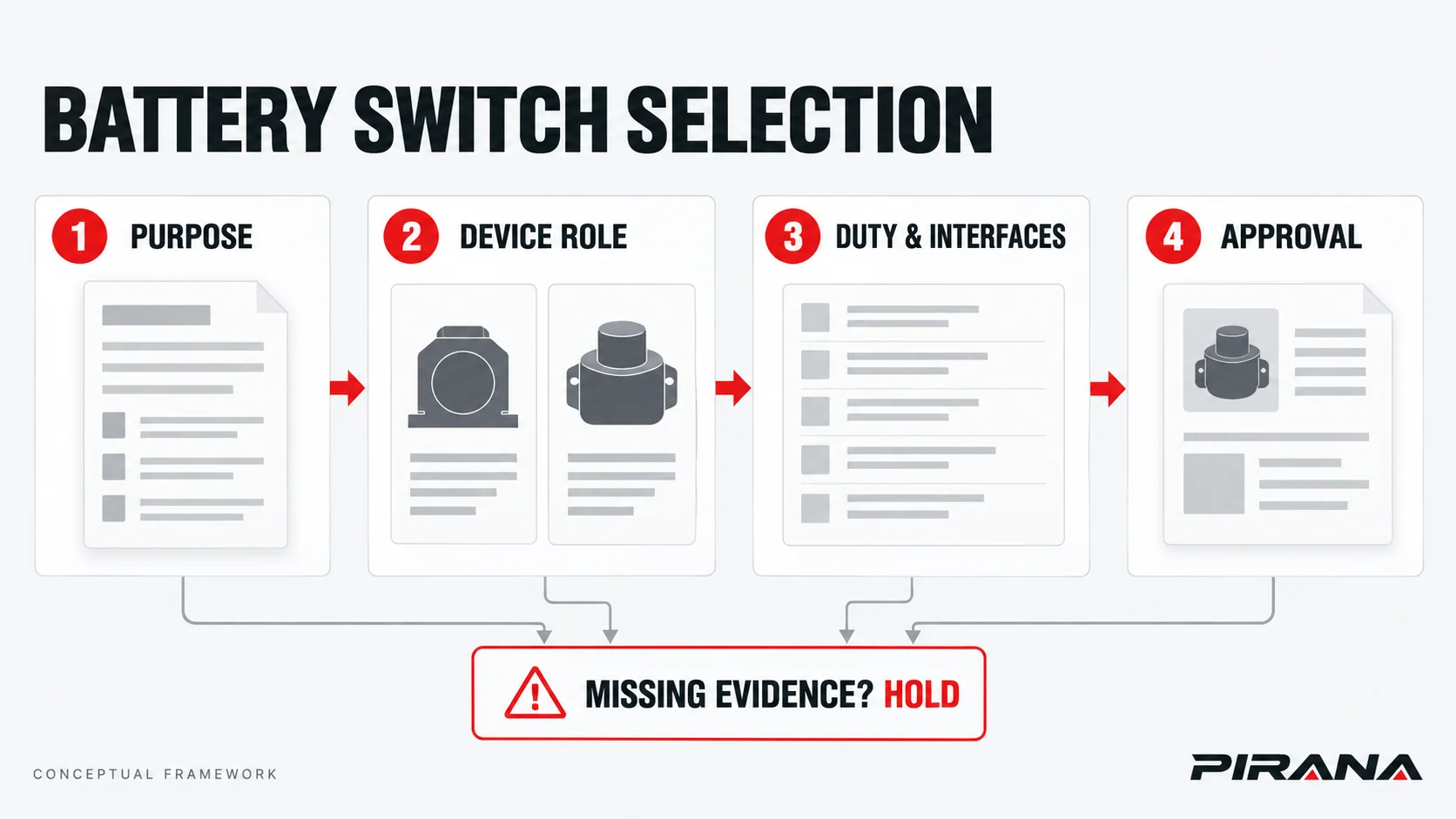
Choose a commercial truck battery disconnect switch by defining the circuit it must disconnect, the role of the part being purchased and the duty it must perform. Then match the documented voltage, current duration, control interface, terminals, mounting and shutdown requirements. A large ampere number or similar exterior is not enough to approve a replacement.
The useful buying result is a traceable specification and a qualified candidate. Final approval requires the actual vehicle requirements and the exact replacement’s technical record. This guide covers low-voltage truck battery-disconnect selection; it does not provide a battery-isolation procedure or select an electric truck’s high-voltage service disconnect.
Define what must be disconnected—and why
Start with a circuit description. Identify the battery-fed loads affected by the proposed device, the circuits that remain supplied and the purpose of operating it. “Battery OFF” is too vague for an order specification.
| Stated purpose | Requirement to establish | Evidence needed before selection |
|---|---|---|
| Reduce consumption while parked | Which loads are disconnected and what residual loads remain | Vehicle power-distribution and operating information |
| Replace an existing disconnect assembly | The original reference/version, switching scope and retained functions | Applicable parts record, schematic and service information |
| Operate the disconnect from the cab | Whether the requested part is a control, a remote power device or a complete system | Control-system description and exact interface requirements |
| Support a defined maintenance task | The vehicle’s actual isolation and verification method | Applicable service-isolation instructions; switch position alone is insufficient |
| Provide an emergency or regulated function | The exact required function, vehicle configuration and destination-market requirements | Applicable vehicle/approval documents and qualified engineering review |
The circuit boundary can be narrower than the label suggests. DTNA’s 47X, 48X and 49X Driver’s Manual, topic 0000112811, warns that its cab load disconnect switch (CLDS) does not remove power from all electrical components, including the starter and single system and actuation module (sSAM). The document also describes residual battery draw with the control OFF. That example demonstrates why a parked-load disconnect must not be assumed to isolate the whole vehicle. Use the DTNA CLDS description within its stated vehicle scope.
Write a short requirement such as: “Replacement for the documented cab-load disconnect device at this location, retaining the existing control and shutdown behavior.” Add the actual references and affected circuits. If the purpose is to add or alter a function, treat it as a system-design decision rather than an assumed drop-in replacement.
Identify whether you need the power device or its control
The actuator the driver touches may be separate from the component carrying the load. Determine which item the enquiry concerns:
- A manual load-carrying disconnect: the operating mechanism acts on the device’s main contacts. Its current path, switching duty and installation requirements need documentation.
- A remotely operated disconnect assembly: a separate command operates the power device. Confirm the control supply, actuation behavior and interfaces as well as the main-contact duty.
- A cab or remote control switch: this may command another device rather than carry battery-cable current. The high-current rating of the remote device does not become the rating required at every control terminal.
- A complete replacement system: define exactly which power device, control, leads, connectors and accessories are included and which existing items remain.
DTNA documents this separation in its 47X/48X/49X power-distribution information: a contacting device in the battery cable access box opens the high-current supply, while the optional CLDS provides the control function. This is a named architecture, not a description of every truck. See General Information, document 0000107349.
Do not approve another relay, solenoid, battery combiner or starter-control part merely because it has similar studs or a metal can. Obtain the specified circuit function, operating behavior and ratings for the candidate. For broader family identification, the truck cabin switch applications guide separates battery controls from other cab controls and power accessories.
Compare current duty with its duration and conditions
Record the requirement and the candidate rating in separate columns. Keep continuous carry, short-duration carry and any required switching capability distinct. A headline “peak” value without a duration or test conditions cannot settle the selection.
| Duty or interface | Vehicle/application input | Candidate evidence to request |
|---|---|---|
| Main-contact voltage | Documented DC circuit requirement and operating conditions | Rated voltage and applicable conditions for the exact device/version |
| Continuous current | Current carried through this device during the specified operation | Continuous rating with its stated installation and temperature conditions |
| Starting or other short-duration duty | Relevant current profile, duration and repetition for the circuit actually switched | Matching time-rated duty and recovery/duty-cycle conditions |
| Opening/closing duty | Whether and under what documented load conditions operation is required | Explicit applicable switching capability; a carry rating alone does not establish it |
| Control/coil interface, if present | Control supply, command behavior and system dependencies | Exact control rating, connection record and operating behavior |
| Fault/protection coordination | Applicable vehicle protection design and device requirements | Relevant approved system evidence; no fault-clearing capability inferred from an ampere badge |
Littelfuse’s technical Manual DC Battery Disconnect Switch Guide, p. 4, treats continuous and starting/short-duration requirements separately and explains that cable size affects the conditions behind a switch rating. It also directs selection toward matching cable terminals and stud dimensions. The practical rule is to read the complete duty specification, not compare isolated current numbers. See the technical selection guide. Its product ratings do not establish any PIRANA item’s performance.
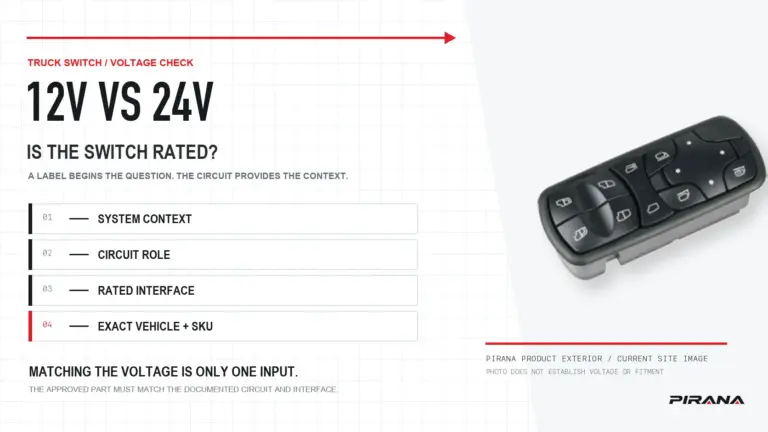
For a remote device, keep main-contact voltage and control/coil voltage as separate fields. Likewise, the truck’s nominal system voltage does not by itself identify the exact part. Use the 12V vs 24V truck switch guide when the supply and interface evidence need further clarification.
There is no universal current allowance or multiplier in this guide. If the required duty or the candidate’s rating conditions are missing, keep the item on hold for technical confirmation.
Match the installed interfaces and exposure
An electrically plausible candidate can still be unsuitable for the fitted location. Compare the actual drawing and installation requirements with the vehicle and original assembly:
- Mounting: bracket or panel arrangement, hole pattern, installation depth, orientation and available access.
- Power terminals: stud or lug form, dimensions, cable-terminal compatibility, spacing, covers and the prescribed connection hardware. Use the applicable installation instructions for tightening requirements.
- Control connection: connector keying, terminal functions, lead arrangement and retention. Equal pin count or wire colour does not establish the same interface.
- Operating method: manual access or remote command, position indication and any required locking or status feedback. Confirm the actual behavior of the selected version.
- Environment: protected or exposed location, moisture, dust, wash conditions, temperature and relevant chemical exposure. Request evidence for the required conditions; a metal housing or rubber cover is not proof of a sealing class.
Photographs are useful for visible configuration. They do not establish internal contact design, coil behavior, terminal assignments or environmental performance. A different mounting footprint, lug orientation or control connector is a reason to investigate the version, not permission to modify the vehicle until it fits.
PIRANA’s battery-switch catalogue provides product references and exterior examples for enquiries. Confirm the exact item, drawing and electrical record rather than extending a catalogue application label into an unconditional replacement claim.
Preserve the vehicle’s shutdown dependencies
Selection must account for when the device may operate and what must remain powered during shutdown. Do not choose a faster or simpler disconnect behavior without checking the system requirements.
For example, Detroit’s DD Heavy Duty Platform Operators Manual, topic 0000022372, describes an aftertreatment post-run indication on the covered EPA10 vehicles equipped with a negative battery disconnect. It explains that switching the disconnect off can interrupt a cycle used to cool the diesel exhaust fluid (DEF) doser. This supports checking the documented shutdown dependency; it does not create a universal waiting time for trucks. See the EPA10 DEF Post-Run Indicator Lamp description.
Record the applicable shutdown instructions, indication or interlock behavior, any loads intentionally kept supplied and the required restoration checks. Emergency requirements need their own applicable authority. Neither a cab-control OFF position nor ignition OFF is proof that work on the electrical system is safe; follow the actual service-isolation method.
If the enquiry concerns a high-voltage service disconnect, emergency decommissioning or a change to the approved power-distribution architecture, stop the general low-voltage parts-matching process and obtain the appropriate vehicle documentation and qualified support.
Turn the evidence into a candidate, hold or reject decision
Use three outcomes so that an incomplete enquiry does not become an approved substitution:
- Candidate: the documented device role, switching scope, duties and interfaces align. Complete any required application/sample validation before final approval.
- Hold: a decisive input or document is missing, ambiguous or unverified. State the exact item needed—for example the time-rated current conditions or control-connector record.
- Reject for this application: a documented requirement conflicts with the candidate, such as an incompatible control interface, mounting arrangement or duty. A higher advertised peak current does not cure that conflict.
Keep one specification record from enquiry through approval:
| Record field | Information to retain |
|---|---|
| Vehicle and identity | Truck platform, relevant build/market details, precise installation location and complete original part/OE references |
| Purpose and boundary | Intended use, affected circuits and what remains supplied |
| Part being purchased | Manual power device, remotely operated assembly, control switch or complete package |
| Electrical evidence | Main-contact voltage, continuous and time-rated duties, required switching conditions and control supply/interface where applicable |
| Physical/environmental evidence | Drawing/version, mounting, power terminals, cables, control connector and exposure requirements |
| Operating dependencies | Vehicle shutdown instructions, indications/interlocks and required restoration checks |
| Decision and approval | Candidate/hold/reject, unresolved items, supporting documents and required validation results |
For a PIRANA enquiry, send this record with labelled front, terminal/connector and mounting photographs, plus quantities and destination. Use the parts enquiry route to request the exact candidate’s documentation. Approve the reference and version only after the decisive requirements are resolved.
References
- Daimler Truck North America — 47X, 48X and 49X Driver’s Manual: Cab Load Disconnect Switch, General Information, 0000112811, topic dated 1 September 2026.
- Daimler Truck North America — 47X, 48X and 49X Driver’s Manual: General Information, 0000107349, topic dated 21 January 2025.
- Littelfuse — Manual DC Battery Disconnect Switch Guide & Market Outlook, 2022, technical selection criteria on p. 4.
- Detroit — DD Heavy Duty Platform Operators Manual: EPA10 DEF Post-Run Indicator Lamp, 0000022372, topic dated 3 December 2025.
REFERENCED IN THIS GUIDE
Products mentioned in this article
These published catalogue references are included because they are discussed in this guide. A reference is a starting point for identification; confirm the exact OE number, connector and vehicle configuration before ordering.
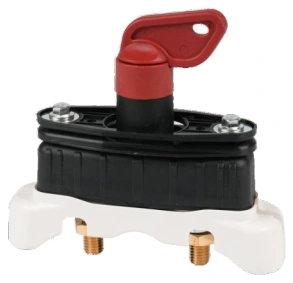
Battery Switches
Battery Switch — OE 21243844 / 20514309
PIRANA Part No. HQ-6612 · OE: 21243844 20514309 21199003 5010480868 7421199003
View product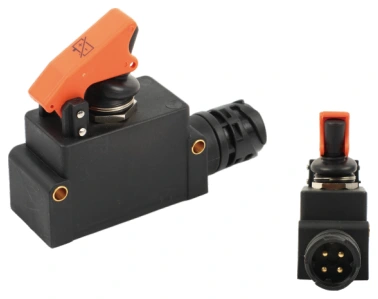
Battery Switches
Battery Switch — OE 7420367498 / 20367498
PIRANA Part No. HQ-6626 · OE: 7420367498 20367498 20429432 20409367
View product