Rain blew through an open window, and now the glass will not move. Or the window lowered without anyone touching a button, followed by a dead master switch while the passenger-door switch still worked. These patterns point to a moisture-related control-path investigation. They do not prove that the switch itself is damaged.
For a power window not working after rain, keep three locations separate: the switch area, the door-hinge wiring harness, and the motor/regulator side inside the door. Which control still works, which window fails and whether the behavior changes over time help narrow the next inspection. Rain timing alone cannot distinguish them.
Keep clear of unexpectedly moving glass. If the control is visibly wet, operates by itself, feels unusually hot or produces a burning smell, stop using it and arrange qualified assistance. Do not repeatedly cycle it to see whether the fault returns.
This article covers the rain trigger. The general patterns belong in Bad Power Window Switch Symptoms; the broader evidence and recording process belongs in Truck Window Switch Not Working? Diagnosis Checklist.
Three possible locations, distinguished by observation
First separate direct exposure from timing. “Rain landed on the driver-door controls through an open window” identifies an observed exposure location. “The fault appeared after overnight rain with the windows closed” points to a different water-entry question. Neither statement establishes where moisture reached internally.
| Possible location | Observation that points toward investigating it | What the observation cannot prove |
|---|---|---|
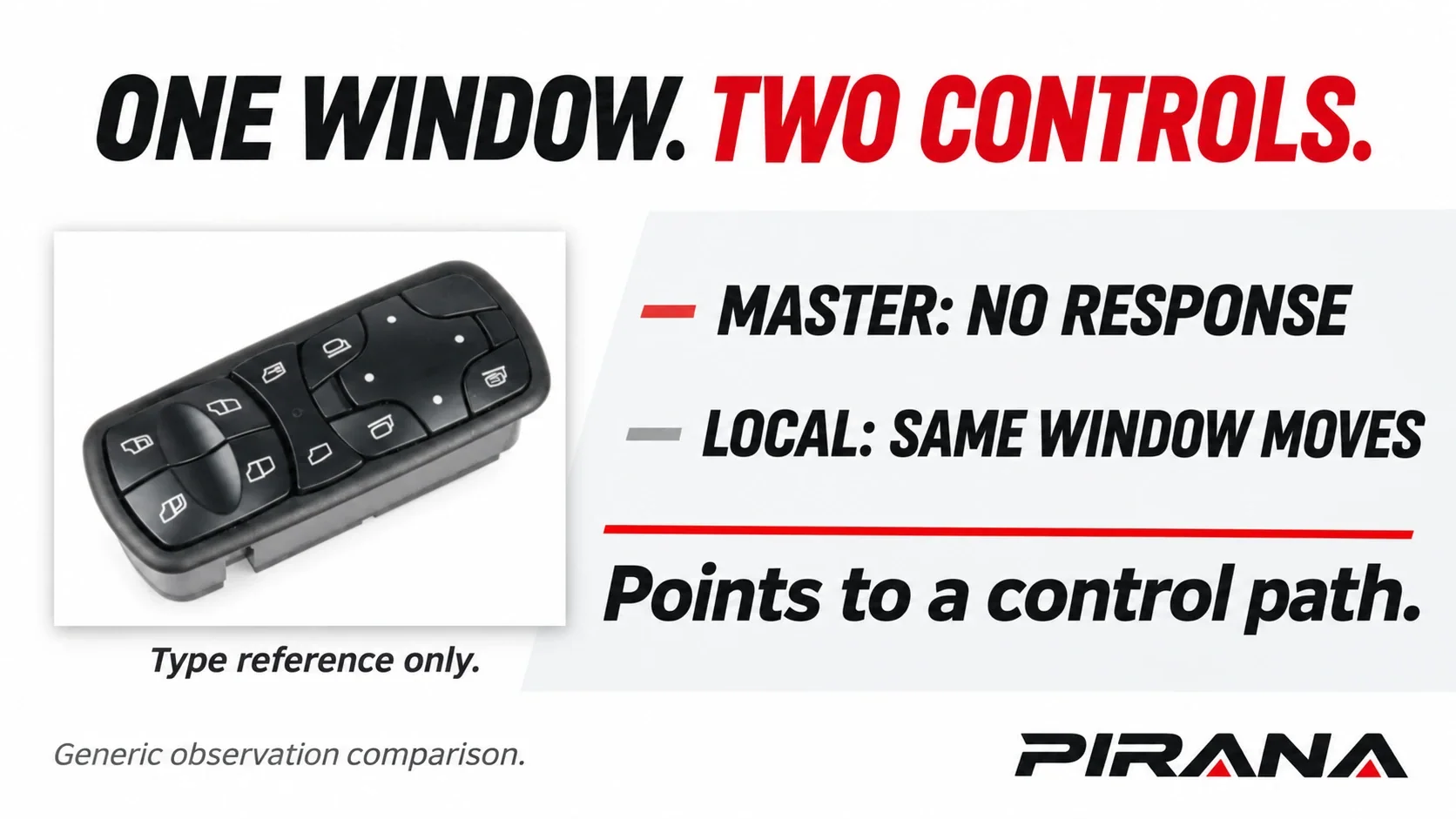
| Water at the switch or its connection, with possible contact corrosion | The exposed master stops responding, but a local door control moves the same glass. One or several master-controlled windows may be affected, continuously or intermittently. | That water reached the switch internally, or that its contacts rather than its supply, connection or controller failed. A change after a knock does not isolate the switch. |
| Broken wire or poor connection in the door-hinge harness | Intermittency has also changed during ordinary door use. One door’s controls or several functions may be affected, depending on the circuit. A previously noticed response to door tapping points to a movement-sensitive connection as one possibility. | That the wire is broken, that rain caused the break, or that a working control clears the moving harness. The actual circuit determines which paths share it. |
| Water affecting the motor/regulator side or its wiring | The same window fails or moves abnormally from both available controls while other windows work. The complaint may be intermittent. | That the motor or mechanical regulator is damaged, or even wet. A common supply/control problem remains possible; a response after door tapping cannot choose between these locations. |
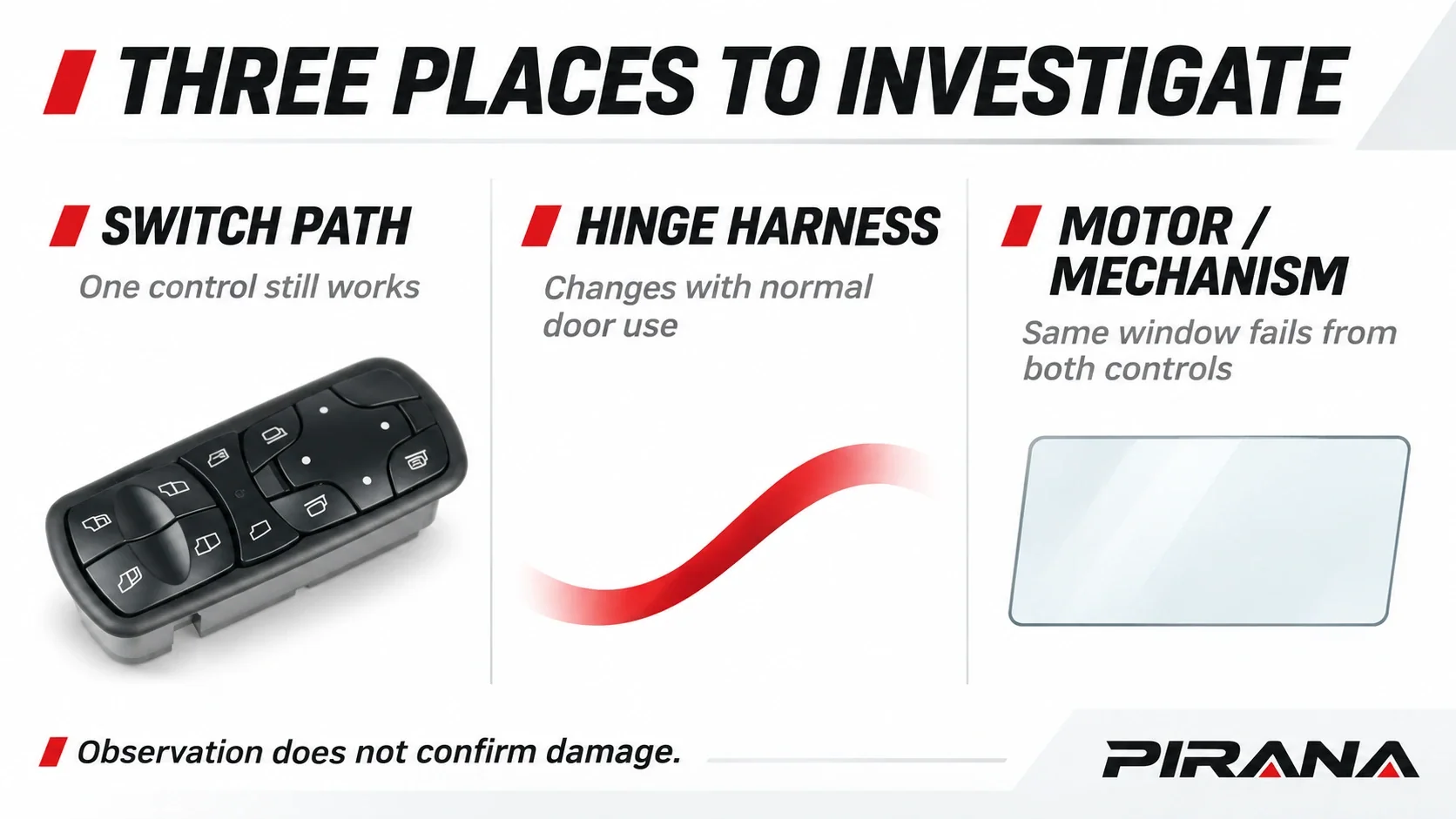
The useful distinction is control location versus the shared path to the glass. If one control moves a window, that points away from a completely inoperative lifting mechanism at that moment. If neither moves it, the observation leaves more shared causes open. Neither result names the failed service part.
Water at the switch: exposure, corrosion and the master-control pattern
An open side window can leave the door-mounted controls in the path of wind-driven rain. Note where water actually landed: on the switch face, surrounding trim or elsewhere in the cabin. A wet surface points to exposure worth investigating; it does not establish an internal water path.
Water-related electrical damage is more than a hypothetical explanation. In its 2014 driver-door-module recall filing, General Motors described fluid entry that could cause circuit-board corrosion and a short, intermittent or lost window operation, and windows moving without user input. The filing concerns specified vehicles and campaign history. It does not diagnose another vehicle or establish the construction of a PIRANA switch.
Moisture at the time of failure and corrosion damage are also different observations. A newly wet control does not prove corrosion already exists. Conversely, a later dry surface cannot establish that the internal condition is sound. That is why rain history belongs with the complaint even when the visible water has disappeared.
Why the driver-side master deserves attention
The master can receive repeated use because the driver operates several windows from that station. Its door-mounted position can also put it below an open window during rain. Use and exposure make it a sensible inspection priority when that is the wet control location. They do not establish that masters universally fail before individual switches.
In a JustAnswer account involving a 2013 Sprinter 3500, the owner reported the passenger window lowering untouched after rain, followed by the driver window. The dual driver-side control then stopped working, while the passenger-door switch remained usable. The owner later said they had obtained a switch from a dealer and removed the unit. The conversation does not document a confirmed repair outcome.
That combination points to reviewing the master-side command path rather than assuming both lifting mechanisms failed together. It still leaves the master connection, required supply and vehicle control architecture to be verified. It is a literature example of a useful observation split, not proof that every rain-related window problem needs a master switch.
A working lock does not clear the window controls
A 2004 GMC Envoy owner on JustAnswer described the driver window stopping after open-window rain exposure, with the lock on that door and the other door-window controls still working. In follow-up, the owner clarified that none of the four window commands at the driver-door station worked.
This points to distinguishing the surviving local controls from the failed master commands. The working lock does not establish that the window-command circuitry is healthy. The exchange does not record a completed repair, and its model-specific advice should not be transferred to another vehicle.
For the difference between control stations, see Master vs Individual Window Switch. Compare the same glass from each available station; different windows do not provide the same comparison.
A door-hinge harness break can look like a wet switch
Intermittency after rain does not necessarily originate in the switch. The harness between body and door belongs in a separate investigation, especially when the complaint has changed during ordinary door movement. That relationship points to a moving connection or conductor path, without proving a break.
The DieselTruckResource discussion “power window mystery – sometimes works, sometimes not” began with an owner describing apparently dead switches, often after rain, and occasional recovery after hitting the door. A respondent suggested an internal wire break where the harness crossed the door opening and reported having found that fault on their own Dodge. Another respondent described a similar wire-break history on a W250.
Those are separate accounts within the discussion. They do not establish that the original owner’s truck was repaired by fixing a hinge wire. The distinction matters: the initial wet-weather complaint supported a hypothesis, while other owners described their own findings.
If vehicle-specific diagnosis confirms an interrupted hinge wire, replacing the switch would leave that interrupted path in place. That explains why the harness possibility cannot be folded into a switch-replacement story. Rain may be when an intermittent complaint is noticed; it is not proof that rain broke the conductor.
Do not strike the door or manipulate wiring as a test. A response previously noticed during normal use is history to report, not a repair or a reliable way to identify a component. Tapping can disturb several nearby connections or assemblies at once.
When the wet area is on the motor/regulator side
The motor supplies movement; the regulator supports and moves the glass mechanically. Water affecting the motor connection or door wiring is a different problem from moisture in the visible control. Do not describe a motor-side electrical fault as a switch fault simply because the button produces no useful response.
General Motors bulletin 18-NA-079, March 2018 provides a documented example on its listed configurations: inoperative or uneven front-door glass movement could involve water intrusion into the door harness, with attention to the motor connection and corrosion. It supports investigating a downstream wet connection. It does not show that a rainy-day complaint proves the regulator itself filled with water.
When the same window behaves the same way from both controls, that points to reviewing shared and downstream paths. When one control moves it normally and the other does not, that points more toward the differing command paths at that moment. Both observations require the actual vehicle architecture before assigning a cause.
Sound and glass movement may help describe the complaint, but they cannot reveal an internal water path from outside the door. The broader mechanical distinctions are covered in Power Window Motor vs Regulator vs Switch, rather than repeated here.
What to observe next without opening the door
If the controls are dry and there is no unexpected movement, heat or odor, compare normal operation from the master and the applicable local switch under the vehicle’s documented operating conditions. Stop if abnormal behavior appears. Note the window-lock setting so an intentional lockout is not confused with a rain fault.
Check which other windows respond. Preserve the difference between one glass failing everywhere and several master commands failing while local controls remain usable. Include the rain exposure and any change previously noticed during ordinary door use. These details point to the next inspection area without requiring access inside the door.
Recovery after drying is reported by owners; treat “it worked again once dry” as an owner-reported observation, not a verified repair. It does not establish which location was affected or that corrosion and connection problems are absent. Do not deliberately wet the controls to reproduce it or treat forced drying as a repair method.
A switch that becomes unreliable again when wet needs inspection. Replacement may be necessary if that inspection confirms switch damage, but recurrence alone does not clear the hinge harness or motor-side connection. The water-entry issue also needs review before a replacement decision is considered complete.
A catalogue example comes after diagnosis
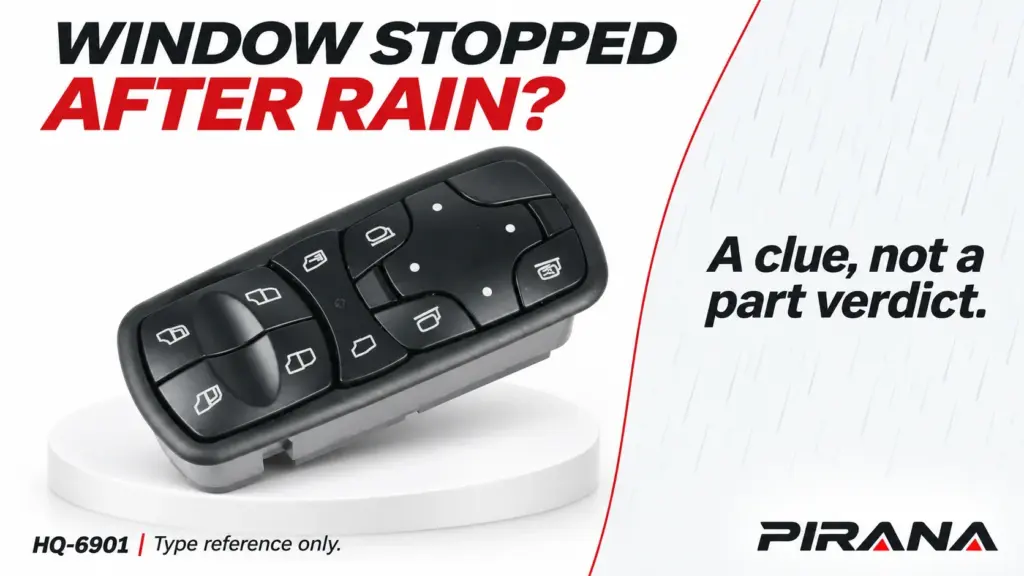
PIRANA HQ-6901 is an example of the master-switch type discussed here. The current catalogue lists OE A9438200097 and Mercedes-Benz Actros / Antos / Arocs / Axor applications. This is an attributed catalogue record, not a claim that HQ-6901 fits the Sprinter, GMC Envoy or Dodge Ram in the cited discussions.
If diagnosis points to a switch requiring replacement, selection starts with the complete original OE reference and the exact vehicle configuration. Confirm the specific part label and catalogue record; neither rain symptoms nor a similar-looking panel establishes compatibility. A harness or motor-side finding points to the relevant workshop repair, not to ordering this example switch.
FAQ
Why does my power window stop working after rain?
Rain timing points to investigating moisture exposure or a connection problem, not automatically a failed switch. Possible areas include the switch and its connection, the door-hinge harness, and the motor-side wiring or mechanism. Which controls still move the same window helps narrow the next vehicle-specific inspection.
Can water damage a power window switch?
Fluid entry can cause electrical damage and corrosion in affected switch or door-module designs. A wet switch surface points to exposure, but does not confirm internal damage. Erratic operation, unintended window movement, heat or odor requires qualified attention; the exact failed part still needs verification.
Why does only the driver’s master switch stop working after rain?
The master may be directly exposed through the open driver window while local controls remain dry. That pattern points to reviewing the master-side command path and connection. Repeated use may also matter, but the symptom does not establish a universal master-first failure rule or prove the assembly is defective.
My window went down by itself after rain – what does that mean?
Uncommanded lowering points to an electrical/control-path concern requiring prompt investigation. It does not identify a particular switch or prove the regulator failed. Keep clear of the glass, stop using the suspect control and arrange qualified help. Report whether the glass moved under power or lost physical support.
Will the window start working again once it dries out?
Owners report recovery after dry conditions, but recovery is not a verified repair or a guarantee of future operation. A return of the fault when wet points to an unresolved problem needing inspection. Replace a switch only when diagnosis supports that part, and address the exposure or connection issue as well.
References
- General Motors, Driver-door-module recall filing 14V-404, July 2, 2014, page 1; covered configurations only.
- JustAnswer, 2013 Sprinter 3500 window complaint after rain, owner conversation; no verified repair outcome.
- JustAnswer, 2004 GMC Envoy driver-door window controls after water exposure, owner conversation and follow-up.
- DieselTruckResource, Power window mystery – sometimes works, sometimes not, discussion beginning October 25, 2025; distinguish the original complaint from respondents’ experiences.
- General Motors, 18-NA-079, March 2018, page 1; listed vehicles and production limits only.
- PIRANA, HQ-6901, OE A9438200097, catalogue record checked November 9, 2026.