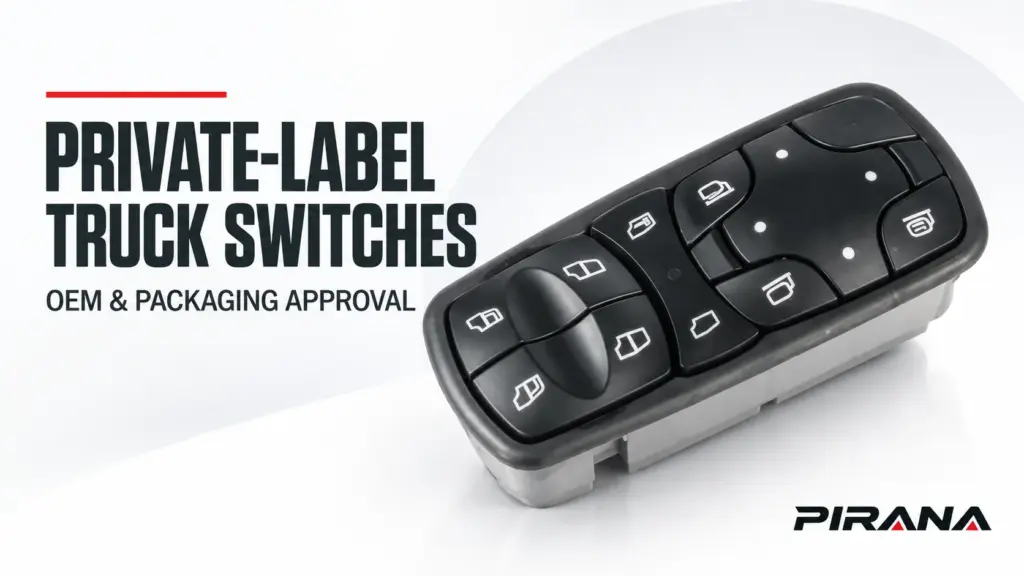
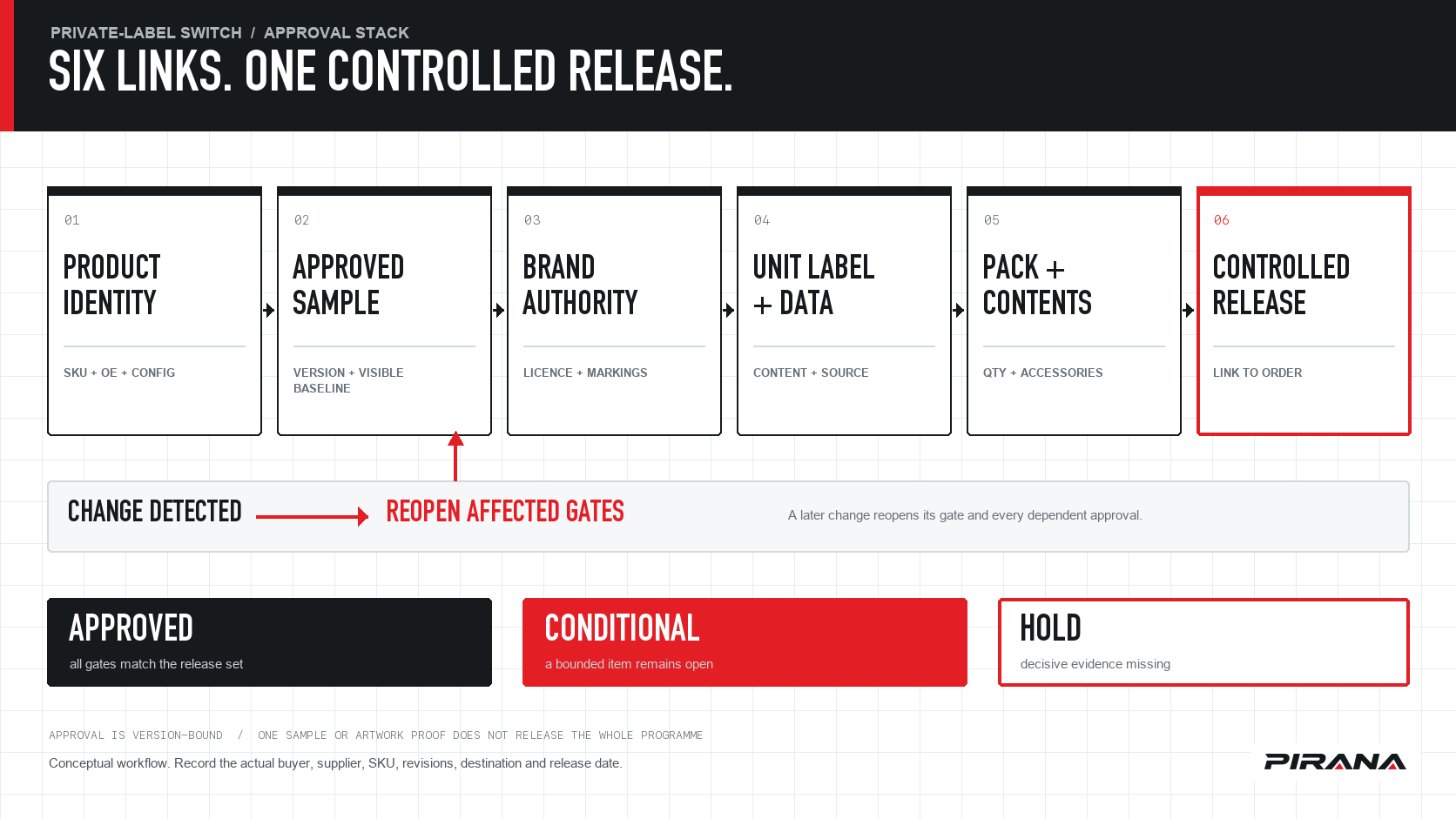
Approve a private-label truck switch through six linked gates: product identity, approved sample, brand authority, unit label and data, inner and export packaging, and a controlled release record. A product sample does not approve artwork created later. An artwork proof does not approve the switch beneath it. A label approved for one destination or order quantity does not automatically carry to another.
The useful release object is therefore one version set: the exact switch, its approved configuration, the buyer’s brand and markings, each label version, each pack version, the destination requirements and the final release record. PIRANA’s OEM/ODM page describes private-label work as product and sample approval followed by logo, label and packaging review, with version control for repeat orders. Its manufacturing guidance says to keep the product number, OE cross-reference, approved sample and packaging version together and review the order if one changes. PIRANA: OEM / ODM Power Window Switch Supply and PIRANA: Power Window Switch Manufacturing.
This page turns those principles into an approval workflow and a reusable programme record. Commercial volumes, timing, label rules, packaging methods, warranty and destination requirements remain programme-specific and are not assumed here.
What OEM and private label mean on this page
In aftermarket purchasing, “OEM” can describe a part category, a customer’s vehicle-brand requirement, a channel, a manufacturing model or a packaging request. The word alone does not establish who manufactures the switch, who authorizes its branding, which vehicle brand approved it or what evidence supports its application.
This page separates two practical supply routes:
- Existing-reference supply starts from a current product, OE reference, vehicle information or approved sample.
- Private-label supply starts from a confirmed product baseline and then adds a controlled buyer identity and delivery package.
PIRANA presents these as distinct cooperation routes. Private-label branding changes the commercial and delivery record; it does not convert an aftermarket product into a genuine vehicle-manufacturer part or prove an OEM supply relationship. PIRANA: OEM / ODM cooperation routes.
Write the intended claim precisely in the approval record. “Buyer brand,” “aftermarket replacement,” “reference supplier,” “private-label programme” and “authorised OEM part” mean different things. If the programme needs a supplier authorization, vehicle-brand licence or market approval, place the evidence for that exact claim beside the programme—not in a general trust section.
The six gates and the decision rule
Use this summary before opening any artwork file. It fixes what each gate must establish and what it cannot establish by itself.
| Gate | Approve | Minimum linked evidence | Do not infer |
|---|---|---|---|
| 1. Product identity | Exact PIRANA or supplier reference, OE relationship, relevant truck configuration and required functions | Current product record, controlled cross-reference, connector/configuration record and vehicle/application evidence where needed | That a matching brand, appearance or OE string proves fitment |
| 2. Approved sample | The sample version and visible configuration future orders must repeat | Dated identity, sample/revision reference, comparison views and any agreed inspection criteria | That one sample proves every later lot or the full product system |
| 3. Brand authority | Who may approve the buyer brand, marks and use of each image or word mark | Buyer instruction, licence or internal authority record through the appropriate commercial channel | That applying a logo establishes genuine-part, OE-supplier or certification status |
| 4. Unit label and data | Exact label artwork, language, product data and data source for the approved destination | Controlled label artwork, approved text/data table and source-of-truth record | That a readable barcode, an OE-looking string or a logo makes the data true |
| 5. Pack and contents | Inner/export pack structure, quantity, accessories, carton marks and packing method | Dated pack specification, physical proof where agreed, quantity/accessory record and destination requirement | That a product approval automatically approves a new pack or quantity |
| 6. Controlled release | One joined version set tied to the buyer, order scope and release date | Approval record, released file versions, change log and order-specific release authorization | That a draft in an email thread is a controlled approval |
Choose one state for each gate:
- Approved — the required evidence exists, belongs to this version and is accepted by the named authority.
- Conditional — the remaining issue is bounded, has an owner and due date, and cannot invalidate the product identity or create a false mandatory label.
- Hold — a decisive field, document, proof or authority is missing, unclear or contradictory.
Release only when every gate is approved or when a programme’s written rule permits a precisely bounded condition. “Conditional” is not a soft pass. It names the gap, the person who must close it and the event that prevents shipment if it remains open.
Gate 1 — Fix the product identity before anything is branded
Start with the article, not the logo.
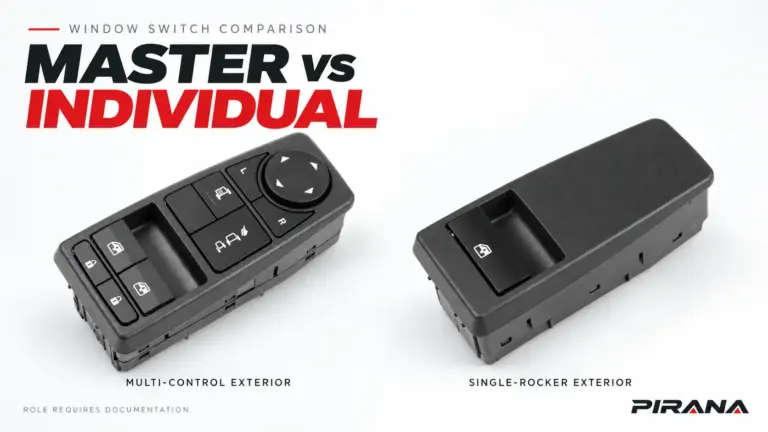
Record the exact PIRANA or supplier part number, all meaningful OE or current supplier references, the relevant truck make, series or platform, market, build range, steering configuration, switch position and required functions. For a power window switch, confirm whether the assembly is a master or individual control and which integrated functions it is expected to provide. The connector record should describe the mating interface and approved configuration without turning a photograph into an invented pinout.
PIRANA’s quality guidance puts identity before performance: confirm the OE reference, switch position, connector layout, pin configuration and truck application before approving the replacement. Its precise construction and functional criteria are agreed for the model and programme. PIRANA: Power Window Switch Quality Control.
Use the OE and connector identification guide to structure the raw reference evidence and the truck-brand selection guide for the vehicle variables. This page starts after that evidence exists and asks whether the product is fit to become the programme’s controlled baseline.
Approval test: every identity field in the programme record points to the same product or has a documented relationship. Unknowns stay visible.
Hold if: the reference is incomplete, several configurations are mixed in one artwork request, or the product identity depends on a front image alone.
Gate 2 — Turn the sample into a controlled baseline
An approved sample is useful when it can be repeated, not merely when it looks acceptable on a desk.
Link the sample to the exact product number and revision, complete reference set, vehicle/application scope, connector and function configuration, visible construction, markings and any approved label or pack versions. Use a sample identifier and date. Photograph front, rear, connector and harness-side views where relevant, and record the controlled evidence separately from the physical sample.
If the programme needs a physical inspection, agree its method, sampling basis, results and acceptance criteria before the inspection. PIRANA states that methods, limits and records are determined by model and programme rather than treated as universal. The truck switch quality inspection guide owns the sample and lot inspection procedure; this gate accepts the sample only after that evidence belongs to the correct version.
Approval test: the baseline can be identified, compared and reused for the next order without relying on memory or an untracked photograph.
Hold if: the sample has no revision, the paperwork and visible identity disagree, the comparison criteria are undefined or a required connector/harness feature remains unverified.
Do not upgrade a sample approval into a claim of lifetime durability, field reliability or coverage beyond the approved configuration. A later production lot still needs the programme’s defined release checks.
Gate 3 — Approve brand authority before drawing the brand
The buyer can instruct what branding it expects. The approval record must still show that the buyer has the right authority to use each brand, logo, photograph, trade name or claim on the product and packaging.
Separate three things:
- Commercial instruction: the buyer’s approved request for its own branding.
- Intellectual-property authority: the right to use each mark or asset, where the programme or destination requires one.
- Product status: whether the product may be described as private label, aftermarket replacement, authorised OEM supply or something else.
A buyer instruction does not settle points 2 and 3. A supplier’s use of a phrase such as “OEM service” does not by itself prove that the buyer is authorised by any vehicle brand. Record the intended public claim in plain language, along with the person who approved it.
Treat every mark as a controlled asset: preserve the correct file, spelling, proportions and permitted placement; record whether the PIRANA mark, buyer brand or no product-brand mark appears; and keep the approved image separate from the instruction to modify it. Where the brand owner, not the purchasing department, controls use of the mark, add that owner’s approval to the record.
Approval test: the buyer can identify every external brand/asset it will use, the right to use it and the exact product status it intends to communicate.
Hold if: the record contains a named vehicle brand without a supporting authority/usage basis, a mark has no approved source file, or commercial copy implies genuine, authorised or OEM-supplier status that the programme has not established.
Gate 4 — Lock the unit label and every data field
A label is both artwork and a data carrier. Approve them together.
Build a label data table before approving the layout. Define, where the programme requires them, the product number, OE/reference fields, description, pack quantity, batch or serial field, barcode data, origin or address fields, warnings and destination language. Keep each field’s source visible so the artwork cannot silently become the master record.
For each row, record:
| Label field | Required source and check |
|---|---|
| Product and reference numbers | Current product record; preserve complete identifiers and their relationship |
| Description and application wording | Approved commercial/application text, not inferred from a screenshot |
| Barcode or code data | The buyer or supplier’s agreed data source and the programme’s scan/verification rule |
| Quantities and units | Approved pack specification |
| Batch, date or serial fields | The programme’s traceability rule and numbering source |
| Language, destination and warnings | The destination/market requirement and an authorized reviewer |
| Brand marks and logos | Approved visual asset and authority from Gate 3 |
No universal barcode, language or label-content rule applies to every buyer and market. The approval must identify which requirements apply to this programme and where they came from. PIRANA’s own order-release guidance includes label, quantity, packaging and approved artwork; it does not publish a universal label standard. PIRANA: Quality Control.
Approve an electronic proof, a physical print proof and production stock as separate evidence when the programme requires all three. An electronic layout can show content but cannot prove printer output, contrast, substrate, adhesive, finish or final size. A physical proof can do so only for the material and process it used. Production stock remains a release check against that approved reference.
Approval test: every visible field and every encoded data field maps to one approved source, and the proof type matches the decision it is meant to justify.
Hold if: the barcode payload exists only as an illustration, a product number has lost a suffix, the destination language has no authorized source, or the approve button sits on an untraceable screenshot.
Gate 5 — Approve the unit, inner and export pack as a set
Packaging is part of the product system the buyer receives. Approve what holds the part, what holds the first pack and how the shipped quantity is identified.
Define the packaging hierarchy with identifiers and versions:
- Unit presentation: bag, sleeve, tray, tube or other immediate pack.
- Inner pack: pack quantity, dividers, protection and any insert or accessory.
- Export pack: carton dimensions/type, fill, closures, weight/quantity and shipping marks where required.
- Contents: switch quantity, fasteners, documentation, labels and any other agreed item.
- Destination requirements: only those verified for this market or customer, with the responsible reviewer named.
PIRANA’s manufacturing page says order release reviews part identity, quantity, marking and packaging and that the packaging version belongs with the approved product and sample. Use that relationship as the core check; the stated commercial quantity and packaging arrangements remain specific to the approved programme. PIRANA: Manufacturing.
The physical proof should be approved at the level the programme actually authorises. A printed carton prototype can show colour and construction; it cannot prove that the future production cartons use the same substrate, adhesive, print settings or dimensions unless those are also controlled. A 3D visual does not replace a structural or fit test when one is required.
Approval test: the approved package identifies its parts, version, quantity and destination basis, and the physical evidence matches the claim being approved.
Hold if: product, label and pack files show different versions, the quantity or accessory list is ambiguous, a carton cannot contain the approved contents as drawn or a market requirement remains an uncited assumption.
Gate 6 — Release one linked version set, not a folder of approvals
The final gate creates a record the next order can follow.
Link the buyer, supplier, programme and order scope to:
- Product number, revision and complete reference set.
- Approved sample or controlled product baseline.
- Brand-authority and approved-asset versions.
- Unit-label artwork, data table and proof version.
- Inner/export pack versions, quantities and accessory list.
- Destination basis and any programme-specific requirement.
- Approvers, approval dates and unresolved conditions.
Store the released files in one identifiable set. Do not leave current status in the “final-final” email subject, a desktop folder or the most recent chat message. A release should say which file version, which physical proof and which product revision it governs.
PIRANA’s guidance to keep the product number, OE cross-reference, approved sample and packaging version together is a practical way to make this linkage visible. Its OEM/ODM route also lists version control for repeat orders. PIRANA: Manufacturing and PIRANA: OEM / ODM.
Approval test: another buyer or supplier can identify the precise approved set without asking which file is current or seeing the original email trail.
Hold if: the release reflects a draft artwork, an unidentified sample, an unapproved destination requirement or a change that has not reopened the dependent gates.
Change control: what reopens approval
A version set is useful only if a change cannot bypass it. The safe default is to reopen the affected gate and every gate that depends on it.
| Change | Reopen at least | Why |
|---|---|---|
| PIRANA/supplier part number, OE mapping or product revision | Gates 1, 2 and 6 | The article and approved sample may no longer be the same product |
| Housing, connector, terminal, control layout or required function | Gates 1, 2 and 6; repeat the programme’s inspection evidence | The visible or interface baseline changed |
| New buyer brand, mark, licence or product-status wording | Gate 3, then Gate 4/5 wherever the mark appears | Brand authority and visible output change together |
| Label wording, translation, product data, barcode payload or code symbology | Gate 4 and Gate 6 | The unit label and its data source must remain linked |
| Pack material, structure, quantity, accessories, dividers or carton marks | Gate 5 and Gate 6 | A new pack changes receipt, protection, counting and release |
| Manufacturing site, process or subcontracted operation where the programme controls it | As required by the programme, commonly Gates 2 and 6 | The approved article may not represent the new source/process; use the supplier’s controlled change record |
| Destination market, customer account or required document | Gates 4, 5 and 6, plus Gate 1 where configuration changes | Requirements and permitted content may differ |
| Scheduled artwork or specification review date | Gate 6 | Continued approval should not depend on a forgotten renewal |
Use the supplier’s controlled change-notification process where one exists. If no process is documented, write one into the programme and name who must notify whom. A change notice does not automatically approve the change; it starts the review.
Approved, conditional or hold
The decision language needs to prevent a “mostly approved” product from drifting into production.
| State | Evidence | Record action |
|---|---|---|
| Approved | All applicable gates have the correct versions and named approval | Release the joined version set for the stated scope |
| Conditional | A bounded item is outstanding; an owner, due date and blocking rule are written down | Permit only the defined next step; do not describe the programme as fully approved |
| Hold | Identity, authority, proof or a decisive programme requirement is missing or contradictory | Stop release and request the specific evidence; do not substitute an email promise |
For example, a sample can be approved for the product identity while artwork remains on hold. The programme is not released. A physical label proof can be conditional pending the buyer’s translated data, but the conditional state must state that production approval and shipment are blocked until that data is approved. This is more precise than an all-or-nothing label.
Copy this private-label approval record
Copy the record into the programme file and replace each bracket. Write unknown rather than leaving a blank.
PROGRAMME: [buyer / programme / sequence]
Approval record version and date: [identifier / date]
Buyer legal or trading entity: [name]
Supplier and manufacturing entity: [name]
Destination market and customer scope: [market / account]
Target order scope and quantity: [quantity / first order / repeat order]

GATE 1 — PRODUCT IDENTITY
PIRANA or supplier part number / revision: [identifier]
Complete OE / current supplier references and relationship: [list]
Truck make / series/platform / market / build range: [fields]
Steering / switch position / master or individual: [fields]
Connector / configuration / required functions: [fields]
Controlled product/application evidence: [document ID / version]
State: APPROVED / CONDITIONAL / HOLD
Evidence / unresolved item / owner / due date: [record]

GATE 2 — APPROVED SAMPLE
Sample ID / date / product revision: [identifier]
Controlled sample or baseline: [record ID / version]
Comparison views and agreed inspection method/criteria: [document ID / version]
Result and limitations: [record]
State: APPROVED / CONDITIONAL / HOLD
Evidence / unresolved item / owner / due date: [record]

GATE 3 — BRAND AUTHORITY
Marks, logos and external claims to appear: [asset IDs / exact wording]
Buyer instruction / authority / approving party: [record]
Product-status wording approved: [exact text]
State: APPROVED / CONDITIONAL / HOLD
Evidence / unresolved item / owner / due date: [record]

GATE 4 — UNIT LABEL AND DATA
Label artwork ID / version: [identifier]
Data table ID / version and field sources: [identifier]
Electronic proof / physical print proof / production sample: [attach separately]
Language, destination and required-warning basis: [source / reviewer]
State: APPROVED / CONDITIONAL / HOLD
Evidence / unresolved item / owner / due date: [record]

GATE 5 — PACK AND CONTENTS
Unit / inner / export version IDs: [identifiers]
Unit and carton quantities: [numbers]
Accessories and documents in the pack: [list]
Physical proof and programme checks: [record]
Destination-specific packaging requirements and evidence: [record]
State: APPROVED / CONDITIONAL / HOLD
Evidence / unresolved item / owner / due date: [record]

GATE 6 — CONTROLLED RELEASE
Released set ID and date: [identifier]
Product / sample / brand / label / pack versions in the set: [list]
Approvers and approval dates: [names / dates]
Open conditions and blocking rule: [record]
Change owner and notification route: [name / method]
RELEASE STATE: RELEASED / NOT RELEASED
Next scheduled review: [date]
What the approval record does not prove
The record coordinates programme decisions. Each external document keeps its own limits.
| Evidence | What it can establish | What it does not establish |
|---|---|---|
| Approved product/application record | The declared reference and application relationship within the record’s scope | That a different revision or later production lot is automatically equivalent |
| Approved sample or inspection record | The observed sample and criteria recorded on its date | Durability, field reliability or every future lot |
| Buyer brand approval | Who accepted the programme’s branding and product-status wording | Genuine-part status or an OEM/vehicle-brand relationship unless separately evidenced |
| Label or packaging proof | The reviewed output under the stated file/material conditions | That production uses the same version unless change and release controls remain active |
| Order-release record | That the specified version set was released for a stated scope | Vehicle fitment, product certification or regulatory compliance outside that evidence |
| Quality-management-system certificate | The certified organisation, site and system scope identified on the certificate | Product approval, individual test success or confirmation of process capability |
The management-system boundary is explicit in IATF’s own rules. Its Rules 6th Edition questions-and-answers document states that IATF 16949 certification is a quality management system certification and is “neither a product or a manufacturing process certification, nor is it a confirmation of process capabilities.” IATF Rules 6th Edition Q&A, 31 July 2024, page 185.
Likewise, a catalogue-data format is not a packaging approval. The Auto Care Association explains that ACES communicates fitment data but will not tell a company which vehicles its own product fits; the application data still has to be researched, created or acquired. Auto Care Association: ACES and PIES FAQ. If an approval record carries catalogue references, keep the data source and fitment evidence separate from the label artwork.
What to send when the programme is not yet defined
If the six gates cannot be filled because the programme inputs are missing, send the available evidence rather than inventing the rest. PIRANA’s RFQ route asks for the OE number or current supplier reference, truck make/model/generation and switch position, front/rear/connector photographs or a physical sample, estimated quantity and destination, and branding/packaging/document requirements. PIRANA also states that it reviews these details against the part rather than applying the same commercial scale or timing to every switch. PIRANA: OEM / ODM RFQ guidance.
A practical first handoff names:
- the exact product or sample and the intended vehicle use;
- the current product, OE-reference and connector evidence;
- the buyer brand and intended product-status claim;
- the destination and required language/document set;
- the initial quantity and a first-order or repeat-order scope;
- which artwork, label and packaging files are drafts;
- the person who can approve product, brand and destination content.
Start with the power window switch catalogue when the product family is still being shortlisted. Send the completed identity and programme record to the PIRANA quotation route so the next step addresses the actual missing field. The downloads page lists the kinds of product documents that may be requested; current availability remains specific to the model and requirement.
A supplier evaluation can happen before or beside this process. If the buyer has not yet established whose evidence will be relied on, use the power window switch supplier evaluation checklist for that separate decision. The private-label approval page begins with a candidate programme and controls its versions.
References
- PIRANA, OEM / ODM Power Window Switch Supply, accessed 22 October 2026.
- PIRANA, Power Window Switch Manufacturing, accessed 22 October 2026.
- PIRANA, Power Window Switch Quality Control, accessed 22 October 2026.
- IATF, Rules for Achieving and Maintaining IATF Recognition — Sixth Edition, Questions and Answers, 31 July 2024, page 185.
- Auto Care Association, Frequently Asked Questions: ACES and PIES data standards, accessed 22 October 2026.
REFERENCED IN THIS GUIDE
Products mentioned in this article
These published catalogue references are included because they are discussed in this guide. A reference is a starting point for identification; confirm the exact OE number, connector and vehicle configuration before ordering.
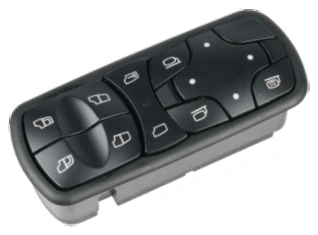
Power Window Switches
Power Window Switch — OE A9438200097
PIRANA Part No. HQ-6901 · OE: A9438200097
View product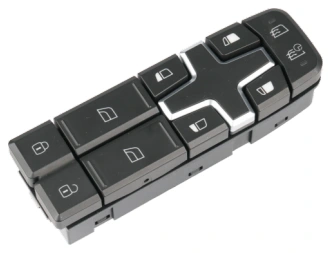
Power Window Switches
Power Window Switch — OE 22154285 / 22154235
PIRANA Part No. HQ-6913 · OE: 22154285 22154235
View product