What this symptom guide covers
This article focuses on patterns that direct attention toward the window-switch control path. The recording process and evidence rules belong to Truck Window Switch Not Working? Diagnosis Checklist; the separate component comparison, Power Window Motor vs Regulator vs Switch, owns motor and regulator symptom interpretation. Those workflows and comparisons are outside this guide.
Bad power window switch symptoms can justify investigating a switch or reviewing a candidate part. They cannot, by themselves, establish that the switch is the problem. In particular, a window working from one control does not prove that the other control receives the power, ground or enablement it needs. The master-side ground exception below explains why that distinction matters.
Patterns that point toward the switch path
- The local door switch fails, but the master moves the same window, or the reverse. This makes the difference between the two command paths relevant. Movement confirms that the window could move from the successful control under those conditions. It does not prove that the silent control is defective: lockout, its supply or return path, a connector and controller interpretation remain possible explanations.
- The master operates only some windows while other channels do not respond. Partial operation makes a channel-specific command or connection worth reviewing instead of treating the entire panel as either good or bad. It does not establish that the inactive channels have failed inside the master. Their downstream paths or enabling conditions may differ.
- One direction works but the other does not. A window that lowers but will not rise, or rises but will not lower, warrants review of the direction-specific control path. It does not prove a worn switch contact, and the existence of movement in one direction does not approve every part of the opposite-direction operation.
- Response is intermittent, or several normal presses are needed before movement begins. The changing response makes the switch and its connections relevant hypotheses. It does not demonstrate that repeated pressing restored an internal contact; vehicle-side wiring, control conditions or another system issue may produce the same sequence.
- The button binds, becomes loose, fails to return, or loses its familiar click while the motor remains silent. A new change in travel, retention or return supports a mechanical review of the control. It does not identify the electrical fault. Absence of a click matters only against the normal behavior of that control; some switches are quiet by design, and no motor sound does not locate the interruption at the button.
- Window, lock and mirror functions on the same fitted panel stop together. This makes a shared assembly or interface relevant. It does not prove that several switches failed at once or that the panel itself is defective. Shared power, ground, a connector or a door controller may affect those functions together. Include only functions actually fitted to that vehicle.
- The complaint appears after water exposure or damp conditions. Moisture history makes the switch area and its interfaces worth reviewing. If white or green corrosion-like deposits are already visible on accessible terminals, record them as observable evidence. Their color alone does not establish their composition, electrical effect or the failed component. A wet-weather association is not proof of internal switch damage.
These patterns are reasons to investigate the control path, not a replacement checklist. Do not keep forcing a sticking button or repeatedly cycle an uncertain system to make a symptom convincing. Keep hands clear of moving glass; heat, smoke or a burning smell requires prompt qualified assistance.
Why a working master can still leave the local switch without ground
The local switch does not necessarily have an independent connection to ground. In some systems, its return path runs through the master-side circuitry. That creates a specific diagnostic trap: the master may move a window while failing to provide the path needed for that window’s local operation.
The historical 1997 Jeep factory service manual, Power Window Systems, section 8S states that the individual switches receive ground through the driver-door module and identifies the master-side relationship in its door-module description. This is evidence for that documented XJ architecture, not a circuit description for every truck.
Toyota’s Electrical Wiring Diagram Workbook, Power Windows system outline provides another historical example: local passenger-window operation returns through the master, and the illustrated lock function can interrupt that ground path. The workbook is an OEM-authored teaching example hosted by a third party; it does not establish a PIRANA product’s internal wiring.
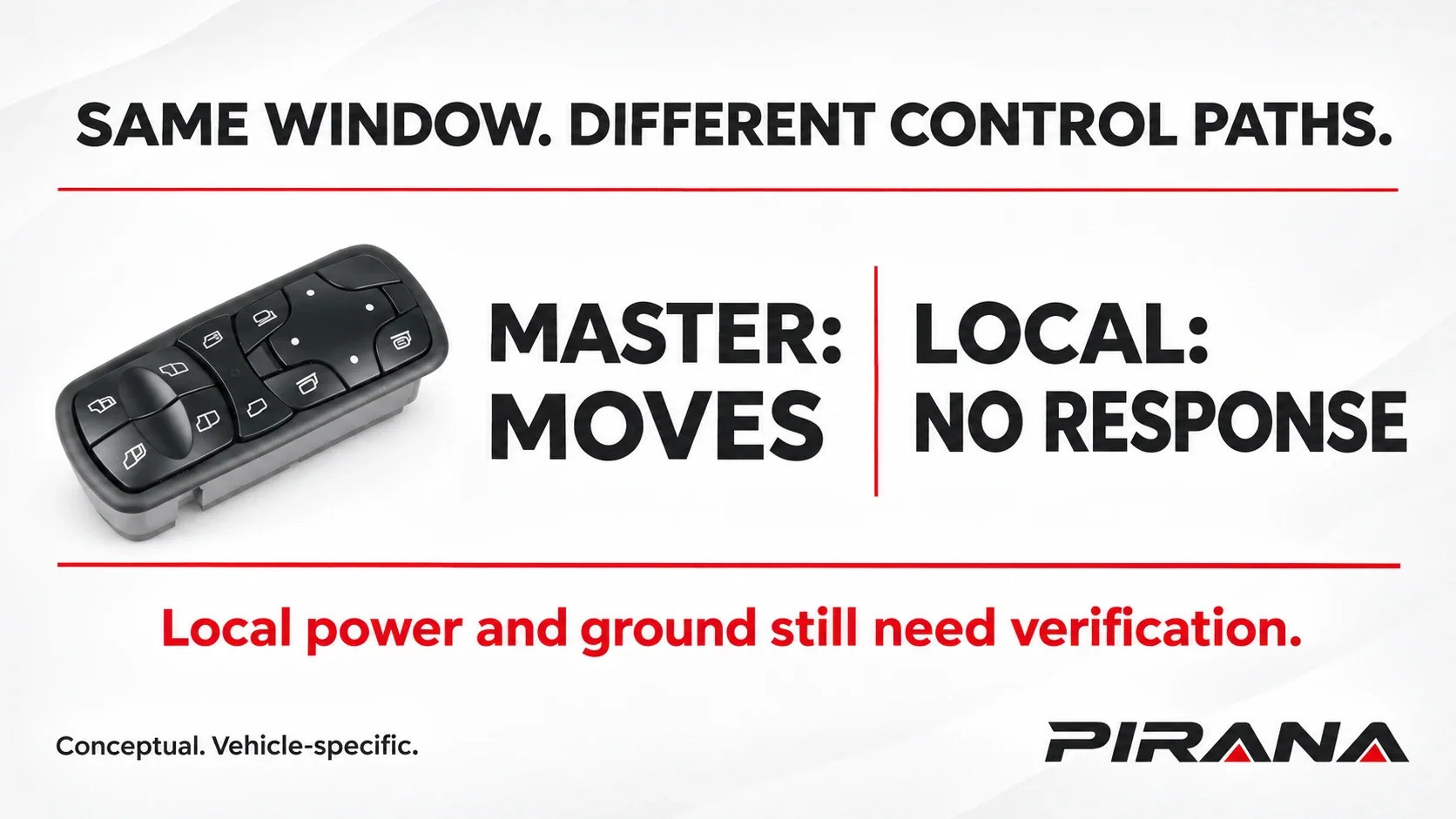
Consider a conditional example, not a reported customer case. The applicable vehicle diagram shows a master-supplied local ground. Diagnosis then establishes that the local switch is serviceable, but the required ground is absent because of a fault in the master-side path. The local switch is not the failed item in that scenario, even though it produces no movement. The fault belongs on the master side or its connection path; the exact component still depends on what the diagnostic evidence isolates.
A working master command therefore cannot clear every master-side function. Its successful operating path and its provision of a return for local use are separate questions. Conversely, simply suspecting a missing return cannot condemn the master either: a connection between the two stations can interrupt the same path.
This explanation applies only when the actual schematic establishes that relationship. A module-mediated or networked system may assign different responsibilities. For the broader role distinction, use Master vs Individual Window Switch. Neither a button count nor the word “master” establishes the architecture.
A stronger switch suspicion needs evidence about the control
A pattern becomes more useful when it concerns the command itself, rather than only the glass failing to move. A button that no longer returns normally adds a different kind of evidence from a silent window with an ordinary-feeling button. A result confined to one control location adds a different distinction from a window that never responds from any permitted control. Neither observation completes the fault isolation.
The gap between those observations and a failed-part conclusion is the control’s actual operation in the vehicle. The relevant service information must distinguish a missing request from a request that is present but not acted on. In a direct switching circuit that concerns the applicable electrical path; in another architecture it may concern how a controller recognizes and handles the command. The distinction cannot be inferred from an AUTO marking or a front photograph.
| Evidence being considered | What it adds to switch review | What must remain unresolved until properly checked |
|---|---|---|
| A changed button feel plus a missing response | A mechanical concern associated with the control | Whether that mechanical concern explains the electrical complaint |
| Different results from master and local for the same window | A difference between command paths | Supply, return, lockout, interfaces and control interpretation for the unsuccessful path |
| Only one master channel fails while others work | A narrower scope than total panel loss | The state of that channel and its separate vehicle-side path |
| A service check isolates the switch response under the specified conditions | Evidence about the actual assembly, beyond symptom wording | Any remaining alternatives and the exact service item authorized by the applicable process |
This table interprets evidence strength; it is not another symptom-record form or an electrical test procedure. A switch becomes an appropriate replacement candidate only when the vehicle-specific evidence supports that handoff.
Button feel, repeated presses and shared functions need different interpretations
A sticking or loose button is directly observable, but mechanical feel is not a universal acceptance test. Toyota’s C0M power-window master-switch technical instructions distinguish a particular catching condition from electrical inspection, and warn that an unsmooth feel is not automatically the defined catching failure. That configured recall procedure cannot be converted into a general truck button test. Its useful boundary is that a tactile complaint and an electrically confirmed fault are different findings.
Intermittent response needs similar restraint. International’s IK0800414, revision 7, for its named TerraStar, DuraStar, WorkStar, TranStar, ProStar and LoneStar applications, describes windows that may resume after the button is pressed again. It also lists wiring and body-controller-related possibilities. The document therefore prevents an easy shortcut: “another press made it work” is not equivalent to “the switch contacts are bad.” No software version, service action or test from that bulletin is prescribed here.
When several fitted panel functions stop together, the shared interface deserves attention as much as the visible buttons. FCA’s STAR publication S2108000106 Rev. A, June 2021, associates intermittent window, lock and mirror complaints with review of corrosion at door/body connections. The publication itself cautions against treating a similar case as a diagnosis. It supports keeping connector and shared-path explanations open; it does not diagnose a particular truck or PIRANA switch.
Moisture evidence does not identify which side of a connection failed
A complaint beginning after water exposure gives useful context, but does not establish where water reached or what it affected. Deposits on a visible terminal belong to the condition evidence. They do not establish that the switch housing, its internal mechanism or the mating harness is the failed service item.
The practical distinction is between the part and its interface. A supplier may receive a switch complaint while the vehicle-side terminal or seal remains the relevant concern. A dry-looking switch face cannot clear the connection behind it, and a visible deposit cannot establish an internal failure without the appropriate interpretation. This guide gives no access, unplugging, cleaning or dismantling instructions.
Keep that boundary intact in a parts enquiry: describe the observed moisture or deposits without labeling them a confirmed cause. Do not use a photograph of a clean catalogue product as evidence of the condition of the unit in the vehicle.
Patterns easily mistaken for a bad switch
Several windows stop together: give shared supply and the documented window-lock state priority in the initial review, rather than assuming several controls failed simultaneously. A working window elsewhere does not prove that the affected branch receives what it needs.
Intermittence changes as the door opens or closes: consider the door-hinge harness and door/body connections before assigning the change to the button; do not deliberately flex wiring to reproduce it.
Motor and regulator clues: movement, sound and mechanical behavior require the separate component interpretation in Power Window Motor vs Regulator vs Switch rather than a switch verdict from this symptom list.
These are limits on interpreting a switch complaint. They do not replace the diagnosis owner’s process or expand this article into a motor/regulator comparison.
Begin selection with identity, after the fault review
The requested outcome is a defensible handoff to part review, not an order based on a symptom phrase. Once the relevant service item is supported by diagnosis, the OE-number identification guide owns the identification and matching task.
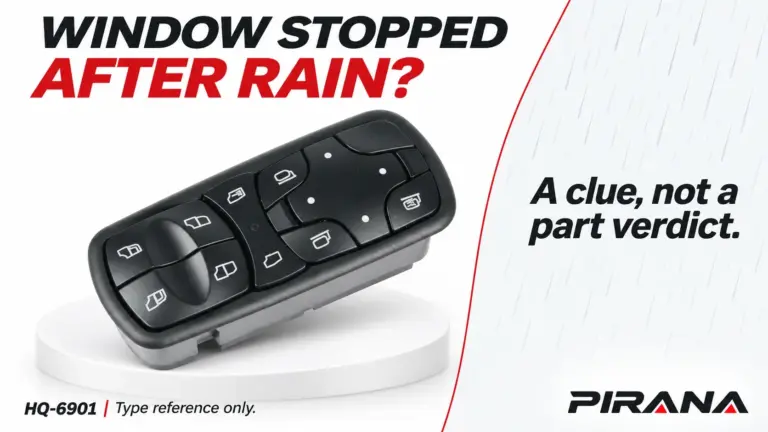
PIRANA’s current HQ-6901 product record lists OE A9438200097 and a Mercedes-Benz catalogue application of Actros / Antos / Arocs / Axor. These are catalogue identifiers, not confirmation that the product explains any symptom discussed here. Use the specific model nameplate or part label and the corresponding catalogue record as the controlling references for review.
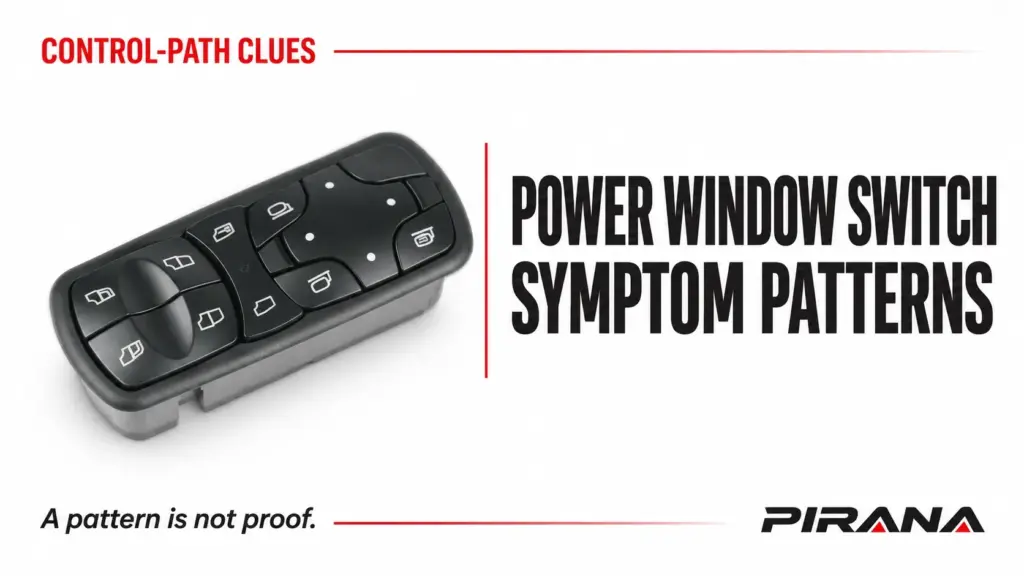
The product photograph identifies the offered exterior. It does not establish a master-supplied local ground, signal protocol, automatic-window capability or compatibility for an unspecified vehicle build. Required functions and exact application must be checked for the specific item; do not transfer the historical Jeep or Toyota circuit examples to HQ-6901.
FAQ
What are the symptoms of a bad power window switch?
Possible patterns include different results from master and local controls, failed channels within an otherwise working panel, one-direction operation, intermittent response, and changed button travel or return. Shared panel-function loss and moisture-related changes also justify review. These signs support investigating the switch path, but do not confirm that the switch assembly is defective.
If the master works but the local door switch does not, which one is faulty?
Neither can be condemned from that observation alone. The local control may be locked out or lack its required supply or ground. In circuits where local ground passes through the master, a master-side fault can prevent local operation while the master still moves the same window. The actual circuit and diagnostic evidence must identify the failed part.
Is a window that lowers but will not rise a switch problem?
It can involve the switch’s direction-specific control path, but one-direction operation does not prove a switch fault. The opposite direction can depend on other electrical or system conditions. Use the applicable vehicle diagnosis to establish whether the required command is missing at the switch or whether the fault lies beyond it before choosing a replacement.
What if one window does not respond to the switch but the other windows work?
Other working windows show that some functions remain available; they do not validate the affected branch or control. The relevant switch channel, its connections, enablement and vehicle-side path still require review. If another permitted control moves the same window, that difference is useful evidence, but it does not automatically identify the non-working control as defective.
How do you confirm the switch rather than the motor or regulator is the problem?
A qualified technician uses the exact vehicle’s service information to distinguish the control request, the supply and return path it needs, and the resulting system response. Confirmation requires evidence that isolates the relevant switch assembly after the applicable alternatives are resolved. A symptom list, a silent motor, a working neighboring window or a catalogue match is insufficient.
References
- Chrysler Corporation, 1997 Jeep factory service manual, section 8S, Power Window Switch and Door Module descriptions, printed pages 8S-2 to 8S-3; historical XJ architecture, third-party-hosted copy.
- Toyota, Electrical Wiring Diagram Workbook, Power Windows, A-2 system outline; historical training circuit, third-party-hosted copy.
- Toyota, Recall C0M technical instructions, power-window master-switch inspection, configured campaign vehicles only.
- International, IK0800414: Power Windows Stop Randomly or Are Inoperative, Power Door Locks Are Inoperative, revision 7, modified September 13, 2013, named truck applications only.
- FCA US LLC, STAR S2108000106 Rev. A, June 2021, intermittent window/lock/mirror concerns and door/body connector corrosion; case guidance, not a diagnostic conclusion.
- PIRANA, HQ-6901 power window switch, OE A9438200097, catalogue record checked November 7, 2026.