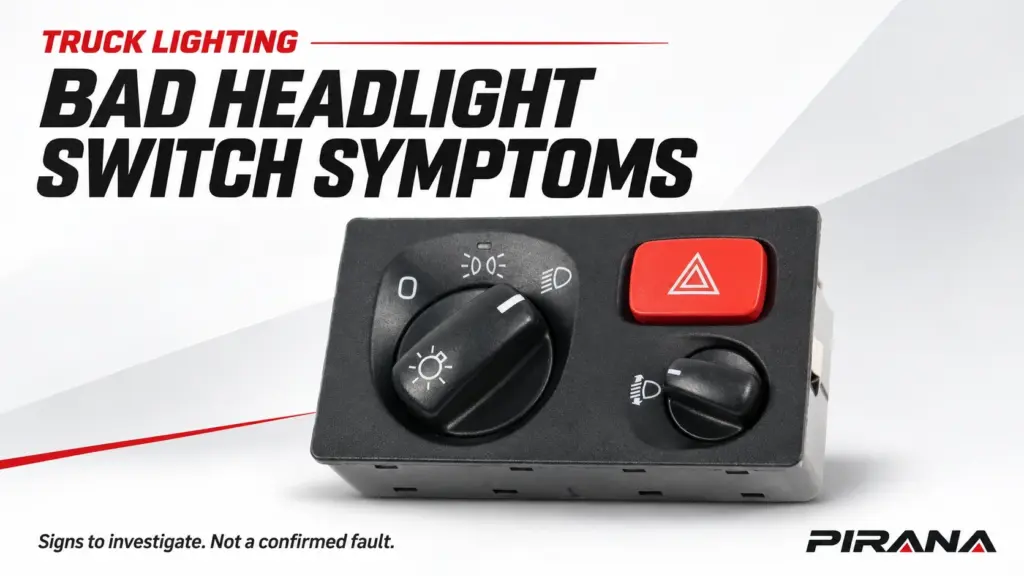
Bad headlight switch symptoms can include the following seven patterns. Each supports investigation and, where appropriate, a parts-selection review; none proves that the switch has failed.
- Heat or a burning smell at the switch: a safety warning. Unusual heat, a scorched smell, smoke or visible melting can indicate an electrical problem around the switch or its connection. They do not establish whether the fault began inside the switch, at a terminal or elsewhere in the circuit. Stop operating a suspect control, stop driving as soon as safely possible, and arrange qualified assistance. Do not keep cycling it to reproduce the fault.
- Some lighting positions work while others do not. Parking or marker lights may work while low beams do not, or the reverse may occur. This helps identify the affected function or circuit branch. It does not isolate the selector: the relevant lamp, supply, protection, relay or controller path may still be responsible.
- Headlights flicker or cut out over bumps. An intermittent connection or control problem deserves attention, especially if the pattern changes with normal control use or road movement. That association does not locate the fault inside the switch; plugs, wiring, grounds and other lighting equipment remain possible causes.
- High beams will not stay on. Momentary flashing may still work while sustained high beam does not. This distinguishes two operating requests, but does not prove the dashboard headlight switch is defective. The column control, operating conditions and vehicle lighting logic must be identified.
- Instrument backlighting changes abnormally with the switch. Unexpected flickering or loss of panel illumination can help identify which functions are affected together. It does not prove a common internal switch fault; a separate dimmer, illumination supply or controller may be involved.
- Lights remain on with the switch at OFF. If the behavior is outside the truck’s documented lighting operation, it warrants review and can leave a battery load while parked. It does not prove stuck switch contacts: a relay, wiring fault or module-controlled function can produce a similar complaint.
- The switch feels loose or no longer has its normal detents. A new loss of positive positioning can suggest a problem with the knob, mounting or mechanism. It does not establish the electrical condition of the assembly, and a control designed without strong detents should not be judged against a different switch.
Heat and burning smell: stop before trying to identify a replacement
Treat heat, odor or melting as a reason to escalate the complaint, not as permission to order a switch immediately. The switch and the harness connector meet at the same location; damage observed there does not automatically identify which component needs attention. A replacement decision must account for the condition of the mating connection as well as the control.
A documented example shows why this distinction matters. NHTSA investigation EA11-012 describes low-beam loss and heat damage involving combination switches and harness connectors in specified Honda vehicles. It also distinguishes lighting configurations with different circuits. This is evidence that a switch-area complaint can involve the connection, not a diagnosis or repair instruction for a truck or a PIRANA product.
If lighting becomes unreliable, do not rely on it for a journey requiring those lights. Smoke or visible melting calls for urgent assistance. This guide supplies no battery-isolation, connector-removal or fuse-removal procedure; the appropriate response depends on the vehicle and the condition found.
Record the pattern without turning it into a verdict
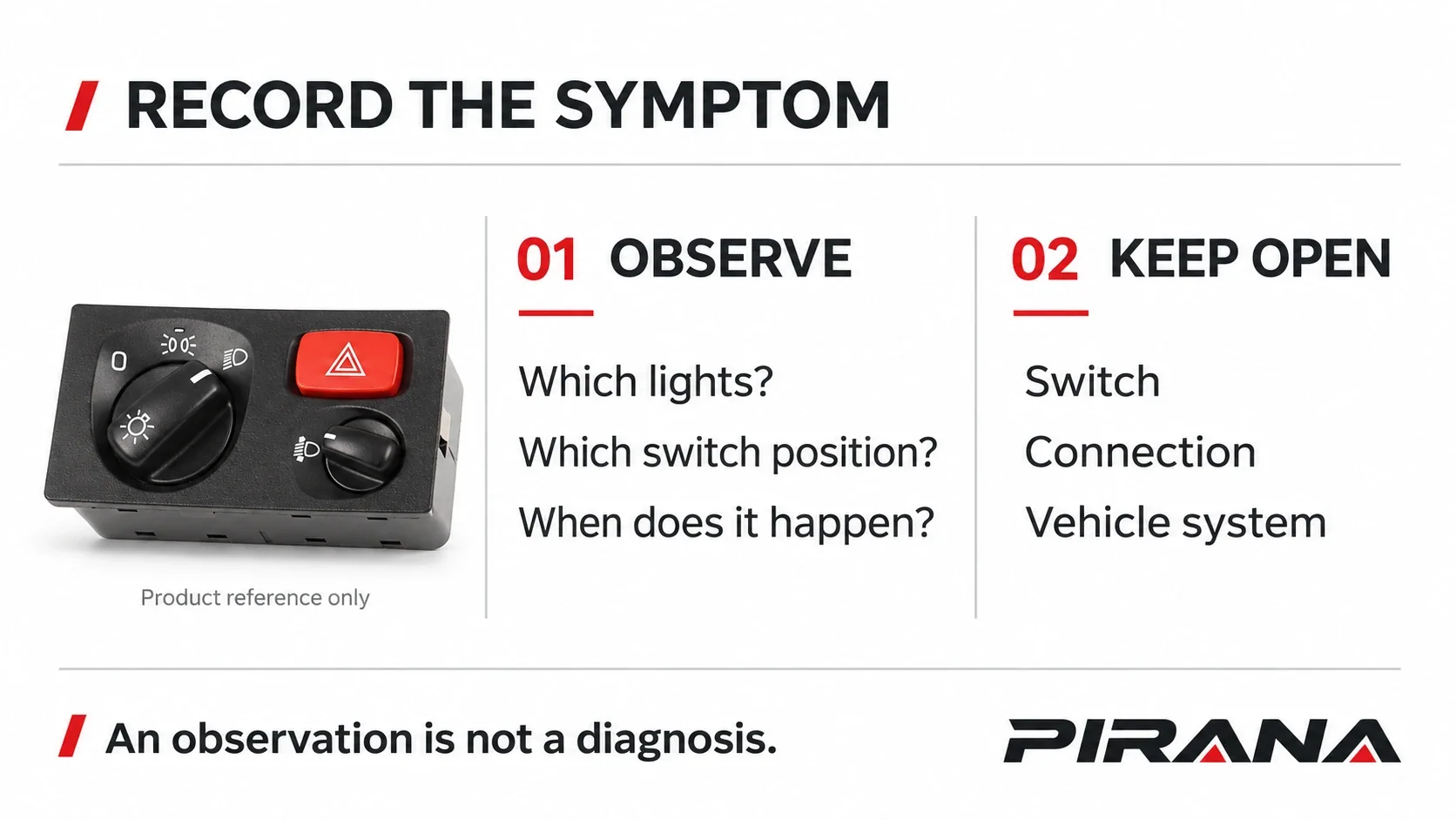
A useful complaint describes what failed and what still worked under the same conditions. “The headlight switch is bad” skips that evidence. “Both low beams stopped, the marker lights remained on, and the switch was in the headlight position” preserves an observation that a technician can investigate.
For position-specific failure, distinguish the selected position from the lamps actually illuminated. A working marker-light position establishes that one observed function was available; it does not validate every part of the headlight system. Equally, a low-beam problem does not show that all the selector’s other functions are affected. Keep the observation narrow.
For intermittent lighting, record whether one lamp or both went out, whether panel lighting changed at the same time, and whether the event followed normal control use, rough road travel or recent work. Do not drive over bumps or manipulate wiring to provoke it. A pattern reported from normal use is useful evidence without deliberately recreating a loss of lighting.
| Observation already noticed | What it helps distinguish | Appropriate next review |
|---|---|---|
| One headlamp fails while the other operates in the same mode | A side-specific complaint from a simultaneous failure | Identify the affected lamp and its local supply/connection path in the vehicle information. |
| Both lamps lose one mode, but another mode works | A mode-specific complaint from total loss of lighting | Review the control request and the relevant shared and separate circuit paths. |
| Panel backlighting and exterior lights change together | A correlated event from an isolated lamp complaint | Establish whether those functions share a control or supply in this truck. |
| Flicker began after lighting accessories or body equipment were fitted | An equipment-change context from an unexplained new symptom | Include the installed equipment and its interface in the diagnostic review. |
| The lights remain on after parking with the selector at OFF | An operating-state complaint with possible parked consumption | Compare documented lighting behavior with the observed lamps and duration. |
This table is an observation-routing framework, not a fault-probability ranking. One-sided failure does not exclude a control fault, and simultaneous failure does not confirm one. Its purpose is to give the workshop a precise starting point without buying parts to test a guess.
What else can cause the same signs?
The distinguishing question is where the intended lighting request stops matching the actual result. In some circuits the switch requests operation and another device handles lamp power. HELLA’s relay technical catalogue, “Typical Applications: Headlights” illustrates that control/load separation. It does not establish which arrangement your truck uses.
Use the following directions with the applicable vehicle documentation. They deliberately stop short of test steps.
| Alternative cause | Direction for distinguishing it from a switch complaint |
|---|---|
| Bulb or headlamp assembly | Establish whether the failure is confined to a lamp, light source or beam function, and identify the installed lighting technology. A lamp-side problem is not settled by the switch’s appearance or feel. |
| Relay, where fitted | Separate the command reaching the relay from its response in the lamp-power circuit. A correct switch request with an incorrect downstream response points the investigation beyond the selector, but still requires the specified checks. |
| Fuse or protected supply | Identify which circuit has lost its supply and why protection operated. A failed fuse is an observation about that circuit, not evidence that the switch caused it. |
| Harness, ground or plug | Relate the affected functions to their connections and any documented damage, corrosion, heat or recent work. Movement-related failure can involve the connector or wiring as well as the switch. |
| Body or lighting control module | Compare the driver’s requested state, the input recognized by the system and the commanded lighting output using the vehicle’s diagnostic information. Unexpected operation or a fault code alone does not condemn either the module or the switch. |
Lamp technology also changes the investigation. For example, HELLA’s xenon troubleshooting information separates the light source, fuse, supply, ground and ballast. That is a technology-specific example of looking beyond the dashboard control, not a universal truck test sequence.
Installed accessories can add another boundary. GM’s PIT5412C bulletin, dated January 19, 2018, describes flickering or inoperative headlights during truck/snowplow light changeover on its listed Silverado and Sierra applications. It identifies a possible mismatch involving the snowplow changeover module and the truck’s lighting system. The example does not diagnose other trucks, but it demonstrates why flicker is not proof of a failed headlight switch.
Truck controls: the rotary selector and column control have different jobs
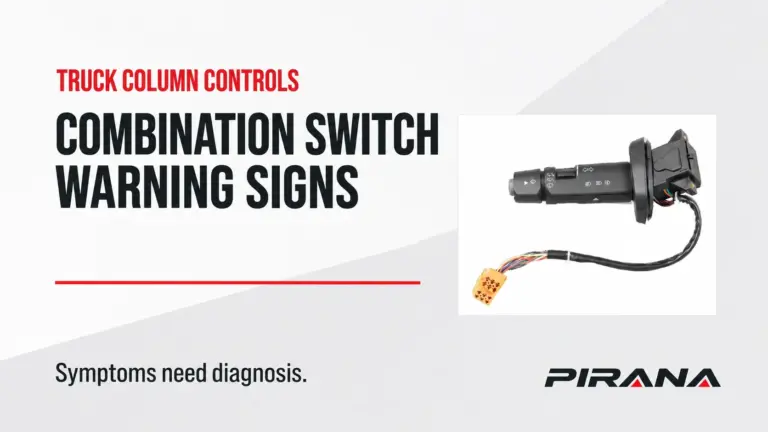
Identify which control the driver means by “headlight switch.” A rotary dashboard selector and a steering-column combination control may participate in the same lighting function without being the same service part. Integrated duties vary with truck configuration, equipment and market. A passenger-car symptom list cannot establish that division for a commercial truck.
The Western Star 47X/49X Driver’s Manual, Chapter 4 provides a concrete example: it describes a rotary headlight selector and a separate turn-signal lever involved in high-beam operation. It also distinguishes sustained high beam from momentary flashing. Those details belong to the documented vehicles; they are not verified functions of HQ-6938.
Consequently, a report that high beams “will not stay on” should name the control used, whether the driver intended a momentary flash or sustained operation, and the vehicle’s operating state. It should not become an order for a rotary selector simply because that part is called a headlight switch.
Apply the same discipline to instrument backlighting. Record whether the complaint concerns the switch’s own illumination, the instrument panel or several cab controls. Their shared timing is useful, but the applicable vehicle record must establish whether their control functions are integrated. For the wider application map, see the Truck Cabin Switch Applications Guide.
Lights stay on at OFF: separate expected operation from a parked load
First specify which OFF position is meant: the lighting selector or the ignition. Also distinguish actual headlamps from marker lamps or daytime running lights. “Lights stayed on after I removed the key” is not the same observation as “the headlamps ignored the lighting selector’s OFF position.”
Some vehicles intentionally retain lighting briefly after parking. The Western Star manual cited above describes a configuration-dependent follow-me-home function. Consult the actual truck’s documentation rather than assigning every truck the same delay or assuming that all remaining illumination is abnormal.
When operation is outside that documented behavior, the command and power paths need review. HELLA’s technical explanation of lights that will not turn off identifies switch, relay and wiring possibilities. A lamp staying energized therefore does not, by itself, identify the switch as the cause.
An unintended lighting load while parked can discharge the battery. How quickly depends on the active load, battery condition and vehicle behavior; there is no useful universal discharge time for this complaint. Arrange vehicle-specific assistance rather than treating a charged or replaced battery as a diagnosis of the lighting fault.
When symptoms justify a parts review
Symptoms justify recording the complaint and identifying a possible service part. They do not authorize a replacement conclusion. Confirmation requires the applicable diagnostic information to separate the switch’s operation from its supply, connection and downstream control path. If that separation has not been established, retain “suspected” or “under investigation” in the job record.
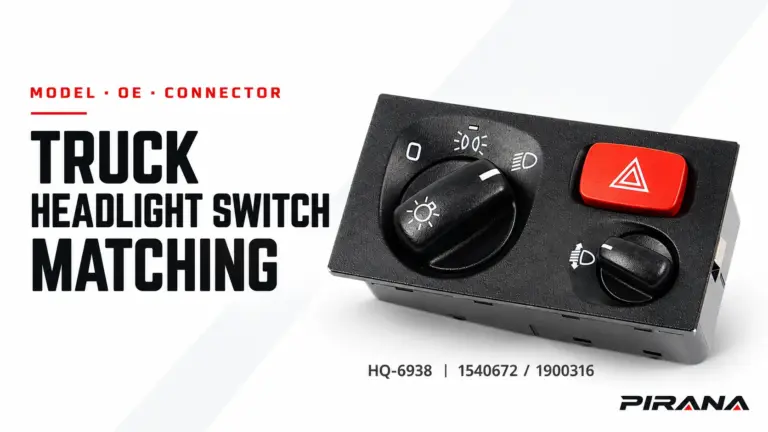
Once the correct control assembly is identified, use Truck Headlight Switch Matching: Model & Connector for the selection review.
PIRANA’s verified HQ-6938 product record lists Scania and OE references 1540672 / 1900316. These are catalogue identifiers for a candidate, not proof that HQ-6938 resolves any symptom described here. Use the specific model nameplate or part label and the corresponding catalogue record as the reference. Exact application and required functions must be confirmed for that particular vehicle and item; neither the photograph nor the OE listing establishes a diagnosis or unconditional interchangeability.
FAQ
What are the symptoms of a bad headlight switch?
Possible signs include unusual heat or a burning smell, failure in particular lighting positions, intermittent headlights, high beams that will not remain on, abnormal instrument backlighting, lights that stay on at OFF, and a loose control or changed detent feel. Heat or burning requires prompt attention. These signs support investigation, not a confirmed switch-failure verdict.
Does headlight flickering always mean the switch is bad?
No. Flickering can involve a lamp, connection, wiring, supply or lighting-control equipment. On an equipped truck, accessory interfaces may also matter. Record which lights flicker and the circumstances, then have the appropriate vehicle-specific diagnosis distinguish the control request from the lamp response. Do not replace the switch solely because the lamps flicker.
Why do the lights stay on when the headlight switch is OFF?
The explanation can be documented automatic or delayed lighting behavior, or a fault involving the switch, relay, wiring or control system. Identify the illuminated lamps and distinguish selector OFF from ignition OFF. If the behavior exceeds what the vehicle documentation describes, arrange diagnosis; the OFF-position complaint alone does not identify the failed part.
Can a bad headlight switch drain the battery?
It can contribute to battery discharge if its fault leaves lighting energized while parked. However, the same parked load can have another cause, and a discharged battery does not prove switch failure. Confirm the unwanted load and its cause through the vehicle’s diagnostic process. The time to discharge depends on the vehicle, load and battery condition.
How do you confirm the switch is faulty rather than a relay or module?
A qualified technician uses the exact vehicle’s service information to distinguish the switch input or output, its supply and connections, and the response of the relay or module where fitted. A symptom or diagnostic code alone is insufficient. The conclusion must isolate the fault to the switch under the documented conditions before replacement is approved.
References
- NHTSA, EA11-012 closing resume: Low Beam Headlights Stop Illuminating, September 17, 2012; specified Honda configurations only.
- HELLA, Relays Catalogue, 2022, “Typical Applications: Headlights.”
- HELLA TECH WORLD, Xenon headlights, “Checking the xenon ballast.”
- General Motors, PIT5412C: Headlight Flicker or Inoperative When Switching Between the Truck and Snow Plow Headlights, January 19, 2018; listed vehicles and equipment only.
- Daimler Trucks North America, Western Star 47X/49X Driver’s Manual, Chapter 4, lighting controls.
- HELLA, The car lights won’t turn off, general electrical fault possibilities, not truck-specific repair instructions.
- PIRANA, HQ-6938: Headlight Switch, OE 1540672 / 1900316, product catalogue record checked November 5, 2026.