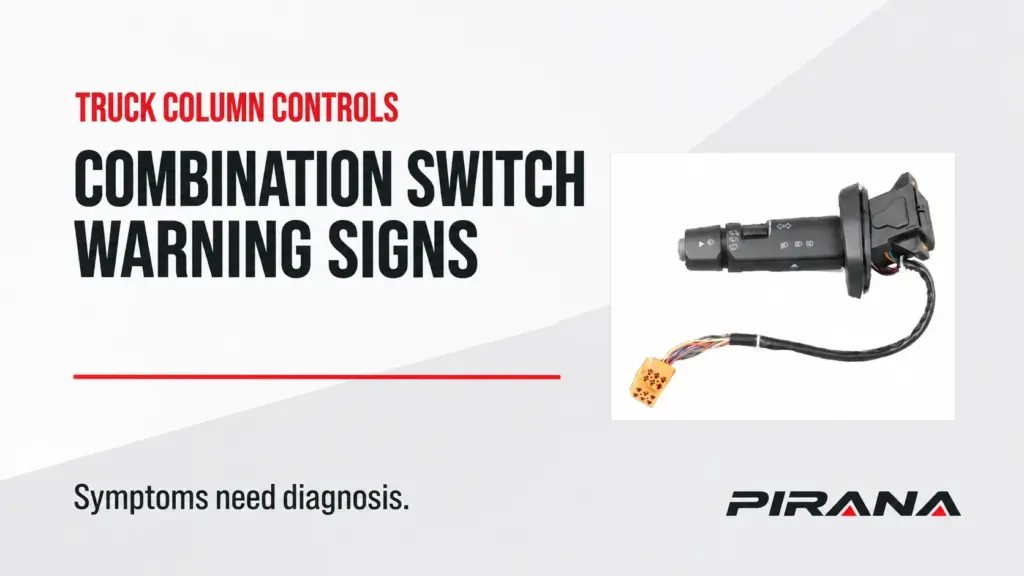
Bad combination switch symptoms can appear in several functional groups. Start with the functions actually assigned to the stalk on the specific vehicle. These signs support investigation and a possible parts-selection review; they do not confirm a failed switch.
Turn signals
- The indicators do not flash, or work intermittently. This identifies an unreliable turn-signal response. It does not isolate the stalk: the flasher or hazard-warning circuit, lamps, connections and body controller may also be involved.
- The lever does not cancel after a turn. On a vehicle equipped with self-canceling operation, a changed return behavior points toward review of the cancellation mechanism and its relationship with the column. It does not prove an electrical switch fault. A truck with a deliberately non-canceling lever has no automatic-return failure merely because the lever stays selected.
- The lever will not stay selected unless held. If the vehicle normally has a maintained turn position, lost retention suggests a mechanical positioning problem. It does not establish whether the switch contacts, mounting or another part of the mechanism is responsible. A momentary lane-change position should not be mistaken for a maintained position.
High beam and flash-to-pass
- Moving the stalk does not change between low and high beam. Where that command belongs to the stalk, the selected request is not producing the expected result. This does not establish whether the input, lamp circuit, relay or controller has failed.
- Flash-to-pass no longer works. This identifies a missing momentary request or response, which should be recorded separately from sustained high beam. It does not prove that the same component or operating conditions govern both functions on every truck.
Wipers and washers, only on vehicles with those controls in the combination assembly
- Only one wiper speed remains available. This narrows the complaint to loss of the expected speed selection. It does not separate the switch from the motor, speed-control circuit, connections or controller.
- The wipers will not stop, or stop away from their normal parked position. This identifies a shutoff or parking complaint. It does not prove that the stalk is continuing to request wiping; the motor’s parking arrangement, linkage or downstream control may need attention.
- The washer does not spray when requested. This identifies loss of the expected washer response. It does not distinguish the stalk request from fluid availability, pump, delivery path, wiring or control faults.
Combined behavior
- Several apparently unrelated functions fail together. This makes a shared point worth investigating, including the assembly and its connections. It does not prove one internal switch failure; a shared supply or controller can also affect several functions.
- Operating one function unexpectedly activates another. Command-linked interference, often described as crosstalk, is a particularly useful clue for reviewing a multifunction control path. It does not locate the fault inside the stalk: crossed or damaged wiring, a connector problem or control logic may produce the same observation. Confirm that the interaction is not an intended vehicle feature.
Lever feel
- The stalk becomes loose, binds or makes a new abnormal noise. A changed mechanical feel supports inspection of the control and its mounting or associated mechanism. It does not establish the electrical cause of a lamp or wiper fault, and a noise near the steering wheel is not automatically coming from the stalk.
If required signaling, lighting or visibility functions are unreliable, arrange qualified assistance before relying on them in traffic or poor visibility. Do not keep forcing a binding lever or deliberately provoke unexpected operation while driving.
Cross-function interference: the most useful pattern to describe precisely
The distinctive value of a combination-switch complaint is the relationship between separate requests. “The indicators and wipers are faulty” leaves the timing unclear. “Selecting the turn signal was followed by an unintended wipe” preserves a request and an observed response. The second report gives the workshop a more focused question about the control path without naming a failed part prematurely.
Two patterns deserve separate records. Simultaneous loss means several functions became unavailable together. Cross-function interference means one selection appears linked to an unintended response elsewhere. Both support review of shared components, but they are not equivalent evidence. Several dead outputs may have lost a common supply; an unintended output following a particular command calls for comparison of that command with what the system recognized and operated.
There is a documented truck-specific reason to take this distinction seriously. Caterpillar’s REHS8717-01 instruction for specified CT660 trucks, dated February 26, 2014, includes verification that high-beam and turn-signal selections do not unintentionally actuate the wipers. This supports recording unwanted interaction as a distinct behavior. It is not proof of the cause on another vehicle, an instruction to carry out those checks here, or evidence of HQ-8105 functions.
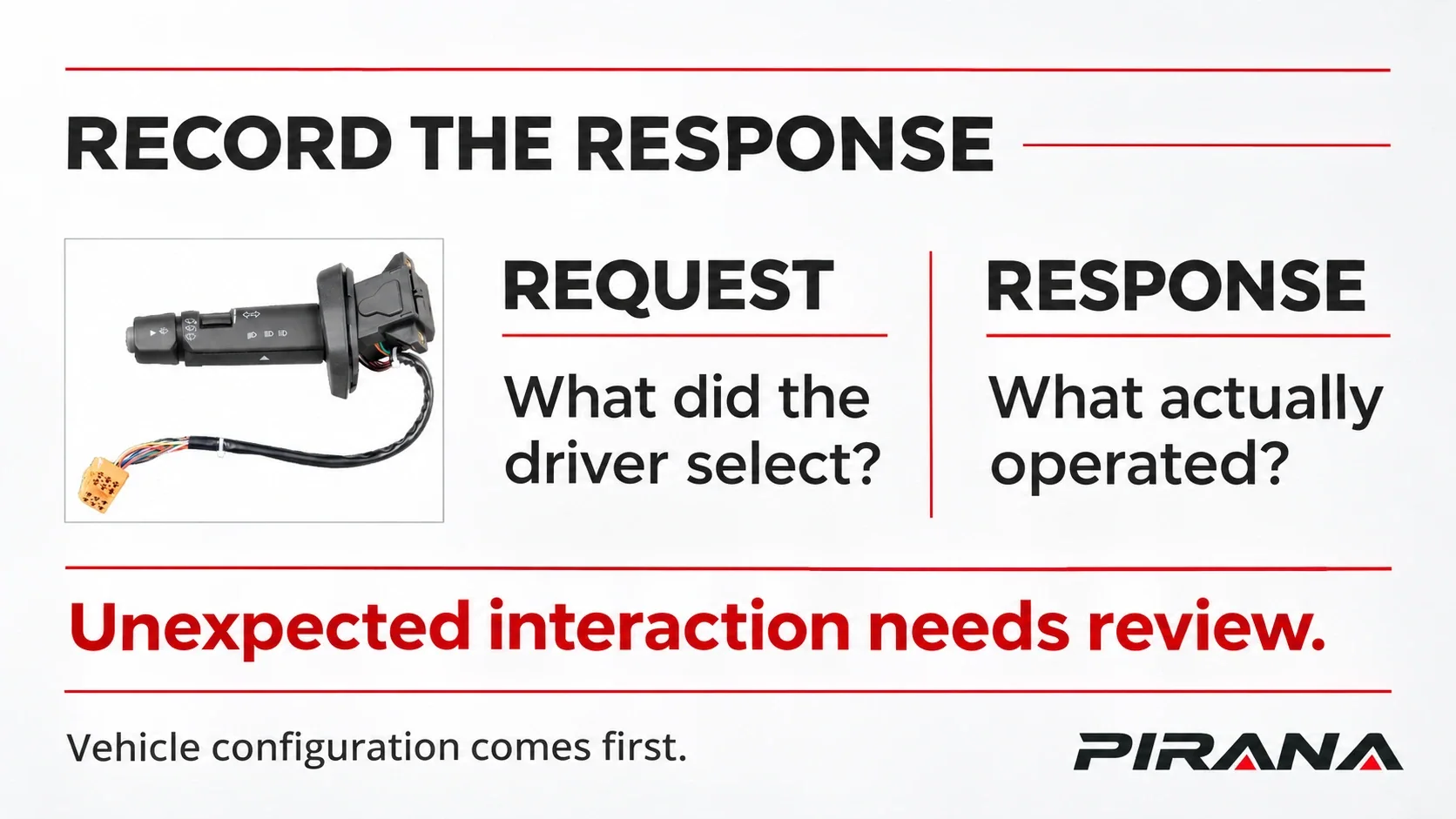
Use observations already noticed during normal operation to prepare the complaint. Do not create a road test, move unknown connectors or reproduce the fault around moving wiper mechanisms to fill out the record.
| Pattern already observed | What to record | What it does not establish |
|---|---|---|
| Several functions became unavailable at the same time | Which functions, which still worked, and whether the change followed service or equipment work | That the combination switch is the only shared point |
| A beam request was followed by an unintended wipe | The intended command, actual response and vehicle operating state | That unwanted interaction originates inside the switch |
| A signal request disturbed another function intermittently | Which direction or selection was involved, and whether the timing was consistent | A repeatable electrical fault or an internal contact defect without diagnosis |
| Two functions operated together in an unfamiliar way | The vehicle’s documented operating behavior and fitted options | That the interaction is abnormal before configuration is checked |
This is an observation framework, not a ranking of failure probabilities. A more distinctive symptom can justify a more focused investigation; it cannot replace the evidence needed to approve a replacement.
Turn-signal retention and automatic cancellation are different questions
A lever that will not remain in its normal selected position has a different complaint from one that remains selected after a turn. In the first case, the reported problem concerns retaining the command. In the second, it concerns releasing that command under the conditions in which cancellation should occur. Reporting both as “the turn signal does not work” hides the distinction.
Truck configuration matters here. The Western Star 4700/5700 Driver’s Manual, Exterior Lighting Controls describes a typically non-canceling combination lever and separately explains the self-canceling version. Automatic return therefore cannot be assumed from passenger-car experience. These are documented arrangements for that manual’s vehicles, not a statement about the MAN catalogue item discussed below.
Record the behavior that changed from normal on the actual truck, together with whether it has maintained, momentary or self-canceling operation as applicable. Changed lever feel is useful supporting evidence, but it does not show the state of every electrical function inside or beyond the assembly.
High-beam ownership: identify the control before naming the fault
High-beam control may belong to a rotary lighting assembly or a steering-column stalk, depending on the vehicle’s configuration. On some arrangements, the selector establishes a lighting state while a separate stalk supplies a beam-change request. Identify the actual division in the applicable vehicle documentation before attaching a symptom to a service part.
This article covers the combination-control side where the function is assigned to it. For the selector-side boundary, see Bad Headlight Switch Symptoms: Signs a Truck Headlight Switch Is Failing. For broader application mapping, see the Truck Cabin Switch Applications Guide.
Wiper speed, parking and washer response need separate descriptions
Use the wiper symptom group only when the vehicle actually places those controls in the combination assembly. A stalk carrying signal controls does not establish that wipers, washers or every lighting function are integrated into that particular product.
Describe the missing outcome rather than the suspected part. “Only one speed works” is a speed-selection complaint. “The blades continue after OFF” is a shutoff complaint. “The blades stop away from their usual rest position” is a parking complaint. Those observations concern different parts of the requested behavior, even if the driver operates them from one control.
Washer response deserves its own line. No spray is not the same as no wiper movement, and neither proves that the combined control stopped transmitting a command. Record the washer response separately from wiping behavior so that a fluid-delivery complaint is not silently turned into an electrical switch diagnosis.
The same caution applies when the fault appears after repair work. Note the event and the affected function, but do not infer that the installed switch is incompatible, requires programming or has failed without the applicable records. This article provides no removal, reset or wiring procedure.
Other causes to distinguish before approving a switch
The useful diagnostic direction is to separate the driver’s request, the input recognized by the vehicle, and the resulting output or mechanical movement. Which components occupy those stages depends on the truck. The following are review directions for the appropriate technician, not a sequence of tests.
| Alternative cause | Direction for distinguishing it |
|---|---|
| Flasher relay or hazard-warning circuit, where fitted | Compare which turn-signal and hazard functions are affected using the actual circuit arrangement. Working hazards do not universally clear the switch, and failed hazards do not universally identify it. |
| Bulb and socket | Establish whether the complaint is confined to one lamp or side, and relate it to the local lamp, socket and connection. A local output complaint does not by itself locate the fault at the stalk. |
| Wiper motor and linkage | Separate a recognized wipe or park request from the motor’s response and the linkage’s movement. Speed loss, continued wiping and incorrect parking require different interpretation. |
| Clock spring | Keep steering-wheel electrical connections and supplemental restraint system concerns distinct from stalk commands. Review the actual column architecture; adjacent or combined packaging does not make the service items equivalent. |
| Harness and plugs | Include shared connections, recent column work, damage and intermittent behavior in the review. A command-linked unwanted response can originate in an interface or wiring path rather than the switch. |
| Body or other control module | Distinguish the requested state, recognized input and commanded output with the applicable service information. A fault code or several inactive outputs alone does not condemn the module or the combination switch. |
A historical OEM example illustrates why the circuit boundary matters. GM bulletin 01073B, June 2008, concerns a hazard-switch contact condition on its listed Blazer, Jimmy, Envoy and Bravada applications. It describes loss of specified stop/hazard functions while turn-signal functions remain unaffected. That is a bounded example of different outcomes within a related assembly, not a diagnostic rule for MAN trucks.
An illuminated airbag warning lamp is not a combination-switch symptom. It belongs in the supplemental restraint system diagnosis and directs attention toward the clock spring or another restraint-system circuit concern, rather than toward a stalk replacement. It does not prove a failed clock spring either. FCA’s 27B / NHTSA 24V-196 recall document describes a clock-spring condition that can illuminate the airbag warning lamp on specified 2016 Jeep Wrangler vehicles. That example establishes the separate diagnostic direction, not the cause on a truck. Airbag and steering-column service requires the applicable qualified service process; no such procedure is supplied here.
What should enter the parts-selection review?
Keep the job record at “suspected combination-control fault” until vehicle-specific diagnosis distinguishes the assembly from its connections and the downstream system. Symptoms justify documenting the complaint and reviewing the possible service item. Confirmation requires evidence tied to the actual vehicle and conditions.
For a supplier enquiry, identify the exact vehicle, the control assembly in question and the complete original reference. Preserve the symptom record alongside that identity so that a catalogue match is not mistaken for a diagnostic conclusion. Selection and fault confirmation answer different questions: a part can be a plausible catalogue candidate without being the cause of the complaint.
PIRANA’s HQ-8105 combination-switch record lists MAN, OE 81.25509.0194, and the catalogue application TGS / TGX / TGA / TGM / TGL. Use the specific model nameplate or part label and the corresponding catalogue record as the controlling references for review. Vehicle build and application must still be confirmed for the exact item.
The public HQ-8105 page does not publish an integrated-function list. Consequently, the signal, beam and wiper examples in this article are general vehicle-system symptoms, not claims that HQ-8105 performs those particular functions. Its product photograph, listed OE reference and model-family association do not fill that missing specification or establish unconditional fitment.
FAQ
What are the symptoms of a bad combination switch?
Possible signs include unreliable turn signals, changed lever retention or cancellation where fitted, missing beam-change or flash-to-pass response, and wiper or washer faults on vehicles with those controls integrated. Several functions failing together or one selection triggering an unintended response are useful shared-path clues. Loose or binding lever feel also warrants review. None confirms switch damage without diagnosis.
Do turn signals that do not flash always mean the combination switch is bad?
No. The flasher or hazard-warning circuit, bulbs and sockets, wiring, connections and a body controller may produce a similar complaint, depending on the vehicle. Record the affected lamps, sides and operating state. The actual circuit information must distinguish the stalk request from the resulting lamp operation before replacement is approved.
Why can several functions fail at the same time?
Separate functions may share a control assembly, connector, supply or controller. Simultaneous failure therefore supports reviewing shared points without identifying which one failed. If selecting one function unexpectedly activates another, record that relationship separately and compare it with the vehicle’s intended behavior. Cross-function interference is informative but is not proof of an internal switch fault.
Does the headlight switch or combination switch control high beam?
It depends on the vehicle. A rotary assembly may own the function, a column stalk may supply the beam request, or separate controls may have linked duties. Consult the exact vehicle’s operating and service information. The label “headlight switch” or a similar-looking stalk does not establish which service part controls high beam on that configuration.
How do you confirm the combination switch is faulty rather than a relay or module?
A qualified technician uses the applicable vehicle information to distinguish the switch request, its supply and connections, the input recognized by the system and the downstream response. A symptom, code or shared failure alone is insufficient. The evidence must isolate the fault to the relevant assembly before a replacement is approved; a catalogue association cannot make that diagnosis.
References
- Caterpillar, REHS8717-01: Installation Instruction for Intermittent Wiper Switch for Certain On Highway Truck, February 26, 2014, specified CT660 applications; cross-function verification on PDF pages 23-24.
- Daimler Truck North America, Western Star 4700/5700 Driver’s Manual: Exterior Lighting Controls, topic dated May 16, 2024; configured lever arrangements only.
- General Motors, Recall bulletin 01073B: Stop Lamps/Hazard Lamps Inoperative, June 2008, listed vehicle/build scope only.
- FCA US LLC, 27B / NHTSA 24V-196: Airbag Clockspring, March 2024, specified 2016 Jeep Wrangler vehicles only.
- PIRANA, HQ-8105 combination switch, OE 81.25509.0194, catalogue record checked November 6, 2026; no integrated-function specification published.