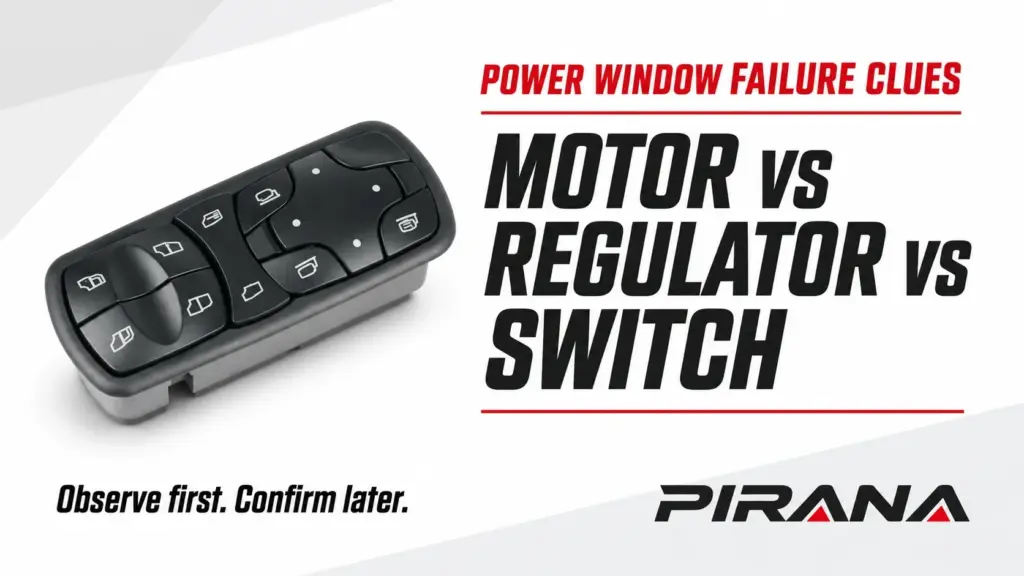
Start with the observed sign, not the part name
| Observed phenomenon | Points toward | Cannot prove |
|---|---|---|
| Completely silent and unresponsive | The electrical side: switch, supply, harness or motor | Which of those four is responsible; silence alone cannot separate them. |
| The motor can be heard turning but the glass does not move | The regulator or cable drive, with the motor doing work | The exact failed regulator element, a detached glass attachment or another mechanical condition. |
| Grinding, cracking or cable noise | The mechanical side of the regulator or cable drive | That the motor is healthy under every condition or that the whole regulator assembly needs the same remedy on every vehicle. |
| Glass tilts, travels out of line or binds | The regulator or guide path | That the motor caused the misalignment; a motor does not make the glass run crooked by itself. |
| Glass drops into the door or will not stay supported | Regulator cable or glass-clamping failure | The exact broken retainer, cable or guide without the applicable vehicle inspection. |
| Movement is slow or weak, becomes harder near the top, or returns after resting | A weak motor or excessive resistance; both remain possible | A choice between motor and mechanical drag. The observation is intentionally insufficient to choose one. |
| The master control moves the window, but the local door switch does not | The switch-side command location or its local path | That the local switch itself is defective; supply, return, lockout or master-side control can be involved. |
| Only one direction fails | A direction-specific switch contact or the motor | Which one is at fault; one-way failure is insufficient to choose between them. |
These are observation-level directions, not diagnoses. In this power window motor vs regulator comparison, “motor turning” means an identifiable running sound, not merely a click or hum. A sound alone does not confirm usable output at the motor-to-mechanism connection. If the sound cannot be identified, keep that distinction unresolved.
This is a component-family comparison, not the symptom-recording workflow. For control locations, conditions and evidence status, use Truck Window Switch Not Working? Diagnosis Checklist. For the distinction between a central control and a local control, see Master vs Individual Window Switch.
The three layers do different jobs
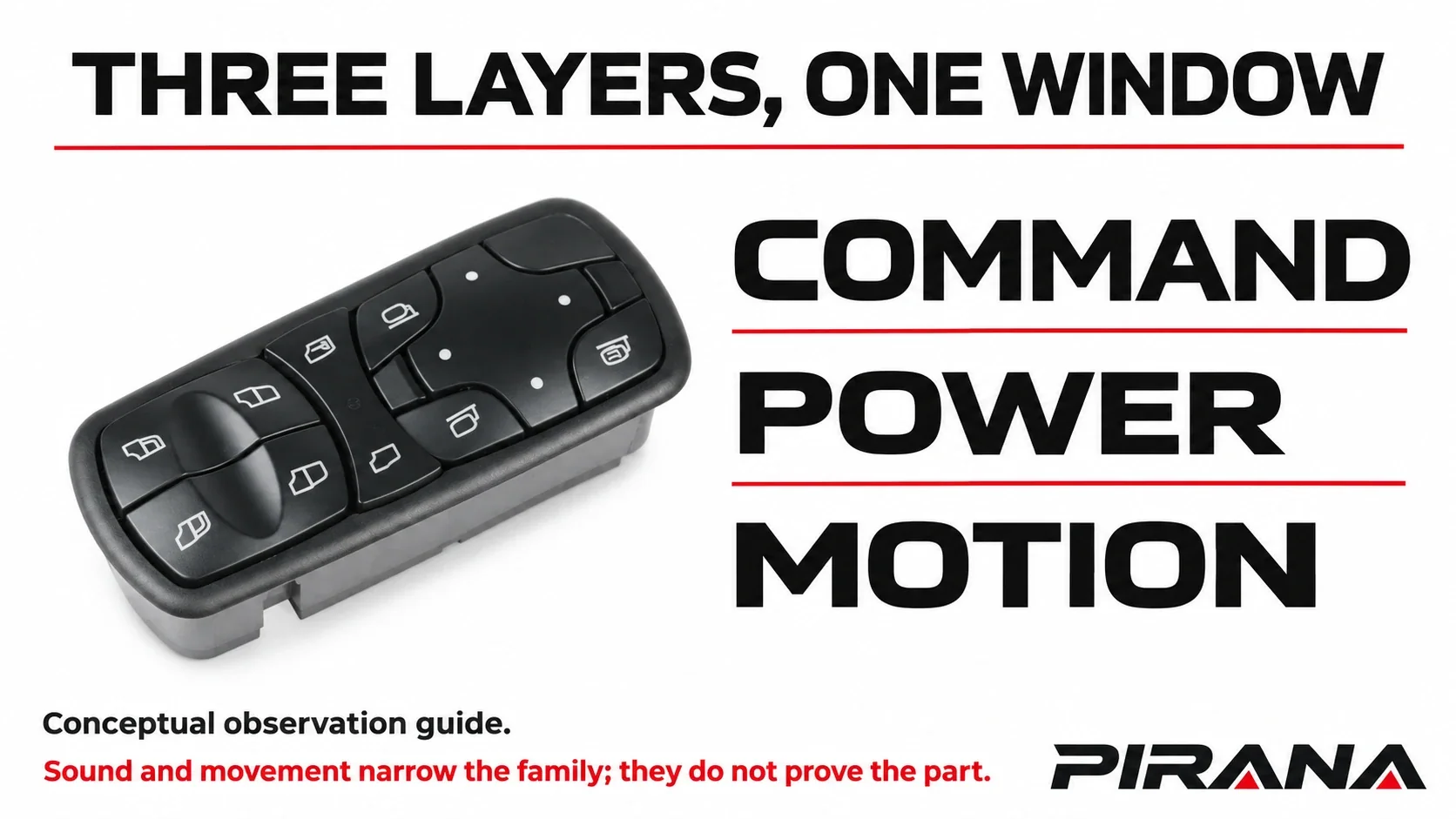
A power window system can be understood as three functional layers. The labels are useful for organizing observations; a vehicle may place more electronics or control logic between them.
The switch is the command layer
The switch converts a driver’s request into a vehicle-side command. Depending on the vehicle, that command may be carried through a direct circuit, a door module or another controller. A switch-directed pattern usually involves the control location, direction selection or button movement: one control works while another does not, one direction disappears, or the button’s normal travel changes.
A result confined to one command location points toward that control path. This page stops at that conclusion; the linked master-versus-individual guide owns the control relationship. Button appearance or a working neighboring channel does not establish the electrical state of the affected channel.
The motor is the power layer
The motor turns electrical input into rotary motion. A completely silent window can belong to the electrical side, including the motor, while an identifiable motor-running sound suggests the motor is attempting to drive the mechanism. Slow or weak movement is less decisive because motor weakness and excessive mechanical resistance can look alike.
Do not convert a restart after resting into a motor verdict. The observation says operation changed with time; it does not reveal whether the cause was within the motor or the load it was trying to move. In BMW’s May 2022 B51 07 22 attachment, the slow-window guidance for named G01/G02 and G05/G06/G07 applications separates mechanical concerns from motor/regulator diagnosis. It supports preserving both possibilities, not applying BMW’s remedy to a truck.
The regulator is the mechanical layer
The regulator transfers motor rotation into glass movement. Cable-style and scissor-style regulators both exist, and the same broad failure family can present differently depending on the vehicle. A glass that tilts, slips, drops, binds or produces cable and gear noise is more informative about the mechanical path than a silent button is.
Mazda’s 09-045/18 bulletin for 2016-2019 MX-5 vehicles documents no movement, glass fallen into the door and abnormal noise associated with cable damage. That is a concrete example of a mechanical drive complaint. It does not establish the same cause for another vehicle, a universal cable failure rate or a PIRANA product function.
Noise also needs a location, even at observation level. GM PI0018B, covering its stated 2008-2014 cars and light-duty trucks, identifies alignment, attachment, run-channel and interfering-component concerns within its regulator guidance. A sound described as grinding or cracking is therefore a mechanical-path clue, not enough to select an exact assembly. Glass traveling crooked points toward how it is guided and supported; the motor supplies rotation rather than independently determining the glass angle.
If glass has dropped, is visibly unstable or makes abnormal mechanical noise, stop cycling the control and arrange qualified repair assistance. Keep clear of the glass path. The comparison table is not a reason to demonstrate the symptom again.
Truck context changes the load, not the observation rule
Commercial trucks can use 24V electrical systems; Mercedes-Benz Trucks, for example, identifies a 24 V on-board supply in its Econic equipment information. This is vehicle context, not a switch rating or an electrical test value. Large, heavy cab glass also makes the actual mechanical load relevant without defining one standard truck window.
Cable-style and scissor-style regulators coexist in commercial-vehicle applications. Valeo’s truck window-regulator range description lists those technology families. That catalogue statement establishes variety, not an endorsement of any replacement or proof of PIRANA coverage. These differences do not supply a universal symptom threshold or part diagnosis.
A heavy window that becomes slower near the top can reflect motor condition, seal or guide resistance, regulator friction or another vehicle-specific load. The observation narrows the family only when combined with sound, movement and control-location behavior. Do not turn truck context into an invented current, voltage, speed or force requirement.
The same caution applies to a switch label. A master, local or AUTO marking describes a control role only within the configured system. It does not establish that every truck routes power, ground or communication in the same way.
What observation can and cannot establish
This article deliberately stays at the observation layer: hear the system, watch the glass and compare a permitted control location with another permitted control location. That is enough to narrow a family in many cases, but it is not enough to confirm the failed part.
Confirmation still requires the service information for the exact vehicle, configuration and system. The exact procedure and its acceptance criteria belong to the applicable service process. This page provides no workshop procedure or numerical acceptance limit.
The distinction is simple but consequential: an observation identifies behavior, an indicated family identifies the next area for review, and a confirmed cause requires discriminating vehicle-specific evidence. The first two can support narrowing and parts review; they do not authorize replacing the visible switch or the most convenient assembly.
The same vehicle may combine a motor and regulator in one service item or list them separately. Their packaging does not make every complaint a failure of both. Let the applicable parts and service records define the item after the fault review, rather than interpreting “motor and regulator assembly” as a diagnostic conclusion.
Route the result honestly
If the pattern points toward the switch layer, record the complete original identifier and move to the OE-number power window switch identification guide. A switch candidate still requires the correct vehicle configuration, position, connector and required functions.
If the pattern points toward the motor or regulator layer, say so plainly: that is a repair-shop component review. PIRANA’s catalogue evidence supports switch sourcing, not a claim that the company supplies every part in the window mechanism.
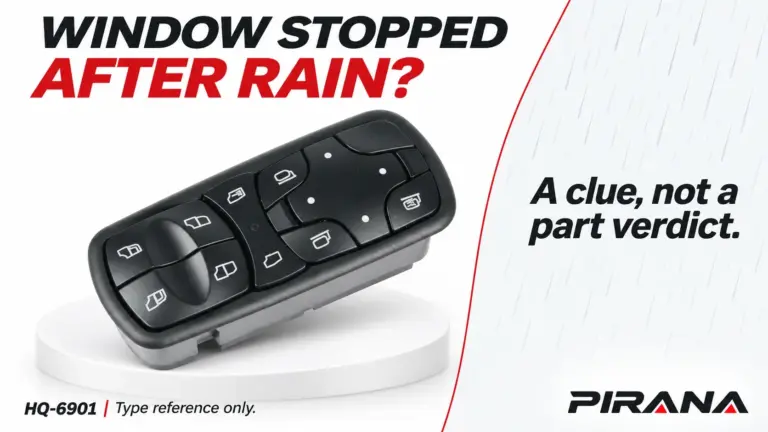
PIRANA’s HQ-6901 power window switch record lists OE A9438200097 and a Mercedes-Benz catalogue application of Actros / Antos / Arocs / Axor. This is a catalogue identity reference. It does not establish that HQ-6901 contains a motor or regulator, that it resolves any symptom in this article, or that it is an unconditional replacement for an unspecified build. Use the specific model nameplate and current catalogue record as the controlling references.
FAQ
How can you tell whether the power window motor or regulator is bad?
Listen and watch. A motor that can be heard turning while the glass stays still points toward the regulator or cable drive. Grinding, cable noise, tilting, dropping or glass movement out of line also point toward the mechanical layer. Slow or weak movement is less decisive because a weak motor and excessive resistance can look alike. Confirmation still requires the exact vehicle’s service information.
If the motor is turning but the glass does not move, which part is bad?
That observation points toward the regulator or its cable and glass-drive connection because the motor is producing motion. It does not identify the exact broken element or prove that the motor is healthy in every operating condition. The vehicle-specific repair review must establish the failed mechanical part.
If the glass falls into the door, is the motor or regulator the problem?
A glass that drops into the door points toward the regulator cable, retainer or glass-clamping side of the mechanism. It does not prove which mechanical element failed, and it does not justify ordering a switch. Treat it as a repair-shop component issue until the applicable vehicle information identifies the required assembly.
Can a bad window switch make the window slow?
It can be part of a window-control complaint, but slow movement does not by itself prove a switch fault. A weak motor, regulator friction, guide resistance or other vehicle condition can also slow the glass. The observation narrows the review only when combined with control behavior, sound and the vehicle-specific diagnostic evidence.
If the master operates the window but the local switch does not, what is the problem?
The difference points toward the local command path, but it does not automatically prove that the local switch is defective. Review the actual command path and enabling conditions in the vehicle information before selecting a switch. If the evidence points to another part of that path, the switch should not be replaced as a guess.
References
- BMW, Attachment to B51 07 22, May 2022, “Window Regulator – Functional Issues – Window Moving Too Slow,” printed pages 45-46; named BMW applications only.
- Mazda North American Operations, 09-045/18: Power Window Does Not Work Properly and/or Abnormal Noise When Operating, December 21, 2018, page 1; 2016-2019 MX-5 only.
- General Motors, PI0018B: Front or Rear Side Door Window Binds, Moves Slowly, Makes Rattle/Squeak Noise, Poor Fit/Misalignment or Is Inoperative, November 2013; stated 2008-2014 GM cars and light-duty trucks.
- Mercedes-Benz Trucks, Econic equipment information, “Electrics,” accessed November 7, 2026; vehicle supply context only.
- Valeo Service, Window Regulator and Electrical Systems for Trucks and Buses, accessed November 7, 2026; attributed technology-family catalogue description only.
- PIRANA, HQ-6901 power window switch, OE A9438200097, catalogue record checked November 7, 2026.