
First identify which start/stop control you mean
This guide concerns a press-operated engine start/stop button: the control the driver presses to request starting or stopping the engine. It does not cover a key-operated ignition switch or the automatic idle stop/start system that may stop and restart the engine during a journey. Similar words on a dashboard do not make these the same part or the same diagnostic task.
Bad engine start stop switch symptoms can include inconsistent response to a normal press, failure to register an expected power-state request, changed button feel or a relevant warning. They support investigating the button and its input path; they do not prove the button is defective. A no-start may instead belong to the battery, starter, key authorization, an interlock or the vehicle-side control system.
| Pattern already observed | What it can suggest | What it cannot prove |
|---|---|---|
| A normal press sometimes gets no response, but a later ordinary attempt works | An intermittent button request or input-path concern | That the contacts are worn; authorization, connections and vehicle state remain possible causes. |
| The expected ignition or accessory state does not change after a press, where that operation is documented | The request may not be reaching or being accepted by the vehicle | That the button itself failed rather than its supply, interface or control system. |
| The button binds, feels loose or fails to return as it normally did | A mechanical concern at the button, mounting or surrounding trim | That the mechanical change caused the electrical complaint. |
| A start-button or keyless-start warning accompanies the complaint | The starting or authorization system has a condition requiring review | That the component named in the message is necessarily the failed part. |
| The engine does not respond to the normal stop request while stationary | A stop-request or vehicle-state concern that needs prompt assistance | That the same internal contact causes every start and stop problem, or that a generic emergency sequence applies. |
| Button illumination changes or disappears unexpectedly | An illumination or power-state observation worth describing separately | That the start request is missing, or that one indicator color has a universal meaning. |
Do not turn the intermittent row into a repeated-press test. Describe what happened during ordinary use. If the button binds, start/stop behavior is unreliable or heat, smoke or a burning smell is present, arrange qualified assistance. Do not experiment with the engine-stop function while the vehicle is moving.
Three similar names, three different jobs
A push-button engine-start control is an input to the configured starting system. Pressing it is not the same as directly supplying power to the starter. The vehicle may also need an accepted key, an appropriate transmission state and other documented conditions before it acts on the request.
A key-operated ignition switch is a different service item, operated through a key and the applicable ignition-lock arrangement. A guide headed “bad ignition switch symptoms” may refer to that architecture. Its key-turning, lock-cylinder or other architecture-specific conclusions should not be imported into a push-button parts enquiry.
Automatic idle stop/start is a vehicle operating function. It may temporarily stop and restart the engine when specified conditions are met. A control that enables or disables that function is not automatically the engine-start button discussed here. Volkswagen’s 27-19-02TT, Auto Stop Standby Message, for its listed Atlas, Tiguan, Jetta and Arteon applications, explains that a standby message can be informational when that automatic system operates normally. It is not evidence that the driver’s engine-start button has failed.
This distinction also protects the parts order. Describe the physical control and the intended job before selecting a category. “Start/stop fault” without that boundary can send an engine-start complaint toward an idle-stop control, or a key-operated complaint toward the wrong button.
What makes an intermittent press a button-related clue?
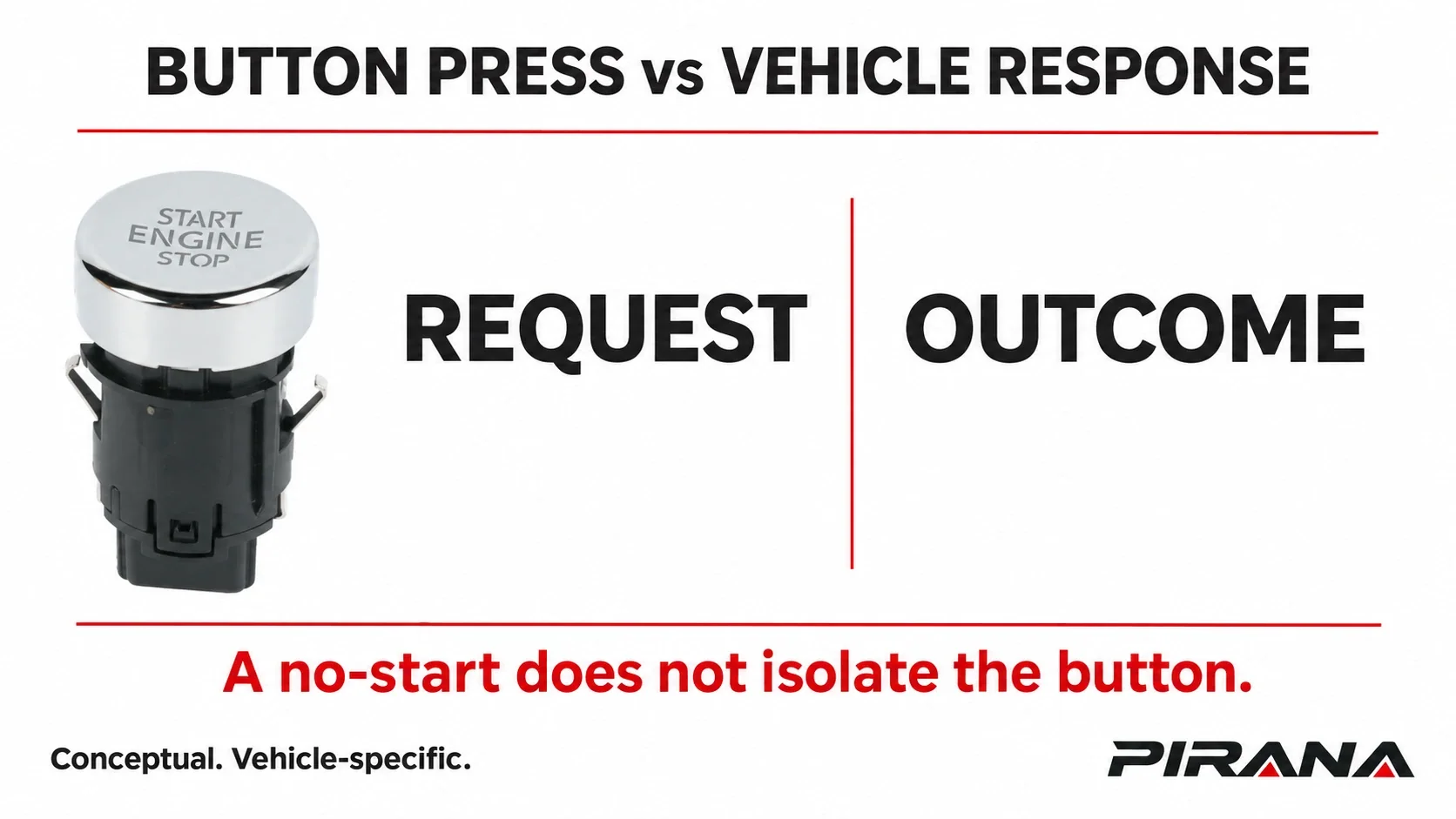
The useful distinction is between making a request and getting an engine response. A button can be suspect when ordinary presses are not consistently registered, especially if there is a new mechanical change. However, an engine failing to start does not tell the observer whether the request was absent, rejected or accepted but not completed.
An OEM example establishes that a real button fault is possible. Bentley’s technical information 2044785/2, Bentayga Start Stop Switch, describes intermittent operation in its stated 2017 Bentayga scope, including contacts that may not close correctly. It associates that condition with failure to start or an implausible-signal message. The example supports investigating the input; it does not establish the same cause on a Volkswagen application or HQ-6168.
Honda’s service bulletin 20-117, dated December 9, 2020, gives another bounded example: its specified 2016-2017 Pilot and 2017 Ridgeline complaint combines failure to start on the first press with a keyless-start error and the named diagnostic condition. That bulletin’s vehicle-specific response is not a universal button replacement rule, a current warranty promise or a cross-reference to a PIRANA part.
What a workshop must establish is the behavior of the exact input under the applicable diagnostic conditions. The appearance of a button, a familiar symptom or success on a later attempt cannot supply that missing evidence. Do not press harder, hold longer or change the operating sequence to imitate an unrelated manual’s remedy.
A warning can name the button while the fault is elsewhere
Read the exact message, but keep its meaning tied to the vehicle information. A warning is an input to diagnosis, not a parts list.
Porsche’s technical information 65/25, dated August 15, 2025, concerns an intermittent power-button warning on its stated 2020-2025 Taycan applications. It identifies a possible dashboard-to-main-harness connection problem and explicitly explains that replacing the start-stop switch does not remedy that particular condition. The Taycan is an electric-vehicle example, not an engine-start procedure for a combustion vehicle. Its value here is the diagnostic boundary: even a message naming a button may refer to an external input-path problem.
Keep illumination separate too. A lamp on or around the button can reflect an operating state, authorization status or fault indication according to the vehicle’s manual. Loss of illumination alone does not establish that the start command is absent. Similarly, a normally lit button does not certify that its request is being recognized.
For example, the 2023 Mazda CX-5 owner’s manual, in Start/Stop Engine, distinguishes key and push-button indications and describes starting-system warnings. Those meanings belong to that configured vehicle. They cannot be used as a universal red, green or amber diagnosis for the PIRANA catalogue item.
Separate a missed request from a battery, starter or authorization complaint
This guide stays at the observation layer. It does not provide an electrical test, trim-removal method, emergency starting sequence or security-system workaround. The next review direction should follow what the vehicle actually did.
| Observed outcome | Appropriate review direction | Why a switch order would be premature |
|---|---|---|
| The vehicle appears to ignore the button and no expected state change is noticed | Button/input path, power supply and the documented enablement conditions | An observer cannot tell whether the request is absent or rejected. |
| The engine turns over slowly, lights visibly weaken or repeated clicking is heard | Vehicle battery, connections and starting-power path | A response occurred, but the symptom does not isolate which power-path component is responsible. |
| A click is heard but the engine does not turn | Starting circuit, starter and its supply, with applicable controls still considered | The sound alone neither proves a healthy battery nor confirms a failed starter or button. |
| The engine turns over but does not run | Engine-starting diagnosis, including authorization or engine-system causes as applicable | Cranking and successful running are different outcomes; a no-run is not automatically a button fault. |
| A key-not-detected or security-related indication is present | Key recognition, authorization and the configured security system | The vehicle may be withholding permission to start even if the button request is available. |
| The display asks for a required operating condition | The relevant interlock or recognized vehicle state | A missing or unrecognized prerequisite can resemble a failed button. |
Bosch’s Starting Systems technical information separates battery condition and connections, starter operation and other engine-start causes. That distinction supports routing a slow-crank or click complaint to the starting-power system. This article supplies none of that document’s numerical limits or workshop procedures.
The Mazda manual cited above also illustrates why authorization and interlocks matter: its starting description depends on recognized key and vehicle conditions. Follow the actual vehicle documentation rather than assuming the presence of a key or a lit dashboard clears those conditions. The small battery inside a remote key and the vehicle’s starting battery serve different roles; a complaint involving one should not be silently converted into a diagnosis of the other.
For a security-state counterexample, FCA’s STAR case S2108000129, May 2021, describes a particular condition in which the ignition state does not advance after a start/stop-button press because of a key/security interaction. It is historical case guidance, not a diagnosis of other vehicles or a claim about current software. No workaround from that case is prescribed here.
What is enough to begin reviewing a replacement button?
A useful fault review distinguishes the physical button, the request recognized by the vehicle and the outcome of that request. It also accounts for the input connection, power conditions and authorization requirements that the applicable service information makes relevant. That is the bridge from a symptom pattern to an evidence-supported service-item decision.
The evidence should support the button as the relevant item before a sourcing enquiry treats it as the failed part. If it instead identifies a starter, battery connection, authorization concern or harness problem, route the case to the repair facility responsible for that system. PIRANA supplies the switch; this article does not offer a starter, vehicle battery, immobilizer module or complete keyless-start system.
If the vehicle does not follow its normal stopping behavior while stationary, seek qualified assistance and use the actual owner’s documentation for that situation. This guide does not give an alternative stopping sequence. Do not interpret an emergency action described for another vehicle as a diagnostic test for the button.
For a broader overview of control families, the Truck Cabin Switch Applications Guide provides application mapping. Its truck examples do not define the passenger-vehicle starting architecture or the function set of the following product.
HQ-6168 is a catalogue candidate, not a no-start diagnosis
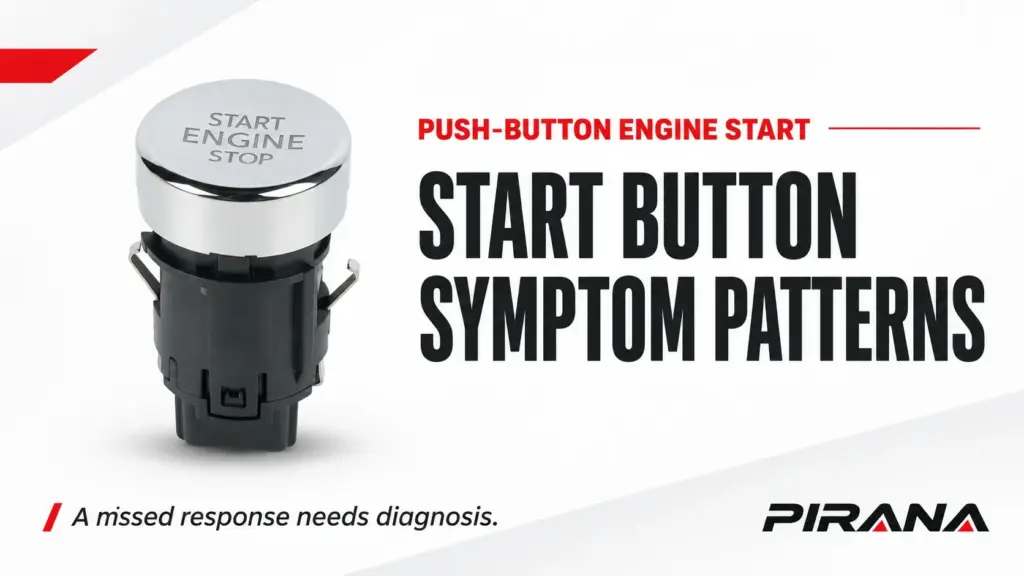
PIRANA’s verified HQ-6168 engine start stop switch record lists OE 1BD 959 839 B and the catalogue application Langyi / Langxing, 2015-2018; Langjing, 2016-2017. The product photo shows a press-operated button marked START ENGINE STOP. Use the specific model nameplate or part label and the corresponding catalogue record as the controlling references.
These records establish product identity and declared application. They do not confirm every vehicle build, connector, electrical interface, authorization dependency or installation requirement. They also do not establish that HQ-6168 shares the internal fault described in the Bentley or Honda examples. Exact compatibility still needs the relevant vehicle and product records.
The current Engine Start Stop Switch catalogue contains 19 listed references when checked for this article. A category label is a discovery route, not proof that every item serves the same starting-system architecture. Preserve the complete OE string, including its suffix, rather than selecting from the face wording alone.
FAQ
What are the symptoms of a bad engine start stop switch?
Possible patterns include inconsistent response to ordinary presses, failure to change an expected power state, abnormal button travel or return, and a relevant start-system warning. Stop-request or illumination complaints also need review. These observations justify investigating the button and its input path; they do not establish a failed switch without vehicle-specific diagnosis.
Does a no-start always mean the start button is faulty?
No. Battery condition, connections, starter operation, key authorization, interlocks and engine-system faults can prevent starting. Distinguish no response, clicking, slow cranking and cranking without running. The exact vehicle’s diagnostic information must establish whether the button request is missing, rejected or followed by a downstream failure.
Why does the engine start only after several button presses?
The changed response can involve an intermittent button input, but a later successful attempt does not isolate an internal contact fault. Connections, authorization and operating state can also change the result. Record the pattern from ordinary use and arrange the applicable diagnosis rather than repeatedly pressing or forcing the button as a test.
Is the engine start button the same as the automatic stop/start switch?
No. The engine-start button requests the driver’s start or stop action. Automatic idle stop/start manages temporary engine stopping and restarting under its own operating conditions, and may have a separate enable/disable control. A key-operated ignition switch is another service item. Identify the actual control and complaint before selecting a part family.
Does replacing the start button fix a keyless-start warning?
Only if the applicable diagnosis supports the button as the cause. A warning may involve its connection, the key, authorization or another control-system condition. A component named in the message is not automatically defective. Use the vehicle-specific evidence and exact product identity before approving a replacement; a catalogue match alone is insufficient.
References
- Volkswagen Group of America, 27-19-02TT: Auto Stop Standby Message, March 16, 2023; listed automatic idle-stop applications only.
- Bentley, 2044785/2: Bentayga Start Stop Switch, stated 2017 Bentayga vehicle scope; release date not established from the document header.
- American Honda, Service Bulletin 20-117, December 9, 2020; specified Pilot/Ridgeline applications only.
- Porsche, Technical Information 65/25, August 15, 2025; stated 2020-2025 Taycan applications, connector counterexample only.
- Mazda, 2023 CX-5 Owner’s Manual, Start/Stop Engine, printed pages 4-6 to 4-9; configured vehicle only.
- Bosch, Starting Systems, battery/starter diagnostic distinctions; no numerical procedure reproduced.
- FCA US LLC, STAR S2108000129, May 2021; historical security-state case, not a diagnosis or workaround for another vehicle.
- PIRANA, HQ-6168, OE 1BD 959 839 B, and Engine Start Stop Switch catalogue, checked November 8, 2026.