By James
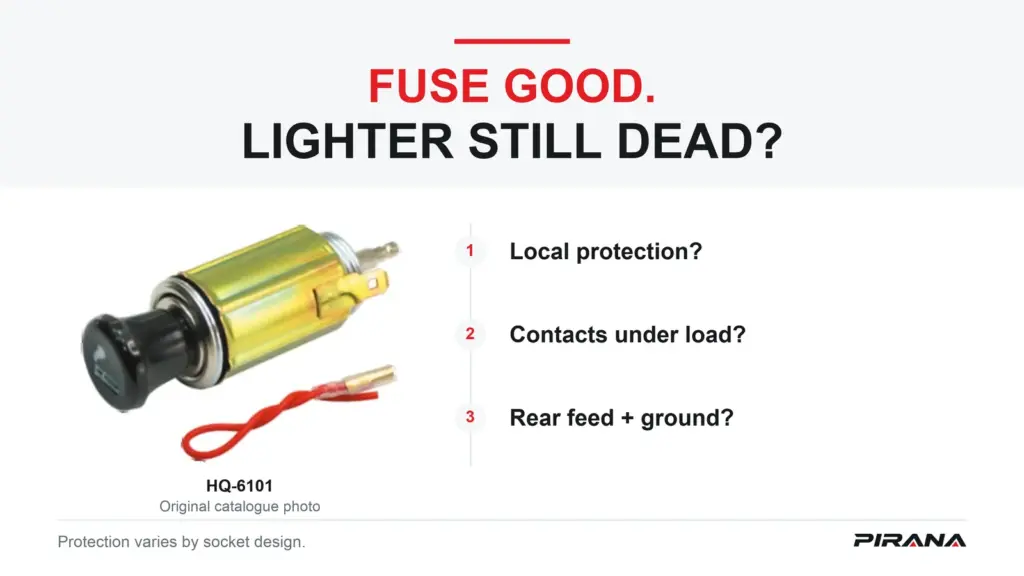
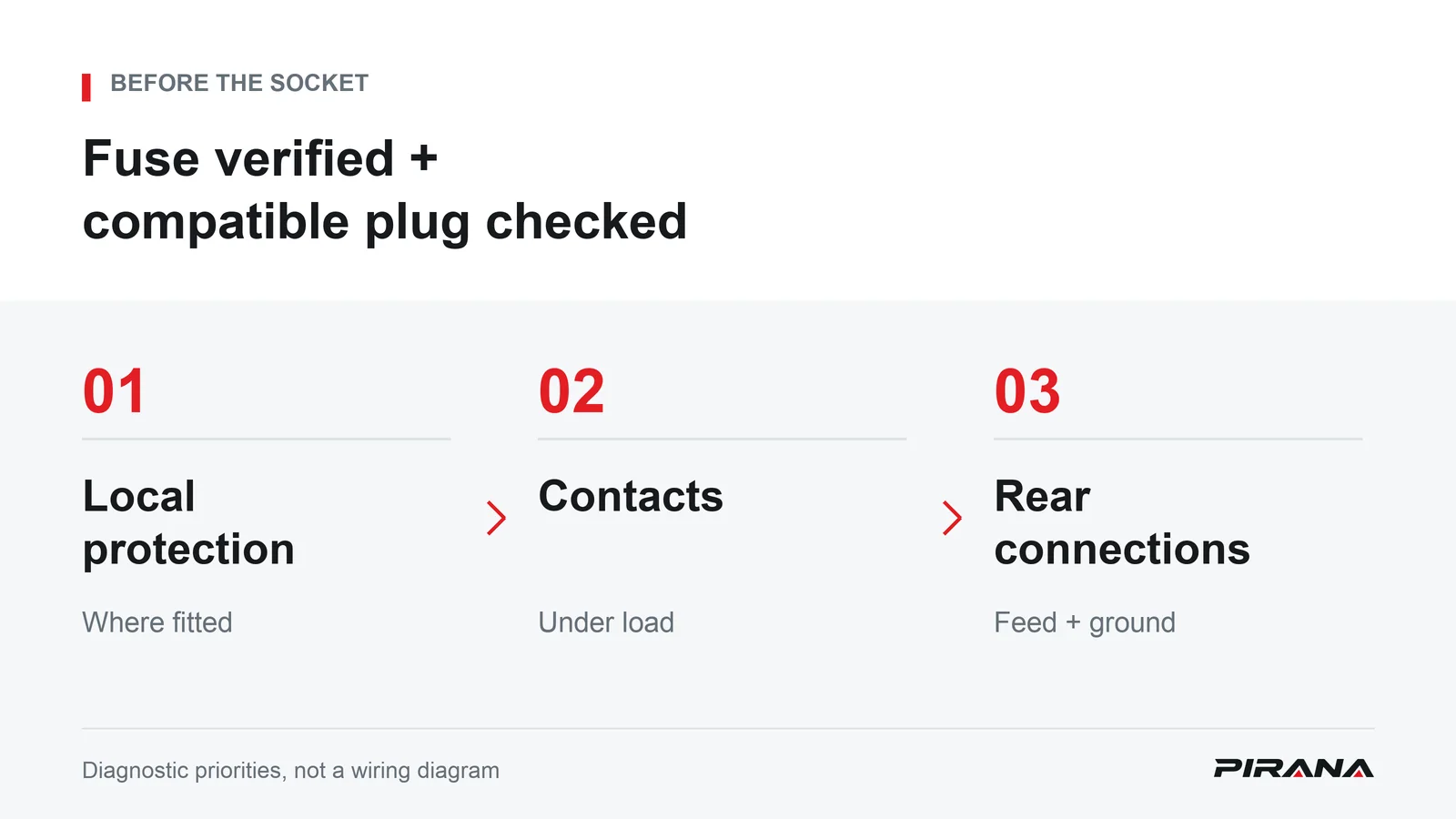
A good fuse does not mean the cigarette lighter circuit is healthy. Some sockets have their own protection at the rear: a fusible link or, in another design, a thermal protector. That protection can interrupt the socket while the upstream fuse remains intact. Other possibilities are corroded contacts that cannot deliver current under load, or a loose feed or ground connection behind the dash.
For a cigarette lighter not working with a verified good fuse, work through those three layers: local socket protection where fitted, loaded contact performance, then rear feed and ground. First, however, prove the fuse electrically and rule out the heating insert or accessory plug. This is a diagnostic direction, not proof that any particular socket has failed.
First, prove the fuse (properly)
“It looks fine” is not an electrical result. Have the correct fuse checked on both sides in the operating state specified for that vehicle. A circuit that is not enabled can mislead the investigation, and a visual check cannot establish whether the complete supply path works. Use the vehicle information to identify the circuit rather than guessing from a nearby fuse label.
A working clock is not a substitute for that check. Some configurations share lighter-related supplies with other equipment; others do not. The Hilux Surf discussion in the Sources includes an owner who mentioned a working clock while investigating a dead lighter. That was an observation about that vehicle, not a universal method for clearing every lighter fuse.
Next, cross-check with a known-good, compatible heating insert or plug, provided the socket shows no heat damage. A failed insert or a plug that does not engage the contacts correctly can mimic a dead socket. Compatibility matters: one working accessory proves only that its own contact arrangement operates there. It does not establish that every insert or accessory plug fits correctly.
These preliminary checks come before dismantling. Once the fuse is electrically verified and a compatible load still fails, repeatedly changing fuses adds little evidence. The next question is where the circuit stops delivering usable power.
Cause 1 – the protection on the back of the socket itself
The fuse box may not contain the only protective element involved. In the IH8MUD thread “Cigarette Lighter Not Working?”, participants describe a small fusible link at the rear of the socket that can open before the supplying circuit fuse. The socket can therefore be dead even though the upstream fuse remains intact.
That rear location explains why looking into the front opening does not settle the question. The link belongs to the socket assembly rather than being another obvious fuse in the vehicle fuse box. Establishing its condition requires identification and inspection of the actual rear assembly by the applicable service method, not an assumption based on the socket face.
A thermal protector is an alternative form of socket-local protection. Manufacturer and production year determine what is fitted; fusible links and thermal protectors are not interchangeable names for one universal rear component. Some sockets have this protection, and its presence must be checked rather than assumed.
There is factory-document support for the thermal-protection possibility. The Fiat Grande Punto diagnostic text, available on a third-party manual host, describes socket thermal protection interrupting the supply after overload. Its specified response to activated protection is socket replacement. That instruction applies to the documented design; it does not establish the construction of another vehicle’s socket.
The IH8MUD rating explanation is qualitative: in the design being discussed, the socket is rated lower than the circuit that feeds it. Local protection can therefore protect the socket before the upstream circuit fuse opens. The MotorsForum Corolla discussion also discusses a rear link and thermal-protector concerns during sustained accessory use. Neither discussion supplies universal ratings for replacement products.
A heating insert that stays engaged or prolonged overload can make socket-local protection a relevant suspect. Usage history strengthens that direction, but does not prove the protection opened. Confirm the fitted design and fault before deciding on a replacement.
The fix is a socket, not a bypass
Do not bypass a failed integral fusible link or remove the insulation that keeps its protective function intact. Advice to defeat that protection appears in forum discussions, but restoring operation that way is not a safe repair.
The distinction is between protecting the feed circuit and protecting the socket itself. Where the socket is rated below its supplying circuit, the upstream fuse can remain intact while the socket is exposed to conditions it was not intended to sustain. Defeating socket-local protection removes that safeguard; the socket can overheat before the circuit fuse opens.
For confirmed failed integral, non-serviceable protection, the correct remedy is replacement of the socket assembly. Restoring the electrical path without restoring its intended protection does not correct the failure. The previous load or stuck insert also needs attention, so a replacement is not exposed to the same unresolved condition.
Use the Truck Cigarette Lighter Socket Replacement Guide for the replacement workflow. The diagnosis here determines whether that workflow is warranted; it does not supply removal or installation instructions.
Cause 2 – power on the meter, nothing under load
A voltage reading at an unused socket does not prove that it can supply a working lighter. A meter can show voltage through a restricted connection that cannot support the heating element’s demand. Corrosion, burned contact surfaces or excessive contact resistance can leave the unloaded reading looking reassuring while usable voltage falls under load.
The useful distinction is voltage present versus current delivery supported. A technician’s vehicle-appropriate loaded voltage and voltage-drop checks can determine whether excessive resistance is consuming voltage before it reaches the load. This is a verification direction, not a universal test value or probing procedure. Fluke’s automotive voltage-drop application note explains why restrictions on either the supply or ground side impair operation and why visual inspection can miss them.
The IH8MUD “Cigarette Lighter Isn’t Working (But Gets Power)” case illustrates the trap. A 1978 FJ40 owner reported voltage but no useful operation. Replies raised contact resistance. However, the owner ultimately changed the fuse and treated the contacts together, then explicitly said the single cause was uncertain. The case supports investigating connections under load, not declaring every similar complaint a confirmed corrosion fault.
The same symptom can arise before the socket, at its contacts, or along the return path. Locating the loaded loss matters more than replacing whichever component looks oldest.
Cause 3 – the feed and ground behind the dash
The socket may be intact while its connections are not. A loose rear connector can interrupt the feed, and a poor return connection can prevent the load from working even when voltage is detected at the socket. Both sides belong in the investigation.
The FJ40 owner’s first discovery was a loose bullet connector. Reconnecting it did not resolve the complaint, which is an important limit: finding one defect does not establish that no other restriction remains. Rear connections need functional verification rather than acceptance merely because they appear attached.
Ground arrangements also vary. Some designs use the metal mounting or body path; others use a separate ground wire. In that same discussion, a dashboard-ground suggestion was corrected for the owner’s 1978 configuration, which had an attached ground wire. Follow the actual vehicle circuit, not another owner’s superficially similar socket.
| Observation | Verification direction | What the result points toward |
|---|---|---|
| Voltage appears unloaded, but a compatible load fails | Loaded voltage and voltage-drop checks at the socket contact interface | A localized loss points toward contact resistance; it does not clear the rear connections |
| Failure remains with a known-good compatible insert or plug | Check rear feed and return performance under the appropriate load | A loss localized to a rear connection points toward that connection rather than the heating insert |
| A rear connector is visibly loose | Verify the connection and the circuit’s loaded operation by the vehicle service method | The loose connection is relevant evidence; it does not prove it was the only fault |
| Ground condition is uncertain | Identify the specified return path, then assess it under load | A restricted return points toward a ground-side problem, not automatically a failed socket |
These are alternative investigation directions, not a sequence of parts to buy. If the fault is in the vehicle feed or return, another socket alone will not remove it.
Ask what was plugged in
Ask two questions: What was connected before the failure, and for how long? Include a heating insert that stayed pushed in, along with any accessory used continuously.
In the Hilux Surf forum case, the owner thought the failure happened while running a refrigerator on a long journey. Another participant described a failure during inverter use. Those histories justify investigating sustained loading; neither report alone proves a particular protective component operated.
A refrigerator, inverter or electric heater can create a different duty from a brief lighter-heating cycle. Their names alone do not establish overload, because the actual accessory, socket rating and permitted duration matter. Record the load and duration instead of assigning an invented power limit to all sockets.
For parking or long-distance use, sustained accessories should use a dedicated, appropriately specified power circuit rather than relying indefinitely on a cigarette lighter socket. Have the intended arrangement assessed for the vehicle and load. That avoids simply replacing a failed socket while leaving its original duty unchanged.
When the socket is condemned
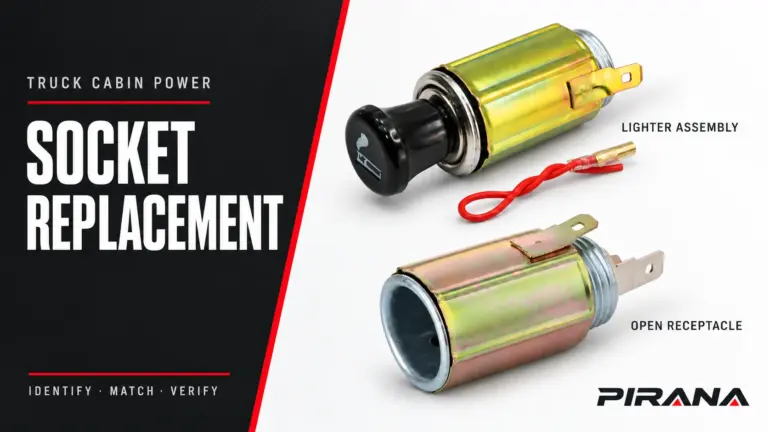
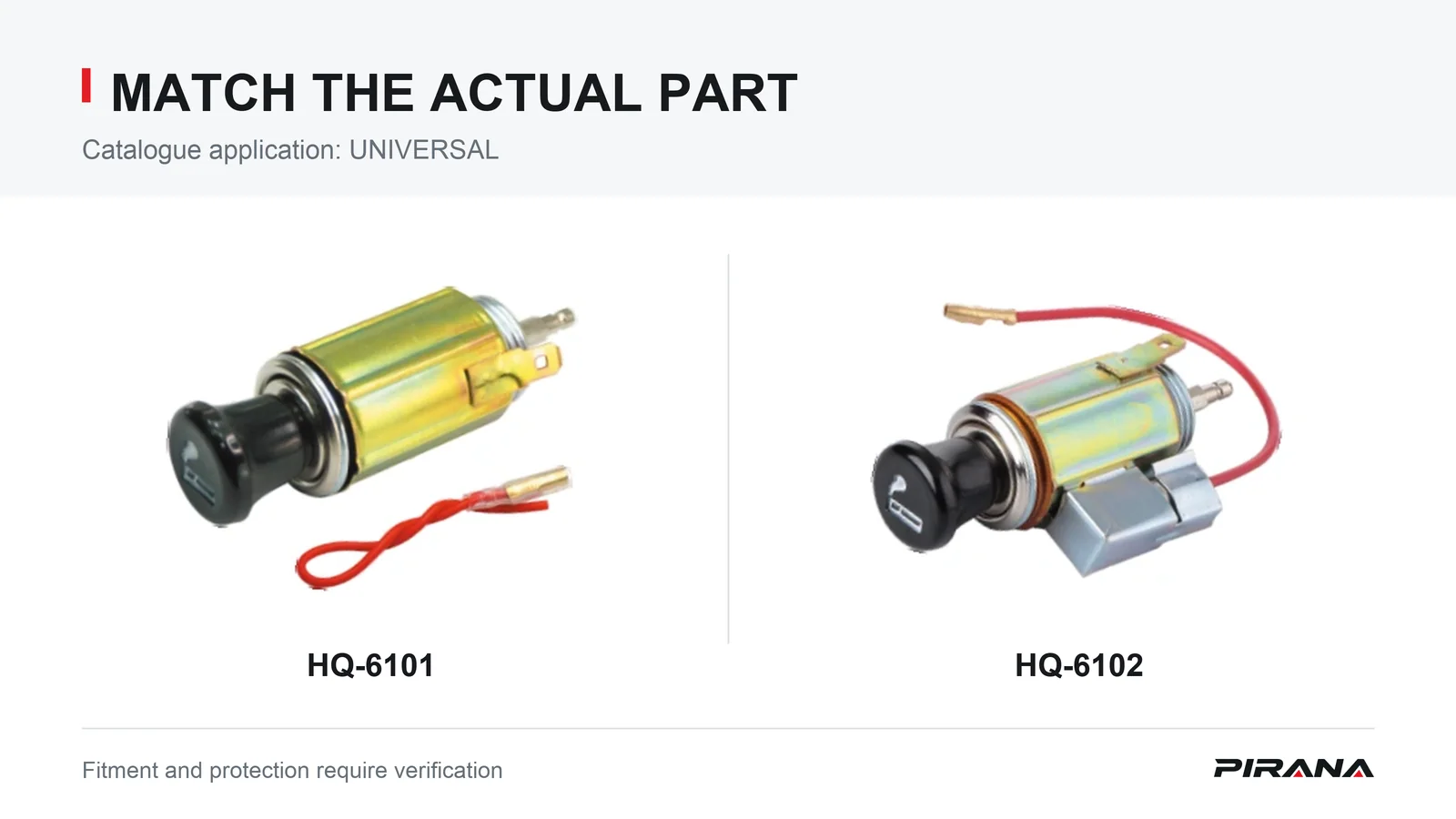
Once testing localizes the fault to the socket or confirms failed integral protection, match the replacement to the physical original and its OE reference if one is available. PIRANA’s Auto Cigarette Lighter category includes HQ-6101, whose catalogue application is “UNIVERSAL”. That declaration is not proof of compatibility with every vehicle, mounting, connector or plug. Its listing does not establish a fusible link, thermal protector or electrical rating. Confirm the actual part and catalogue record before selection; use the replacement guide for the subsequent workflow.
FAQ
The fuse looks fine – can it still be the fuse?
Yes. Visual appearance does not establish electrical performance. Have the correct fuse checked on both sides in the required vehicle operating state. A clock or another shared-circuit item working is configuration-specific evidence, not a universal substitute. If the fuse is electrically verified good, investigate socket-local protection where fitted, loaded contacts, and rear feed and ground rather than repeatedly replacing the fuse.
Where is the fusible link on a cigarette lighter socket?
On designs that have one, it is at the rear of the socket as part of the socket assembly, not visible through the front opening. Other designs use thermal protection, and construction varies by manufacturer and year. Identify the actual assembly before assuming protection is present. A front photograph cannot establish its presence or condition.
My socket shows 12 volts but the lighter will not heat up – why?
An unloaded voltage reading does not prove the circuit can support the heating element. Corrosion or excessive resistance at contacts, the rear feed or the ground can cause voltage to fall under load. A faulty or incompatible heating insert is another possibility. Vehicle-appropriate loaded voltage and voltage-drop checks are needed to locate the restriction; the reading alone does not condemn the socket.
Can I just bypass the fusible link to get it working again?
No. Bypassing socket-local protection defeats a safeguard. Where the socket is rated below the supplying circuit, the upstream fuse may not open before the socket overheats. Replace the assembly when its integral, non-serviceable protection is confirmed failed, and resolve the condition that caused the failure. Restored operation after removing protection is not a completed repair.
What usually kills the socket’s own protection?
A heating insert that stays engaged or sustained overload can activate local protection where fitted. Ask about prolonged refrigerator, inverter or electric-heater use, including duration. These are relevant histories, not proof that every such accessory overloads every socket. Confirm the socket design and fault, and assess the intended accessory duty before fitting another assembly.
Sources
Forum discussions are literature examples of complaints and field experience, not universal specifications or service instructions.
- IH8MUD: Cigarette Lighter Not Working? – rear fusible-link discussion and design-specific protection rationale.
- IH8MUD: Cigarette Lighter Isn’t Working (But Gets Power) – loaded-contact questions, rear connection, ground-configuration distinction and uncertain final cause.
- MotorsForum: My cigarette lighter / plug is not working, any help?? – rear-link and sustained-load discussion.
- Hilux Surf: Cig lighter not working – it’s not the fuse – accessory-use histories.
- Fiat Grande Punto: Cigar lighter/current socket not working – factory diagnostic text, rehosted by Workshop Manuals; thermal-protection and replacement direction for that design.
- Fluke: Diagnosing voltage drop – Electrical automotive troubleshooting – qualitative supply-side and ground-side resistance principles.
- PIRANA: Auto Cigarette Lighter category; HQ-6101 catalogue record; Truck Cigarette Lighter Socket Replacement Guide. Internal links appear at their relevant decisions in the article.