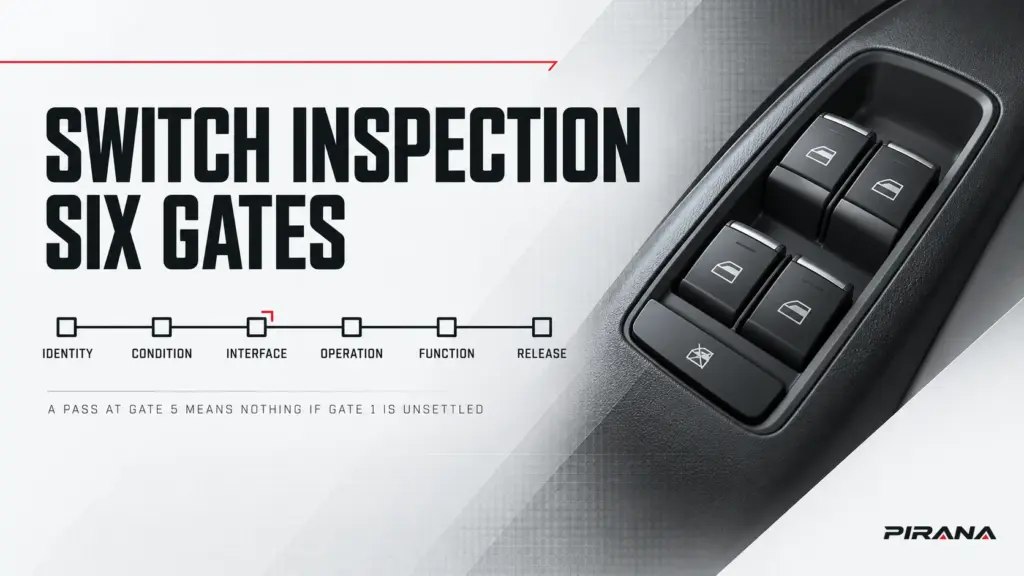
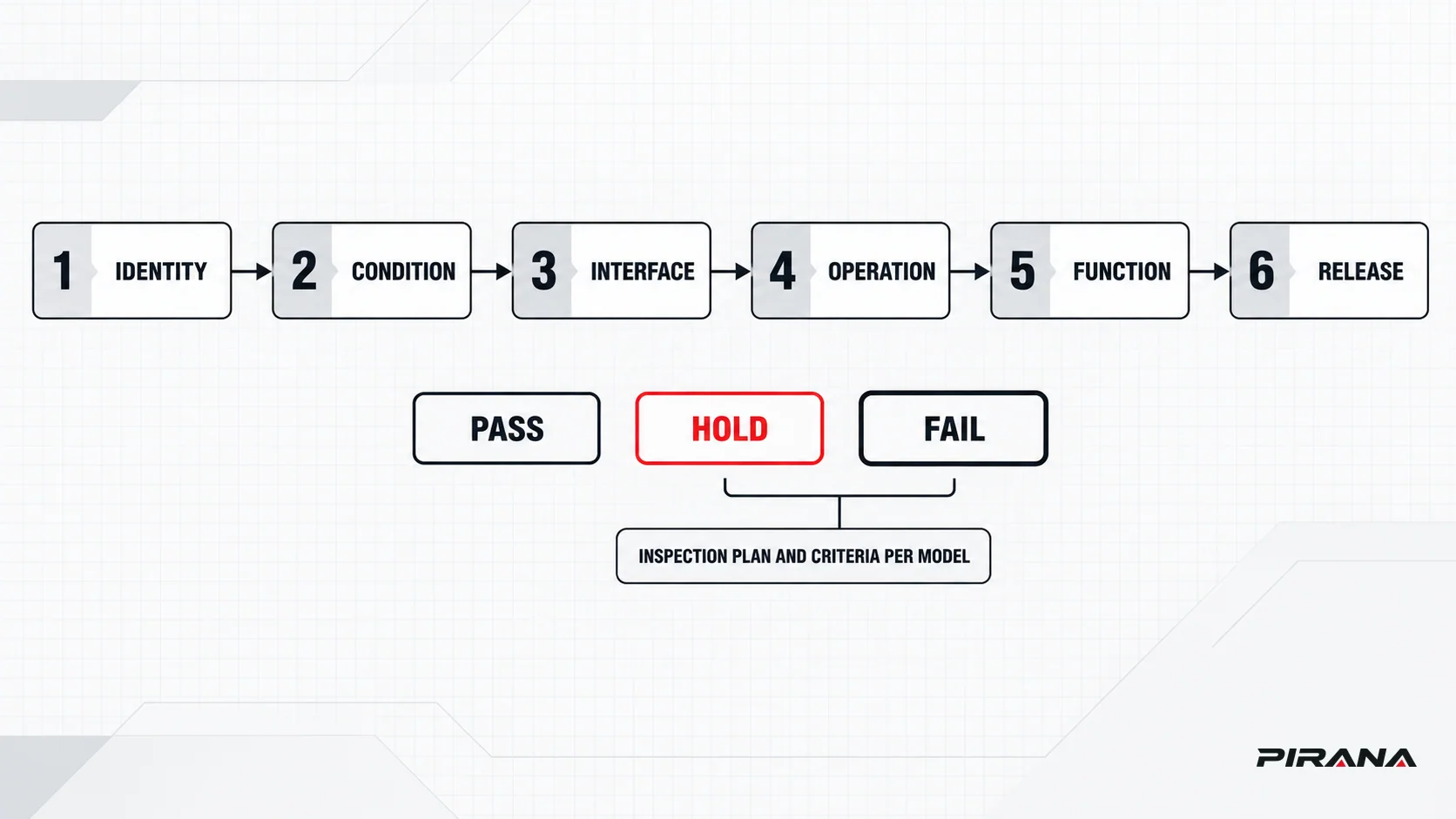
Inspect a power window switch sample or incoming lot in six ordered gates: identity, physical condition, interface, operation, required function and order-release records. Write a result against each gate before you touch the next one. A switch can operate perfectly and still be the wrong part for the vehicle, which is why PIRANA’s own quality guidance puts identity before performance: confirm the OE reference, switch position, connector layout, pin configuration and application before approving a replacement. PIRANA: Power Window Switch Quality Control.
The order matters more than the list. Gate 1 fixes the reference the remaining five gates measure against; inspecting function first produces a result you cannot attach to any approved configuration. This page gives you the sequence, the stop conditions, a record you can reuse, and — just as important — the boundary between what an inspection proves and what a controlled document, a certificate or a catalogue entry has to prove.
It does not publish acceptance numbers. Test methods, limits and records belong to the specific model and program: PIRANA states that its final inspection plan is agreed for the exact part and destination market rather than claimed as universal for every switch. Where a gate needs a numeric criterion, the record names the document that supplies it.
Three inputs before the first checkpoint
An inspection without these inputs produces observations, not a release decision.
| Input | What it must contain | If it is missing |
|---|---|---|
| Approved reference | PIRANA part number, the complete OE reference as copied from the original part or approved record, and the revision or version that sample approval locked | Stop at Gate 1. A part number alone cannot tell you which version you are measuring |
| Agreed inspection plan | The method, sample basis and criteria applicable to this model, and who signs the result | Record the gate as hold — criteria not defined and request the model document |
| Traceable article | Purchase order or program number, batch or shipment identity, and the sample or approval record this article is linked to | Without traceability, a pass cannot be reused for the next order |
The same three inputs are what make a repeat order manageable. PIRANA’s manufacturing route describes production as reference confirmation, component preparation, assembly with agreed checks, then order release, and advises keeping the product number, OE cross-reference, approved sample and packaging version together — reviewing them if any one element changes before the next order. PIRANA: Power Window Switch Manufacturing.
Gate 1 — Identity and reference
Compare the article to the approved reference, not to a memory of the last order.
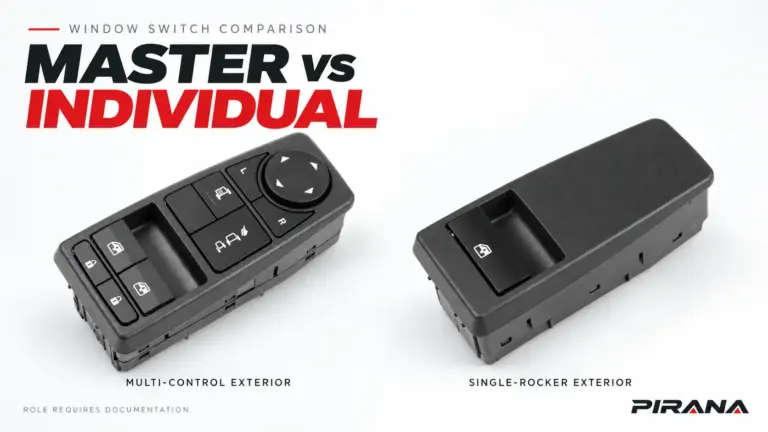
Check the moulded or label markings that identify the part, the complete OE reference, and the configuration the order names: vehicle make and series or platform, left- or right-hand drive, physical left or right side, front or rear door, and whether the assembly is a master control or an individual one. Record each field with what you physically saw.
Expected result: every identifier on the article matches the approved reference, or the difference is explained by a documented relationship.
Stop and hold when: a marking is absent, illegible, or differs from the approved record; the position or control role cannot be established; or the OE reference on the part and on the paperwork disagree.
One number group is not one relationship. A single PIRANA record may display several references — HQ-6918B shows 81258067093 and 81258067108 — and the catalogue states plainly that its application information is a reference, not a guarantee of fitment, and that listed related products are not confirmed substitutes. Record which reference the article actually carries and treat the others as unverified until a controlled document says otherwise.
Gate 2 — Physical condition and construction
Now look at the article as a manufactured object.
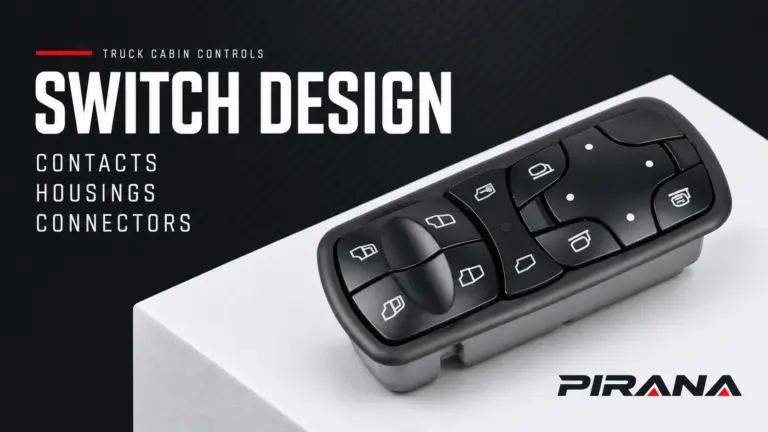
- Housing: cracks, incomplete fills, warped mounting bosses, flash on mating faces, discolouration or surface texture that differs from the approved sample.
- Terminals: presence, straightness, corrosion or heat discolouration, and whether any terminal sits short of its designed depth in its cavity.
- Controls: button and rocker fit, colour and legend against the approved artwork, nothing loose or rattling inside the assembly.
- Consistency: compare against the approved sample under the same light and at the same distance, not against a phone photograph taken weeks earlier.
Expected result: the article matches the approved sample on visible construction and finish, with documented differences only where the approved record allows them.
Stop and hold when: any visible difference changes how the part fits, connects or is identified. Cosmetic variance that the approved sample already contains is a note, not a hold.
Gate 3 — Interface: connector, mounting and harness side
This is where a switch that passes every other gate still fails in the field, and it is the gate buyers most often shorten by photographing the front of the part.
Compare the rear of the original and the candidate in the same orientation, using a visible feature such as a latch as the orientation reference. Record:
- Connector quantity, housing outline, keying and latch position.
- Total cavities and populated contacts — separately. A moulded opening often offers more positions than the number of terminals actually fitted.
- Terminal retention: where the connector design permits it, does each terminal hold under light axial pressure on the wire, and are the locking features fully engaged?
- Mounting clips, locating features and housing shape against the approved record.
The harness side belongs in this gate. A Subaru technician’s report from the August 2018 TechTIPS newsletter describes an inoperative rear window where the individual terminal anchors held, but the connector body allowed every terminal to back away from its pin in the master switch, because a secondary lock around the harness side of the connector was partially dislocated. Relatching the connector restored operation and the switch was not the fault. Subaru TechTIPS, August 2018, page 1.
Expected result: the mating interface is complete, correctly locked and consistent with the approved record on both the part and the harness side.
Stop and hold when: a latch is broken or absent, a terminal is displaced or recessed, or keying differs. Equal cavity count or a similar plug outline is a reason to keep checking, never a pass.
This gate stays visual and mechanical. Do not probe, jumper or bridge terminals to satisfy it. Pin assignments, circuit behaviour and any test setup come from the applicable vehicle or product documentation, not from an inspection bench.
Gate 4 — Operation
Work the controls as the vehicle would.
Press each button through its full travel and release it. Cycle the rocker or toggle. Check that each control returns, seats and stays in position, and that legends stay readable and aligned. Where the assembly integrates window-lock, door-lock or mirror controls, actuate those too and note whether the mechanism engages.
Expected result: each control moves its designed way, returns or latches as specified, and feels consistent with the approved sample.
Stop and hold when: a control sticks, stays down, passes without resistance, makes an unexpected sound inside the housing, or returns differently from the approved sample.
Operation establishes mechanism behaviour only. It says nothing about whether the correct circuit closes, and it is not evidence about durability: without the model’s endurance report — the SKU or series, sample revision, cycle and load conditions, procedure, pass criteria, result and date — an inspection cannot support any service-life claim.
Gate 5 — Required function against the order definition
Write the function list the order requires before you test anything: which windows the assembly controls, whether it is master or individual, which integrated controls must work, whether illumination is expected, and whether automatic up/down, one-touch or anti-pinch behaviour is part of the requirement.
Then test only what you can honestly test at this stage. A switch in a purchase-office sample box usually cannot demonstrate vehicle function, and pretending otherwise creates a false record. Where function must be confirmed in the vehicle, use the applicable replacement and post-installation checks, which are owned by the truck power window switch replacement checklist.
Two boundaries matter here.
Architecture: not every switch drives a motor directly. Mitsubishi’s April 2021 service-manual update for the 2022 Outlander describes a system in which the front and rear window motors, the power window main switch and the body control module transmit and receive signals over LIN, with motor-integrated electronics handling anti-pinch and fail-safe behaviour. Mitsubishi TSB-21-42A-002, page 3. In that architecture a switch may look correct, connect cleanly and move its contacts while the vehicle still does not perform the required function.
Initialisation: losing automatic behaviour is not proof of a defective switch. Subaru’s service information 07-93-15 (23 July 2015, for 2015 and later Legacy and Outback models with the auto up/down feature) states that the AUTO function is disabled whenever the vehicle battery is disconnected, that testing of returned switch assemblies showed the vast majority were not failed as claimed, and that the model’s initialization procedure for both front switches must be completed before replacing any switch assembly. Subaru Service Information 07-93-15.
That sequence is a Subaru-specific example, not a universal reset. Do not generalise it to a truck or another model: use the initialization steps from the applicable vehicle information and record which document you used.
Expected result: each required function is either demonstrated, held for vehicle verification with a named method, or excluded by the order definition.
Stop and hold when: a required function cannot be demonstrated or scheduled with a defined method, or when the only available evidence is a similar-looking part that happens to work on one vehicle.
Gate 6 — Order-release records
The last gate is paperwork, and it is a real inspection gate.
Verify the part marking and label content against the approved version, barcode or code readability, pack quantity and accessory list, inner box and export carton condition and markings, and the destination market stated on the order. Confirm that the record you are signing points back to the same reference used for sample approval, so the next order can be matched rather than re-litigated.
Artwork, label content and packaging versions have their own approval sequence, which is the subject of the private-label truck switch OEM and packaging checklist. Gate 6 checks the shipment against an already-approved record; it does not approve a new one.
Expected result: what arrives matches what was approved, and the approved combination is documented.
Stop and hold when: label or marking version cannot be tied to the approved record, quantities or contents differ, or the destination market introduces a document requirement nobody has checked.
Recording the result: pass, hold or fail
| Result | Use it when | What happens next |
|---|---|---|
| Pass | The article matches the approved reference and the applicable criteria, with evidence recorded | The gate contributes to a release decision for that recorded configuration |
| Hold | A decisive field cannot be established, or criteria for this model are not defined | Request the model document and re-inspect; the sample stays quarantined |
| Fail | The article conflicts with the approved reference or an agreed criterion | Quarantine, photograph, keep the article, and open a corrective query with the identity record |
Copy the record below into your incoming-inspection or supplier file. Write unknown rather than leaving a field blank: a named unknown is an actionable check, a blank is a rumour.
Inspection date / inspector:
PIRANA part number and revision:
Complete OE reference as marked on the article:
Vehicle make, series/platform, market, position and control role:
Order / program and batch or shipment identity:
Approved sample or reference record used (document ID and version):
Inspection plan or criteria applied (document ID and version):
Gate 1 Identity — result / evidence / unresolved:
Gate 2 Physical condition — result / evidence / unresolved:
Gate 3 Interface and harness side — result / evidence / unresolved:
Gate 4 Operation — result / evidence / unresolved:
Gate 5 Required function — result / evidence / unresolved:
Gate 6 Order-release records — result / evidence / unresolved:
Overall: RELEASE / HOLD / FAIL
Gate that decided the result:
Documents still required:
Next review date or order this record supports:
What this record does not prove
Buyers routinely load an inspection sheet into a supplier file as though it were product validation. Four different kinds of evidence answer four different questions.
| Evidence | What it establishes | What it never establishes |
|---|---|---|
| Your completed inspection record | This sample or lot matches the reference and criteria you recorded, on the date recorded | That the part fits any specific truck, or that other lots behave the same |
| A controlled model document (datasheet, drawing, test report) | The stated property for the named model, revision, method and conditions, if the document reports it | Applicability to a different OE reference, revision or destination market |
| A quality-management certificate | The certified organisation, site and scope of a management system, within its validity dates | Product certification, that a specific switch passed a test, or confirmation of process capability |
| Catalogue or application data exchange | How fitment and product information are formatted and communicated between trading partners | Which vehicles the manufacturer’s own product actually fits |
On the certificate question, IATF is explicit about its own scope. Its Rules 6th Edition questions-and-answers document states that IATF 16949 certification is a quality management system certification and is “neither a product or a manufacturing process certification, nor is it a confirmation of process capabilities.” IATF Rules 6th Edition Q&A, page 185. Verify the named legal entity, site, scope and validity before placing any certificate in a product approval file.
On data standards, the Auto Care Association’s own ACES and PIES FAQ answers the question directly: “Will ACES or the VCdb tell me what vehicles and equipment my products fit? No.” ACES communicates fitment data between trading partners; the application data itself must be researched, created or acquired. Auto Care Association: ACES and PIES FAQ. Treat a data-exchange format as a delivery capability, never as hardware evidence.
PIRANA applies the same discipline to its own documents: the certifications route states that model number, document holder, test scope and dates all matter, that a document for one switch does not automatically cover another OE reference or destination market, and that no universal certificates are posted. PIRANA: Certificates & Compliance Documents.
Checkpoints that shift by switch family
Six gates stay the same; the decisive field inside a gate changes.
| Switch family | Gate where the check changes | What to add to that gate |
|---|---|---|
| Power window switch | Gate 3 and Gate 5 | Connector and terminal retention on both sides, plus the function list including integrated lock, mirror and illumination controls |
| Headlight switch | Gate 5 | Position sequence and lighting-function review against the vehicle’s required positions rather than window control |
| Battery switch | Gate 1 and Gate 5 | An agreed isolation duty and application scope for the specific product, since vehicle battery isolation is not an industrial disconnect specification |
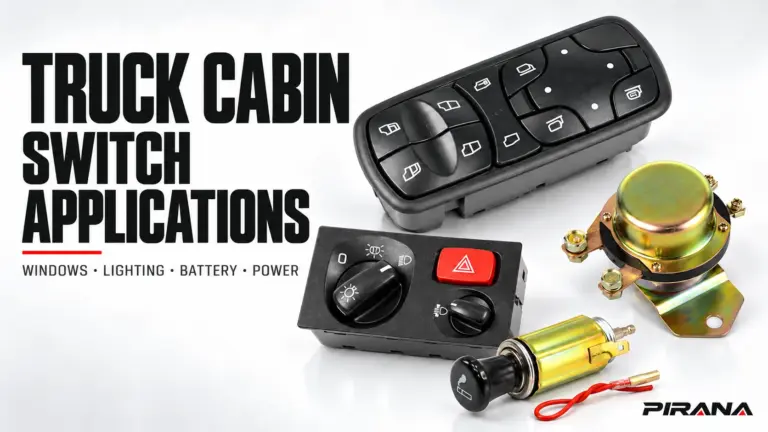
If you are checking a headlight or battery switch against the same record structure, keep its own product page open, and do not carry window-switch criteria across: headlight switches and battery switches are separate product families with different function questions.
Get the criteria for the model you are inspecting
If Gate 2, 4 or 5 keeps landing on hold — criteria not defined, the gap is the model document, not your procedure. Request it with the inputs PIRANA asks for: the OE number or PIRANA part reference, truck make, model and switch position, the document type and intended use, and the destination market plus any required standard. Product catalogue, model-specific datasheet, drawing or image set are the files buyers commonly request, and availability depends on the model and market. PIRANA: Request Catalogs & Datasheets.
Before that, make sure the reference itself is settled. The OE-number and connector identification guide covers reading the markings, and the brand and configuration selection guide covers the vehicle fields a gate-1 record needs. Both feed the identity block above; neither replaces the inspection.
To compare candidate parts against your approved sample, browse the power window switch catalogue and send the complete reference with front, rear and connector photographs to the quotation route so a matching review can start from the same evidence.
References
- PIRANA, Power Window Switch Quality Control, accessed 22 October 2026.
- PIRANA, Power Window Switch Manufacturing, accessed 22 October 2026.
- PIRANA, Certificates & Compliance Documents, accessed 22 October 2026.
- PIRANA, Request Catalogs & Datasheets, accessed 22 October 2026.
- PIRANA, HQ-6918B / OE 81258067093 product record, accessed 22 October 2026.
- IATF, Rules for Achieving and Maintaining IATF Recognition — Sixth Edition, Questions and Answers, 31 July 2024, page 185.
- Subaru of America, Service Information 07-93-15: Unnecessary Power Window Switch Replacements, 23 July 2015.
- Subaru of America, August 2018 TechTIPS newsletter, QMR of the Month, page 1.
- Mitsubishi Motors North America, TSB-21-42A-002: Updates to 2022 Outlander Power Window Control System, April 2021, page 3.
- Auto Care Association, Frequently Asked Questions: ACES and PIES data standards, accessed 22 October 2026.
REFERENCED IN THIS GUIDE
Products mentioned in this article
These published catalogue references are included because they are discussed in this guide. A reference is a starting point for identification; confirm the exact OE number, connector and vehicle configuration before ordering.
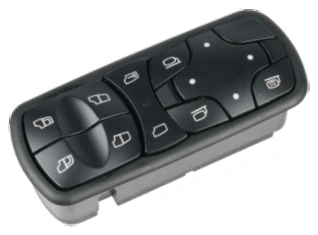
Power Window Switches
Power Window Switch — OE A9438200097
PIRANA Part No. HQ-6901 · OE: A9438200097
View product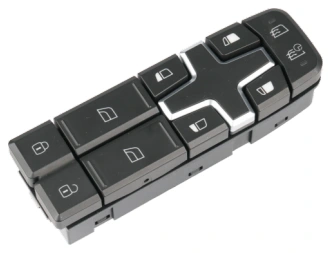
Power Window Switches
Power Window Switch — OE 22154285 / 22154235
PIRANA Part No. HQ-6913 · OE: 22154285 22154235
View product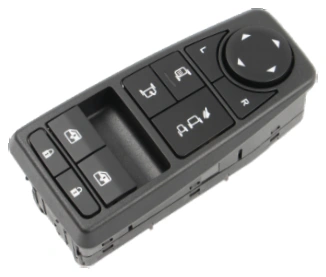
Power Window Switches
Power Window Switch — OE 81258067107 / 81258067092
PIRANA Part No. HQ-6918 · OE: 81258067107 81258067092
View product