By James
If all power windows stopped working at once and neither the master nor the individual door switches can move them, start with the circuit they share. Check the protection device, the incoming feed at the master switch, the master ground, the door jamb harness, and finally the master switch itself, in that order. Several separate motors or regulators failing at the same instant would be a poor starting assumption.
Use the wiring diagram and operating conditions for the actual vehicle. The order below prioritizes points that can affect the whole group. Each check tells you where to look next, and the master assembly enters parts review only after the required inputs and expected output have been verified.
Read the pattern first
Confirm which windows normally respond to which controls and whether the vehicle is in the state that permits basic window movement. Check the documented window lock setting as part of that comparison. The pattern for this guide is a group that previously worked and then became unresponsive from every applicable control, including the master. A failure noticed on the same day is weaker evidence than several windows actually stopping during the same event.
| What you observe | Where to take the diagnosis |
|---|---|
| Every window stops together and no applicable switch responds | Follow the shared protection, feed, ground and harness checks below before considering the master. |
| One window is dead while others still move | Follow the affected branch using the window switch diagnosis checklist. |
| A window responds only to the master or only to its own door control | Compare the documented roles of the two control points in the master vs individual window switch guide. |
| A window or control responds intermittently without a confirmed group outage | Route the observation through the power window switch symptom guide. |
If the whole group repeatedly drops out and recovers together, keep following the shared path. What was happening just before it stopped, such as the same window being commanded or the driver door moving during ordinary use, can distinguish which part of that path deserves attention.
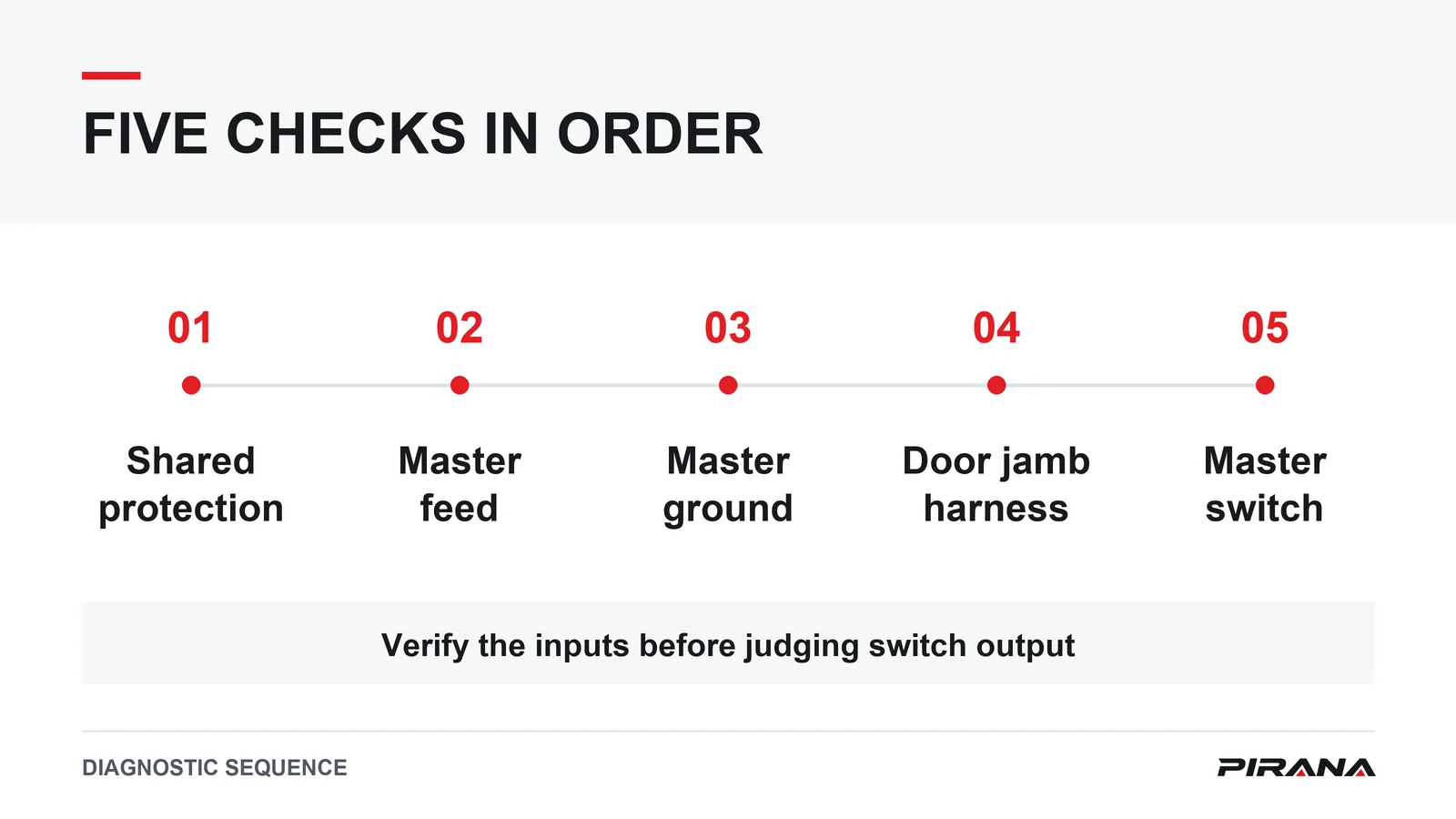
Check 1 – the protection may not be a fuse
Find out what protects the window circuit on the actual vehicle before drawing a conclusion from the fuse panel. Some vehicles use a circuit breaker for this circuit. The factory description for one Jeep Cherokee configuration shows the window system receiving power through a breaker in the junction block under the documented ignition conditions. The vehicle’s own information determines the device and operating state to verify. Jeep power window system description
A NAXJA owner reported that all four windows stopped while going down, briefly moved again, and were then stuck low. The owner could not identify a corresponding fuse. A reply identified a breaker for that application and suggested the master feed or ground if the loss affected every switch. The thread records a diagnostic suggestion and the observed interruption. It leaves the cause of the outage unresolved. NAXJA field case
When the fault is present, have the shared protection checked for supply on its input and output sides using the vehicle procedure. Supply entering the device and failing to leave it points to the device or its operation. If the input is also unpowered when it should be live, the investigation moves farther upstream. If supply is available at the output, the next question is whether it reaches the master connector. An intact fuse element alone cannot answer that question.
The reset design matters. A thermal breaker designed to reset automatically can open on overload and close again after it cools. Some window circuit breakers use a different reset behavior tied to removing power. Check the actual device before interpreting the timing. If a confirmed cycling breaker opens as the windows stop and resets as they return, the next job is to find what is making it open. Littelfuse circuit breaker reset types
A stalled window motor on a branch can draw enough current to operate a device shared by the group. Every window on that protected supply can then lose power, even if only one branch initiated the overload. If the interruption tends to follow a command to the same window, tell the technician which command preceded it. The branch still needs verification. A restored window after a reset only tells you that operation returned.
Check 2 – is power actually reaching the master switch?
Have the incoming supply voltage measured at the master switch connector in the operating state specified by the vehicle’s service information. The diagram identifies the correct feed, and the service procedure determines how to verify it. A check upstream tells you what happened at that point. The connector check tells you whether the feed made it to the assembly you are evaluating.
The owner of a 1998 Explorer XLT reported no movement from the driver control or any of the three local switches. Fuse checks and relay swaps did not restore operation. The owner then reported that the incoming master feed was unpowered while the system was supposed to be enabled. That observation shifted the investigation upstream of the switch. It did not identify which upstream part or connection caused the loss. ExplorerForum field case
If voltage is absent where the documented feed should be live, trace the supply back toward its protection and the intervening connections. If the required feed is present, check the ground under the same conditions. Where the failure is intermittent, a reading taken after the windows recover only describes the circuit in its working state. The most useful evidence is a result taken while the symptom is present and under the conditions the service procedure calls for.
Check 3 – the master ground
A shared feed and a shared return have the same diagnostic priority. The master can have voltage available at its input and still fail to operate if the ground path it needs is open or unable to carry the load. Ask for the documented ground check as well as the feed check. A reading against a convenient body reference does not by itself verify the actual return used by the assembly.
On vehicles whose local controls depend on the master circuit, the local switches can go dead along with the driver controls when the master is disconnected or loses a required feed or ground. This makes an all-controls outage consistent with a master circuit problem. The switches may be different control points without having independent electrical paths.
In an IH8MUD discussion, an FJ62 owner reported that the windows had stopped responding even from their own switches after damage to the master controls. A reply stated, “None of the windows will work without the master switch.” Use that observation for systems whose diagrams show the same dependency. The discussion did not verify a final repair or establish that all vehicles share that layout. IH8MUD field case
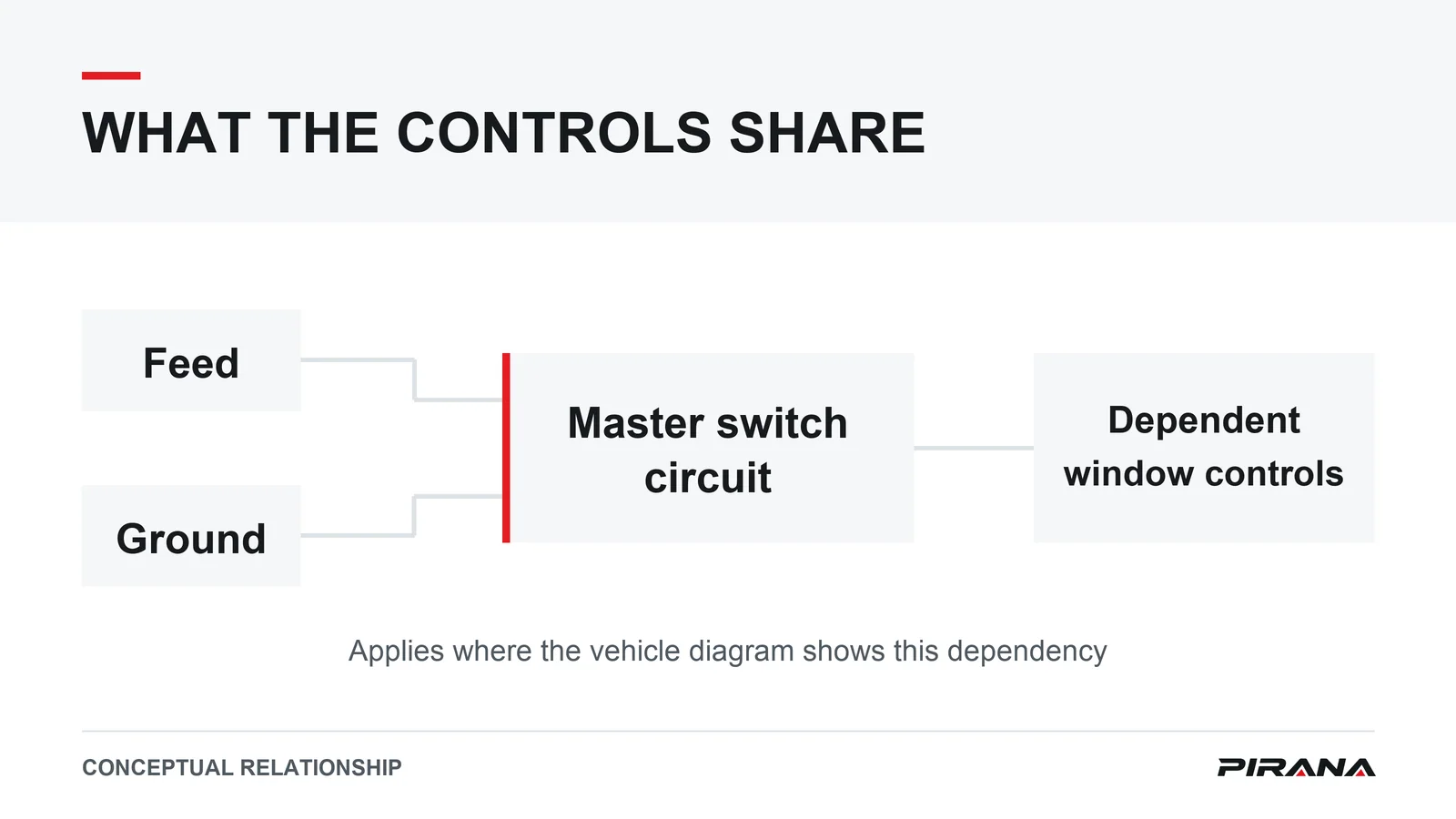
Check 4 – the door jamb harness
On a vehicle with a door mounted master, the harness crosses a moving joint between the body and door. The wires in the flexible boot bend during ordinary opening and closing. Repeated bending can damage strands inside a conductor, including under insulation that still looks intact. If the affected conductor serves a shared feed or ground, one break there can interrupt the group.
A change as the driver door opens or closes in normal use is a clue to that moving span. Record whether the group loses or regains operation at a particular door position. Have the relevant harness and connections visually inspected and the indicated conductors checked for continuity by the vehicle procedure. A normal looking boot or a working reading at one stationary position cannot settle an intermittent connection complaint.
Toyota documented an inoperative window associated with a broken wire in a harness connecting a master switch to a body controller. The investigation on that vehicle involved installation and corrosion factors. It illustrates why a broken door harness conductor belongs in the diagnosis, while the cause and which controls are affected still depend on the actual harness and circuit. Toyota door harness investigation
Only now the master switch itself
Consider the assembly when its required incoming power and ground pass the specified checks during the fault and its expected output is missing. First establish what output the vehicle calls for and under which conditions. The service information distinguishes the switch’s role from any downstream control path. A missing output with sound inputs points toward the assembly and warrants the documented confirmation.
That decision changes where the repair goes. A loss at the feed or ground remains a circuit problem to resolve at the verified location. When the service checks isolate the switch itself, use the actual part and its recorded OE reference to select a candidate, then follow the replacement review for the vehicle. OE identification guide and replacement checklist.
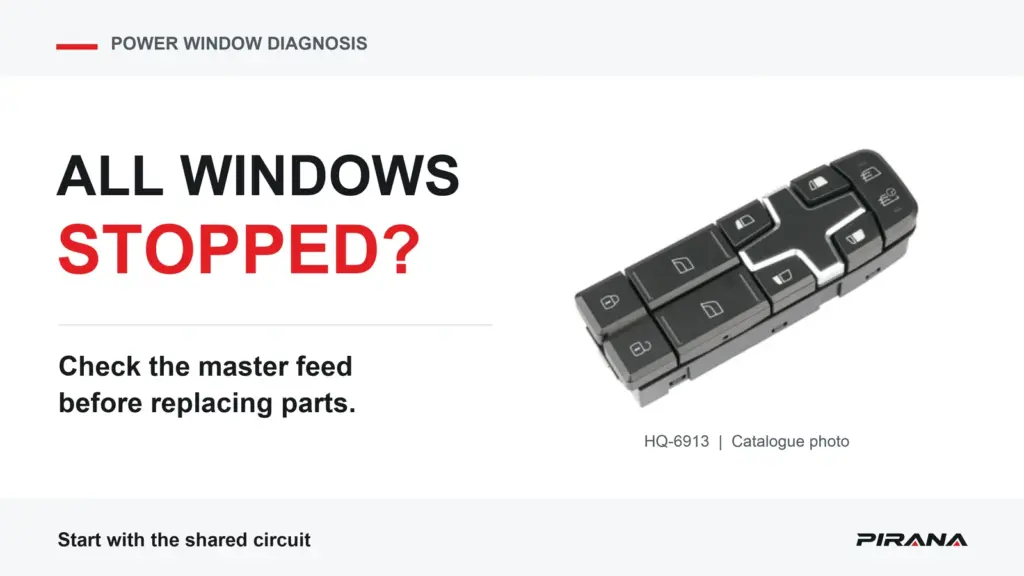
PIRANA lists model HQ-6913, application VOLVO FH1996-2013/FM, and OE references 22154285 / 22154235. Match the original part identification and the current catalogue record for the specific vehicle. Power Window Switch catalogue and HQ-6913 product record.
What not to do
- Do not start by replacing motors or regulators. The first task in a simultaneous outage is to verify the path the affected windows share. Individual motor or mechanism evidence belongs in the component comparison. Power window motor vs regulator vs switch.
- Do not jumper around a fuse or circuit breaker to keep using the windows. Doing so defeats the protection of the shared circuit.
- Do not keep relying on a breaker to reset. Repeated operation of the protection calls for locating the cause, including any branch that is drawing excessive current when commanded.
FAQ
All my power windows stopped working at once – is it a fuse?
It could be the shared protection. Check the vehicle information to see whether the window circuit uses a fuse or a circuit breaker, and verify the specified device in the correct operating state. Then check the incoming feed at the master switch connector. A good device at the panel leaves the connection between that point and the master to be verified.
The windows died, then worked again an hour later – what does that mean?
If the circuit has a confirmed self-resetting thermal breaker, recovery can fit the breaker cooling and closing again. Timing alone cannot show what opened the circuit. Verify whether the breaker operated, then locate any downstream overload. A recurring loss that changes with door movement also warrants a check of the harness and connections.
Can one bad window motor make all the windows stop?
Yes, indirectly, if that branch shares protection with the rest of the group. A stalled motor can increase current enough for the shared protective device to open. If the group goes dead when the same window is commanded, that is a direction for checking the branch. It does not establish a failed motor without finding the source of the overload.
If every switch including the master is dead, is the master switch bad?
A loss of the master circuit’s feed or ground can cause the same symptom where the other controls depend on it. Verify shared protection, the feed and ground at the connector, and the relevant door jamb harness. Missing expected output with the required inputs confirmed during the failure is the condition that points toward the master assembly.
Why would the wiring in the door jamb break before anything else?
The driver door harness bends at the same moving span every time the door is opened or closed. Conductors there can lose strands or break while the outside still looks intact. A change in the symptom during normal door movement makes the moving harness a sensible check. Inspection and continuity verification of the relevant path establish whether it explains the loss.
Sources
The forum threads document reported cases. Use the vehicle’s own service information for circuit configuration and testing.
- NAXJA, simultaneous interruption and a breaker suggestion for the reported application. Power windows failure
- ExplorerForum, failed controls and a reported missing supply at the master. ’98 Explorer XLT power windows stopped working
- IH8MUD, local controls and master circuit dependency in the FJ62 discussion. window problem
- Jeep factory service description, rehosted by CHARM. Power window system operation
- Littelfuse, automatic and modified reset behavior. Aftermarket Circuit Breakers
- Toyota, vehicle specific door harness investigation. Defect chronology, page 2
- PIRANA Power Window Switch catalogue and HQ-6913 product record, linked in the part review section.