By James
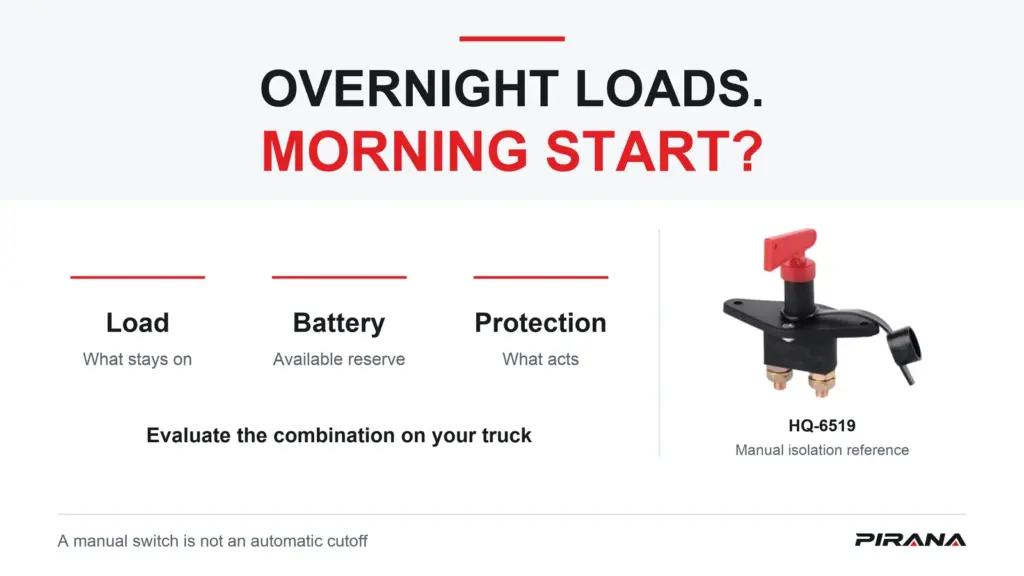
It can be possible, but an overnight run needs enough battery reserve left for the morning start. The answer depends on the total load you leave on, the condition of the battery bank, and the protection actually fitted. An inverter being able to power a refrigerator does not establish that the starting batteries can support it all night.
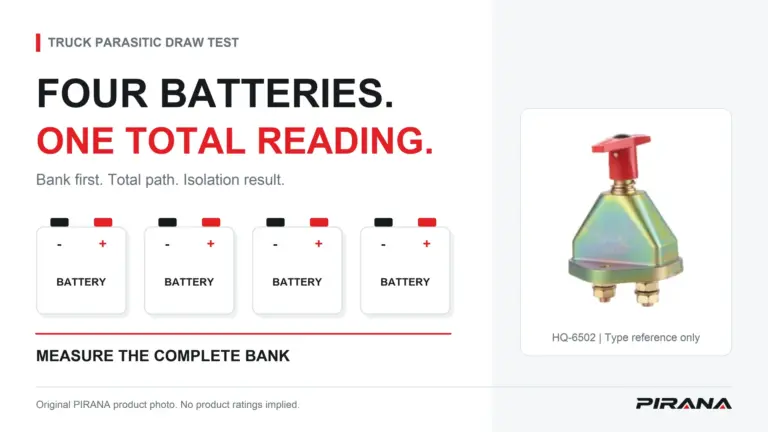
If you are worried about an inverter draining truck batteries overnight, first separate intentional use from unwanted consumption. The four-battery parasitic-draw guide covers draw that remains when the truck should be shut down. This article covers the inverter and sleeper appliances you deliberately leave running. Their consumption belongs in the overnight plan, even when nothing is broken.
What is actually drawing all night
Start with the whole sleeper load, including the inverter itself. An inverter left on can consume battery energy with no appliance plugged in. Its operating mode matters, too. A model’s normal idle behavior and any energy-saving mode need to be checked in its manual. Manufacturer specifications list no-load consumption separately from appliance output, so an empty outlet is not evidence that the battery feed is inactive. Victron no-load specifications
That background load continues alongside whatever the refrigerator uses. Identify the cooling type before borrowing another driver’s experience. A compressor refrigerator normally cycles according to cooling demand. Its overnight use depends on how often and how long the compressor runs. A hot sleeper can increase that running time.
A basic thermoelectric cooler can behave as a continuous load while it is switched on. It should not be assigned the off periods of a thermostatically cycling compressor refrigerator. The actual appliance controls still govern. Dometic’s hybrid-cooler manual, for example, distinguishes compressor thermostat operation from a thermoelectric mode in which that thermostat has no function. That is a documented example of why the operating mode matters, not approval to leave any cooler running unattended. Dometic cooler operating manual
| Load to account for | Continuous or intermittent? | What to establish for your night |
|---|---|---|
| Inverter with no appliance drawing output | Background consumption while on; mode dependent | The fitted model’s idle or energy-saving behavior |
| Compressor refrigerator | Normally cycles with cooling demand | How warm the sleeper is and how much the compressor runs |
| Basic thermoelectric cooler | Can draw continuously while cooling | The actual cooler type and control mode |
| Parking heater or air-conditioning controls | Depends on the fitted system and operating state | Which electrical functions remain enabled |
| Chargers and monitoring equipment | Depends on whether each device remains active | Which loads stay supplied throughout parking |
Include direct battery-fed sleeper devices as well as those powered through the inverter. Otherwise, switching the inverter off may remove less of the total overnight demand than expected. A complete list lets you identify which loads are optional and which need a different supply arrangement.
The original TruckersReport overnight question came from a driver spending a first night in the truck with a refrigerator running and fresh batteries. Replies described differing temperature, battery and equipment conditions. Those accounts explain why another driver’s successful night is useful context, but not a duration promise for your truck. Overnight battery life and mini fridge?
The battery side of the bargain
Count alone does not establish usable reserve. For otherwise comparable batteries in the same intended bank configuration, a larger healthy bank can provide more margin. But three sound batteries and four batteries containing a weak unit are not a comparison that can be settled by counting cases. Confirm the actual bank arrangement and condition rather than treating every fitted battery as equally available capacity.
A weak member in a parallel bank can reduce the usable reserve and affect the group. Battery health therefore belongs in an overnight-use decision as well as a no-load drain investigation. The parasitic-draw guide linked at the start separates battery condition from external consumption. Its battery-assessment method stays there; the consequence here is that the planned load needs to be judged against the bank you actually have.
Temperature changes that margin. Cold reduces available capacity in lead-acid batteries and makes preserving starting reserve more important. A cooler sleeper may reduce compressor running time, but that does not make the battery-side temperature effect disappear. The two sides of the overnight decision can move in different directions. Trojan battery temperature guidance
Treat a change in battery health, bank configuration or weather as a reason to review an earlier successful routine. Past starts show what happened under those conditions. They do not establish an unchanged reserve for every subsequent night.
Three ways to protect the start, and what each one cannot do
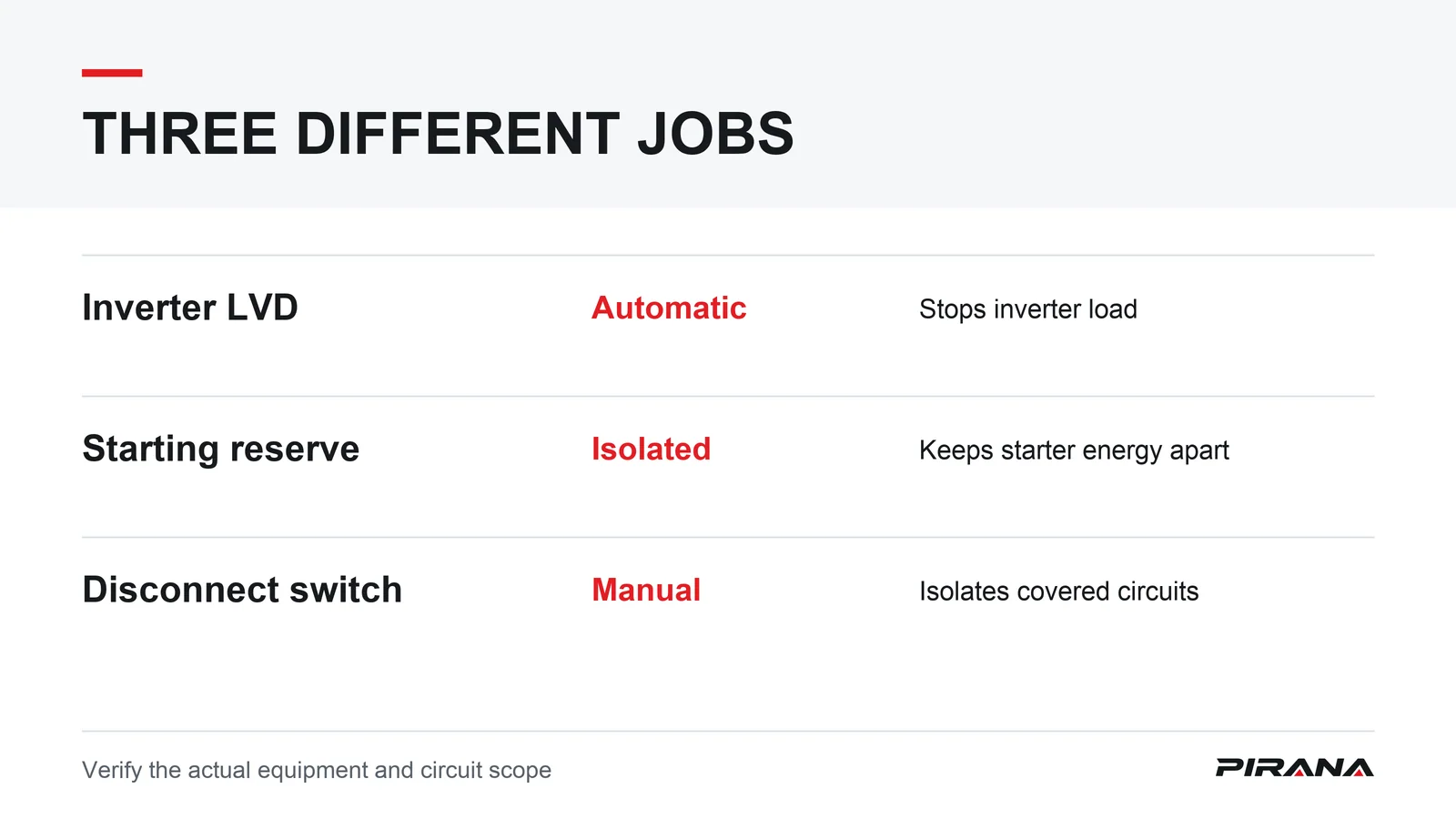
Protection changes which energy can be used, which load is stopped, or who must act. It does not make the overnight demand disappear.
| Method | What acts | What it can do | Its boundary |
|---|---|---|---|
| Inverter low-voltage disconnect, or LVD | An automatic function on equipment that includes it | Shut down the inverter when its configured condition is reached | It acts on the inverter load, and its settings must suit the equipment and battery |
| Separate starting reserve or auxiliary battery arrangement | Separation between the starting supply and sleeper supply | Keep sleeper use from drawing on the isolated starting reserve | The actual installation must provide the intended separation |
| Manual battery disconnect switch | A person opens the switch | Isolate the circuits within its installed scope | It cannot watch battery voltage or protect an operating load automatically |
Inverter LVD acts automatically, where fitted
Some inverters and fleet specifications include low-voltage shutdown. A driver in a TruckersReport fleet discussion described the fleet’s selected inverter as shutting off at low battery, after other inverters had contributed to repeated dead-bank incidents. That is a reported equipment choice, not a feature that can be assumed on every inverter. Fleet inverter account
Read the fitted inverter’s manual to establish whether the function exists, what it controls and which settings apply. Victron’s configuration guidance directs the shutdown setting back to the battery manufacturer’s specification. There is no PIRANA shutdown voltage to substitute for those instructions. Inverter low-battery settings
Also establish which loads remain after the inverter stops. Direct-fed equipment may still be operating. Automatic inverter shutdown is a useful boundary on that inverter’s consumption, but the remaining bank condition and other loads still matter to the morning start.
An isolated starting supply keeps reserve separate
A separate starting reserve or an auxiliary supply for sleeper loads changes which pool of energy those loads can use. This addresses the shared-bank problem by separating the supplies in the actual installation.
A participant in the overnight thread recalled an isolated starting battery as a historical Freightliner option. Treat that as a reported option, not evidence that a particular truck has it. Confirm the installed arrangement from the vehicle and equipment documentation. The existence of an extra battery does not establish separation. This is an architecture to verify, not a wiring or retrofit procedure.
A manual switch needs a decision and an action
A manual disconnect is useful when the intention is to isolate its covered circuits. If the sleeper load is still running through that circuit, the switch must remain closed. It therefore cannot preserve reserve automatically while you sleep.
Where the vehicle documentation identifies a sleeper branch that can be isolated independently, opening the appropriate switch ends consumption within that branch’s scope. Establish that scope before relying on it. A manual switch belongs in a planned shutdown or long-parking routine; it is not a replacement for an inverter’s automatic protection.
Why a single voltage number will not save you
The overnight forum thread contains conflicting advice about where a driver should become concerned. One reply accepts a lower reading than another. Selecting either number as a universal starting limit would ignore the battery, the loads and the conditions in which the reading was taken.
A rested battery reading and a reading while the refrigerator or another sleeper load is operating are different observations. The measurement location and timing also matter. A dashboard display, the inverter’s display and a battery measurement need to be understood in their own contexts before comparing them. Battery-manufacturer guidance distinguishes rested, open-circuit assessment from conditions with charging or discharge in progress. Trojan battery assessment guidance
Use the applicable battery and inverter manuals to define the operating limits and the vehicle’s instructions to understand the displays. Then keep a record of representative nights within that permitted operation. The aim is to recognize the combination of equipment and conditions that changes the outcome, not to find the lowest reading at which the engine will still crank.
| Record | Why it matters |
|---|---|
| Bank condition and charge state before parking | Makes the starting point visible |
| Sleeper loads enabled and their operating modes | Distinguishes idle consumption from appliance use |
| Sleeper and battery-side temperature conditions | Helps explain changes in cooling demand and reserve |
| Display or measurement location, timing and load state | Makes observations meaningfully comparable |
| Any automatic shutdown and the loads still operating | Shows the actual protection boundary |
| Morning starting behavior | Records the outcome without proving a universal threshold |
A repeatable record can support decisions to reduce optional loads, check the bank or have the protection arrangement reviewed. Do not deliberately exhaust the starting bank to create a baseline. If the existing routine leaves uncertain reserve, establish a suitable protection or supply arrangement before relying on it overnight.
Sitting for days is a different problem
Long parking changes the plan. Even a modest background load left enabled can accumulate consumption over a longer absence. In the ExpeditersOnline “Dead Battery” discussion, a respondent reported returning after a week away to a dead truck with the inverter left on. That was the respondent’s experience, separate from the original poster’s complaint, and it gives no guaranteed overnight runtime. ExpeditersOnline field account
For days or weeks away, follow the vehicle’s prescribed shutdown and manual-isolation arrangements, together with the battery manufacturer’s maintenance-charging guidance. Verify what remains supplied outside the isolation boundary. The switch’s position alone does not establish that every possible draw has been removed.
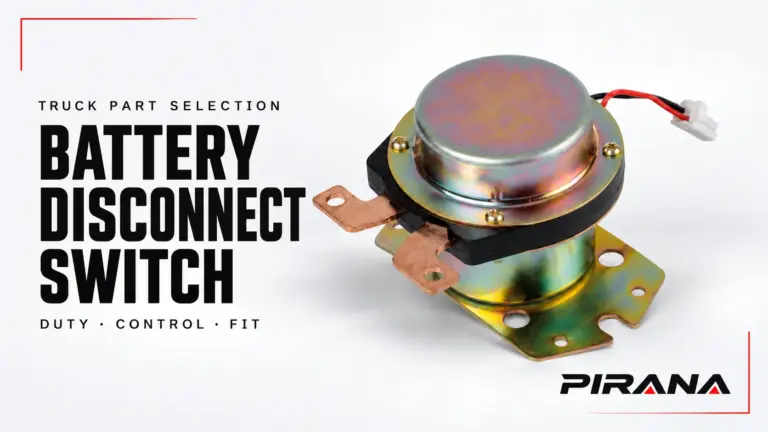
PIRANA’s Battery Switch category is relevant to this manual-isolation role. The following are catalogue identity records to check against the original part and actual application.
| Model | OE reference | Catalogue application |
|---|---|---|
| HQ-6502 | WG9100760100 | Steyr |
| HQ-6519 | 81.25506.6033 | F3000 |
| HQ-6520 | DZ95189763010 | M3000 |
These records do not establish inverter protection or an automatic low-voltage function. PIRANA supplies battery switches, not inverters, LVD devices or auxiliary battery systems. Use the commercial-truck battery disconnect selection guide for a switch-selection question. Overnight consumption alone is not a reason to replace an existing disconnect.
If you woke up to a flat bank anyway
First distinguish what was deliberately left on. In the TruckersReport Peterbilt case, the owner reported leaving the inverter and refrigerator running and finding the batteries discharged. That establishes the reported load history, not whether the bank was healthy or which load dominated. How are my batteries wired?
If the loss occurs with intended sleeper loads operating, revisit their modes, the bank condition and the protection boundary. Reduce optional demand or have the appropriate supply and protection arrangement assessed. A flat bank does not by itself condemn an inverter or battery switch.
If the truck also loses charge when the intended loads are off, move to the parasitic-draw and battery-condition guide. That is the separate investigation for unwanted consumption and battery retention. The routing matters because an overnight-use plan cannot explain away an all-off loss, while a deliberate running load is not automatically a parasitic fault.
FAQ
Can I leave the inverter on all night with nothing plugged into it?
An inverter can still consume battery energy with no output load. Check the fitted model’s idle behavior and operating mode. Its ON state alone does not show whether it is the main overnight consumer, but its consumption still belongs alongside the refrigerator and other sleeper loads. Include it in a long-parking shutdown plan as well.
What voltage is too low for the truck to start in the morning?
There is no universal voltage line for every truck, bank and measurement condition. A rested reading and a loaded reading are not equivalent, and forum advice differs. Use the battery, inverter and vehicle documentation, then compare records taken under known conditions. A displayed number alone cannot guarantee sufficient starting reserve.
Is a low-voltage disconnect the same as a battery disconnect switch?
No. An inverter LVD is an automatic voltage-based shutdown function on equipment that includes it. A manual battery disconnect requires someone to open it and isolates only the circuits within its installed scope. PIRANA’s battery switches belong to the manual-isolation category; PIRANA does not supply inverters or LVD devices.
Which drains more overnight, the fridge or the inverter?
Identify the refrigerator type and its actual running behavior before ranking the loads. A compressor refrigerator normally cycles, while a basic thermoelectric cooler can run continuously. The inverter adds its own model-dependent background consumption. Compare the enabled modes and observations for that installation rather than assigning either device a universal share of the drain.
My truck will sit for a week – does the same advice apply?
Use a long-parking plan with the vehicle’s prescribed manual isolation and suitable maintenance charging. An overnight appliance routine does not establish reserve for an extended absence. Verify which circuits remain supplied. If the bank still loses charge with intended loads off, use the four-battery parasitic-draw guide to separate unwanted consumption from battery-condition problems.
Sources
Forum accounts supply reported experiences, not universal runtime or electrical limits.
- TruckersReport, Overnight battery life and mini fridge?
- TruckersReport, How are my batteries wired?
- ExpeditersOnline, Dead Battery
- TruckersReport, Pride Transport, fleet inverter account
- Victron, Sun Inverter specifications and inverter settings
- Dometic, B40 AC/DC operating manual
- Trojan, lead-acid FAQs and battery assessment guidance
- PIRANA Battery Switch category and HQ-6502, HQ-6519 and HQ-6520 catalogue records, linked in the long-parking section.