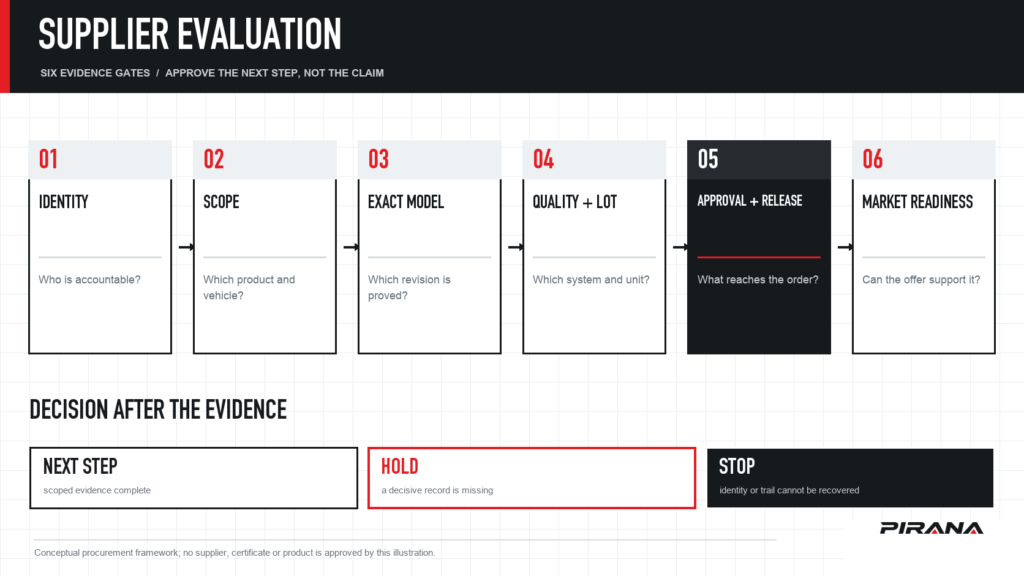
Do not approve a power window switch supplier from a catalogue count, one certificate or a sample that happens to work. Evaluate six evidence gates in order: supplier role and identity, product and application scope, exact-model evidence, quality and lot controls, approval and release, and market/commercial readiness. Then record one outcome: Approve for next evaluation step, Conditional / hold, or Do not proceed.
An approval in this article never means that the supplier is good for every switch or every market. It means the reviewed supplier and the reviewed product scope have produced enough traceable evidence to justify the next action, such as requesting a sample, completing an audit or issuing a trial order. Any identity, version, application, destination or commercial requirement that has not been checked stays outside that approval.
This distinction protects the buyer from two common mistakes. The first is treating a management-system certificate as proof that a particular switch fits a truck. The second is treating one passing sample as proof that later production, another OE reference or another market has the same result. A supplier evaluation should leave a record that shows what was reviewed, what remains unresolved and who owns the next decision.
The six-gate supplier evaluation at a glance
| Gate | Decision to make | Evidence that can support it | Typical stop condition |
|---|---|---|---|
| 1. Role and identity | Is the party a manufacturer, brand owner, trading company or distributor for the proposed product? | Legal/trading identity, product responsibility, site or manufacturing relationship, relevant authorization for the proposed role | The accountable party or product role cannot be established |
| 2. Product and application scope | Which switch families, references, platforms, markets and functions does the supplier actually claim? | Current catalogue, product list, controlled scope statement, application-data sample and version/date | A broad claim cannot be reduced to a defined product and application scope |
| 3. Exact-model evidence | What proof exists for the exact candidate switch and revision? | Datasheet, drawing, approved configuration, inspection/test record and fitment mapping | The evidence names another model, lacks decisive criteria or cannot be connected to the candidate |
| 4. Quality and lot controls | How does the supplier connect a result to the production population and the lot offered? | Scope-specific QMS certificate, inspection plan, sample/lot record, traceability and nonconformance response | A certificate, result or test is treated as universal proof beyond its stated scope |
| 5. Approval and release | How is the approved configuration protected before and during an order? | Approved sample or baseline, revision/change record, purchase specification, lot and order-release record | A part, process, label or packaging change can reach shipment without approval |
| 6. Market and commercial readiness | Can the supplier support the buyer’s destination, channel and agreed commercial requirements? | Destination-specific documentation, labeling/packaging specification, data-delivery format and quotation terms | A critical requirement remains assumed, unavailable or inconsistent with the quotation |
The order is deliberate. Supplier identity determines who is accountable. Product scope determines what can be evaluated. Exact-model evidence gives the quality records something to attach to. Release controls determine whether an order matches the approved article. Commercial readiness comes after those questions because price and lead time cannot repair an unidentified or unsupported product.
Gate 1: establish who is responsible for the product
Start with the name of the legal entity or seller and the role it performs for the proposed product. “Manufacturer,” “factory,” “brand owner” and “supplier” are not interchangeable descriptions.
- A manufacturer performs or controls the manufacturing activities relevant to the offered switch. Confirm the legal entity, site relationship and which product or operation the evidence covers.
- A brand owner controls a product brand or programme specification but may use another organization for production. The brand name alone does not identify the producer or the evidence holder.
- A trading company may source, consolidate or administer orders. That can be a useful commercial role, but it does not make the trader the manufacturing-record owner.
- A distributor may hold stock and provide local service. Establish whose product, revision and product evidence it is supplying.
A credible supplier can explain the division of responsibility without turning the answer into a logo presentation. For the proposed product, record:
- legal or verifiable trading name and business location;
- accountable contact for technical, quality and commercial questions;
- role in design, tooling, manufacture, final assembly, testing, packing and shipment, as applicable;
- identity of the document holders for drawings, inspection results, certificates and order records;
- any subcontracted process that is material to the product claim.
Do not infer in-house manufacturing from a domain name, product photograph, factory image, range size or claim of “direct factory” supply. Ask who holds the record for the exact operation and whether the document names the relevant organization or site. Private-label branding can also change the label and packaging record without changing the manufacturer: keep those roles separate.
Gate 1 passes when the supplier and every material party behind the proposed product can be identified well enough to assign technical, quality and order responsibility. A mismatch between the seller’s identity and the documents’ holder is not automatically disqualifying, but it must have an explanation and a traceable relationship.
Gate 2: reduce the catalogue to an evaluable product scope
A large catalogue indicates that many references can be explored. It does not establish that every listed number is supplied, technically equivalent, fit for a stated vehicle or produced in the same way. PIRANA’s own window-switch page describes OE numbers as identification references rather than a guarantee of interchangeability, and asks buyers to confirm switch position, connector and vehicle generation. PIRANA: Power Window Switch Manufacturer and Supplier.
Write the candidate scope as a record rather than a slogan:
| Scope field | What to request or record | Why it matters |
|---|---|---|
| Product family | Switch design, application family and any related control functions | Establishes what the evidence is meant to cover |
| Supplier reference | Exact supplier/PIRANA number and revision or version where available | Creates a stable identity for the product being reviewed |
| OE reference | Complete number, including meaningful prefixes and suffixes; relationship source and direction | Distinguishes identification from interchangeable replacement |
| Vehicle application | Make, platform or model family, applicable market and production range | Keeps one vehicle label from standing in for every configuration |
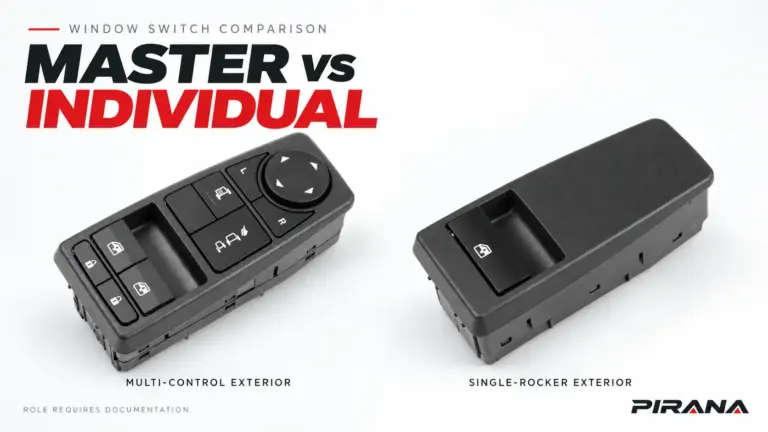
| Switch role and position | Master or individual, physical side, front/rear and LHD/RHD as relevant | Different cab and door configurations may require different products |
| Required functions | Windows controlled, automatic operation, lock, mirror, illumination or other integrated controls when applicable | A physically similar part can have a different function set |
| Interface boundary | Connector/terminal/mounting configuration and any documented system dependency | Records which technical questions require exact evidence |
| Destination | Buyer’s target market/channel and required documents | Makes the applicable requirement visible before a quote is approved |
Make and model are useful filters, but they may still leave variants. The buyer’s record should carry every field that changes the part or the evidence set. If the supplier cannot state whether a vehicle label includes a different market, build break, steering configuration or equipment option, mark that field unknown rather than converting the catalogue text into certainty.
Application data also needs a boundary. The Auto Care Association explains that ACES is a standard for managing and communicating product fitment data and PIES is a standard for product information. Its FAQ states plainly that ACES or the Vehicle Configuration database will not tell a manufacturer which vehicles its product fits; the company still needs to research, create or buy its application data. Auto Care Association: ACES and PIES FAQ.
TecDoc’s own documentation describes catalogue and OE-data structures that link references, vehicles and aftermarket products. Those tools can improve how a supplier stores and delivers catalogue information. They do not turn a linkage into a promise that the hardware satisfies every applicable vehicle requirement. TecAlliance: TecDoc Catalogue and TecAlliance: TecDoc OE Parts Data.
Gate 2 passes when the buyer can name the exact product family and a bounded application/reference scope, see which fields are declared versus verified, and understand the data format or source behind the catalogue claim. A candidate reference remains a candidate until the evidence in Gates 3–5 connects the vehicle requirement to the exact offered part.
Gate 3: require evidence for the exact model
The central question is not “Does the supplier have quality documents?” It is “Which document supports which claim for this product and version?” Use a claim-to-document crosswalk before deciding that a supplier file is complete.
| Claim the buyer wants to rely on | Minimum useful evidence | What it can establish | What it does not establish by itself |
|---|---|---|---|
| The catalogue identifies a candidate part | Product record with supplier and OE references, application fields and version or date | A defined item to investigate | Physical interchangeability or complete vehicle coverage |
| The candidate has the expected configuration | Exact-model datasheet or controlled drawing showing the relevant dimensional, interface and functional fields | A stated configuration for the identified model/revision | That every related reference or later revision is the same |
| A sample met an agreed requirement | Inspection or test record with model, sample/lot, method, conditions, acceptance criterion, result, date and sign-off | What was checked for the identified article under the recorded method | That the whole population, another SKU or field service matches the result |
| The supplier has a certified management system | Current certificate naming the standard, organization/site, scope and validity | Certification of the management system within the stated scope | Product approval, fitment, process capability or a SKU’s performance |
| The vehicle application is supported | OEM/application requirement plus approved supplier reference mapping and relevant configuration controls | Only the bounded relationship shown by those records | That another market, position or function variant is interchangeable |
| This order matches the approved article | Approved sample or controlled baseline plus order specification, lot identity, final release and packaging version | That the identified order is tied to the reviewed configuration | Ongoing durability, reliability or compatibility outside that specification |
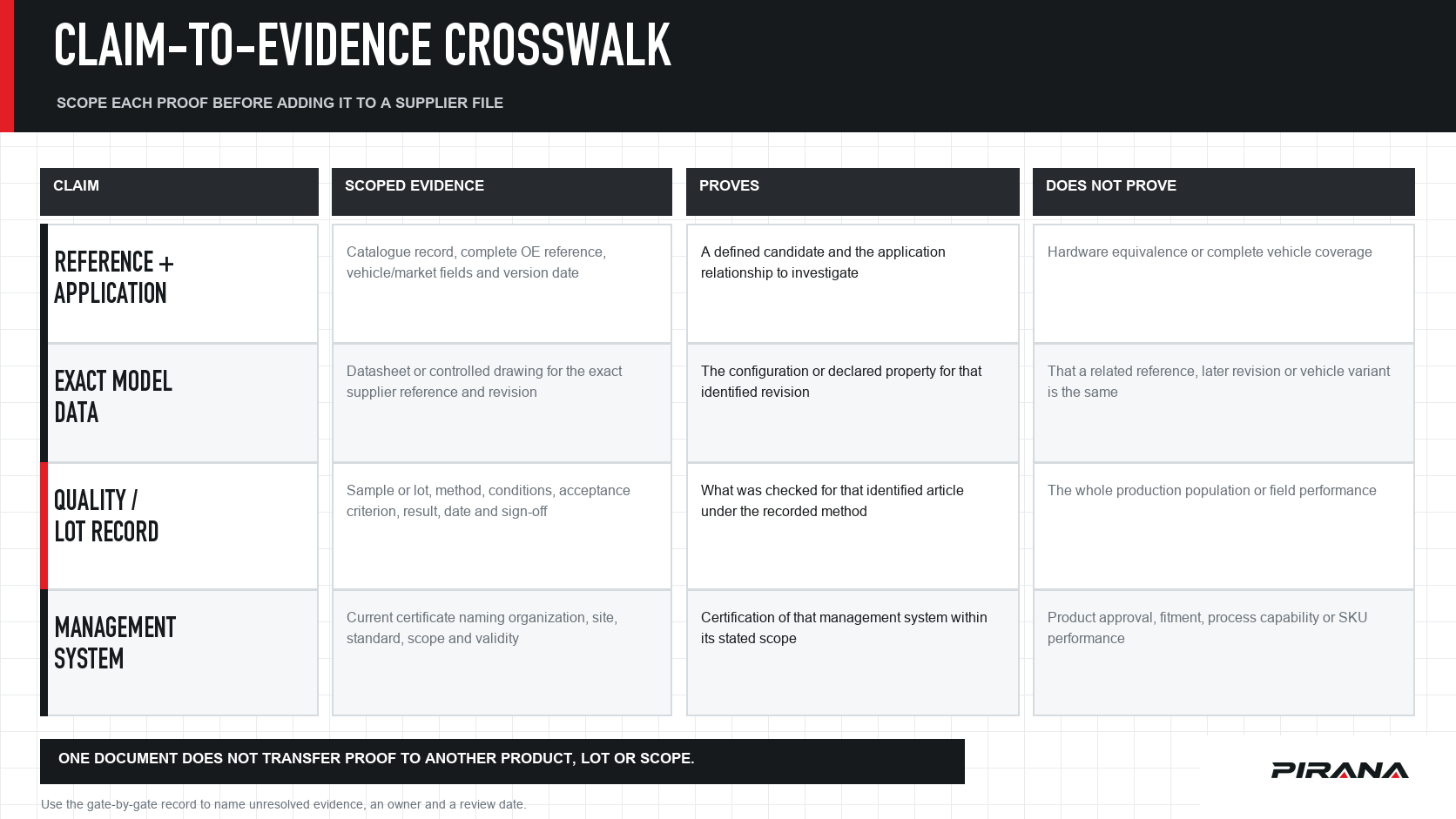
Ask the supplier to identify what each file proves rather than sending an undifferentiated document bundle. A useful response states the holder, exact model/revision, issue date, scope, method or requirement, result, limitations and whether the file is controlled. Redact commercially sensitive formulas or supplier information where necessary, but do not remove the details that determine whether the evidence applies.
Two boundaries need particular care.
First, technical data is not automatically a validation result. A drawing can define the intended geometry; a datasheet can state a declared function; a test can show what happened under a method. The buyer should see which one supports the claim.
Second, one model does not qualify a whole family. Similar-looking switches can vary in connector, terminal arrangement, position, switch role, function set or vehicle generation. If the supplier transfers a result from another reference, ask for the bridge evidence: the relationship, the material similarity, the risk assessment and the reason the earlier result represents the new configuration.
For unresolved identity, use the existing owners rather than asking this evaluation page to guess. The OE-number identification guide builds the reference and connector record; the truck-brand selection guide turns a vehicle family into configuration questions. Return here when the supplier must prove how its evidence applies.
Gate 3 passes when every consequential claim has a document at the correct level, tied to the exact candidate and revision. A missing result produces Conditional / hold unless the claim can be narrowed to what the available record actually supports.
Gate 4: separate quality-system evidence from product and lot evidence
A quality-management-system certificate and a product test answer different questions. For automotive supply, IATF makes the scope explicit. Its Rules Sixth Edition Q&A states that IATF 16949 certification is a quality-management-system certification, “neither a product or a manufacturing process certification, nor is it a confirmation of process capabilities.” IATF: Rules Sixth Edition Q&A, page 185.
That boundary applies to any management-system certificate, not only IATF. Before adding a certificate to the supplier file, inspect:
- the exact standard and edition;
- the certified legal entity;
- the site or remote support activity covered;
- the scope of activities and products;
- issue and expiry dates;
- the issuing body and the ability to verify the record;
- any excluded process or transferred activity that matters to the product.
The certificate can support a claim about the certified management system within that scope. It cannot replace a model-level test, drawing, sample approval, lot result or vehicle application record.
Then ask how a product-level result connects to the lot that would be shipped:
| Traceability question | Evidence to request |
|---|---|
| What fixture, tool, material or revision produced the sample? | Product revision and approved-sample or controlled-configuration record |
| What was inspected or tested, how, and against what criterion? | Scoped inspection/test record with method, conditions, limits, result and date |
| Which production unit does the result describe? | Sample or lot identity and traceability rule |
| What happens when a result does not meet the criterion? | Nonconformance and containment process, owner and disposition rule |
| How is a failed or suspect lot prevented from release? | Quarantine/release authority and record that corresponds to the supplied product |
| What can the buyer verify on receipt? | Agreed inspection plan, sampling method and acceptance criteria |
This page does not prescribe universal cycles, voltages, temperatures, dimensional limits or defect rates. Those values belong to the exact product requirement and applicable method. PIRANA’s public quality page similarly says identity comes before performance and that test methods, limits and records are confirmed by model and programme rather than claimed as universal for every switch. PIRANA: Power Window Switch Quality Control.
Gate 4 passes when the supplier has scoped system evidence, exact-product evidence appropriate to the claim, and a traceable route from approved configuration to lot release. A supplier may pass this gate for one reviewed programme and remain unapproved for a different SKU, material, process line or market.
Gate 5: control sample approval, revisions and order release
A sample becomes useful evidence only when it has an identity that can be repeated. Record the sample as a controlled baseline: exact product number and revision, complete OE reference, application scope, connector/function configuration, visible appearance, label and packaging version. The buyer and supplier should also know which measurements or checks define acceptance.
Avoid a “golden sample on a shelf” without a record. If the physical sample is the baseline, connect it to:
- a unique sample/reference identifier;
- the approved drawing or specification;
- the inspection criteria and result;
- the date and approving parties;
- the changes that require reapproval;
- the expected marking, label, quantity and packaging.
PIRANA’s manufacturing page describes a reference-led sequence from reference confirmation and component preparation through assembly with checks to order release. It advises keeping the product number, OE cross-reference, approved sample and packaging version together and reviewing the order if one changes. This is a PIRANA-described process, not independent proof of every future order, but it gives a practical test for the supplier’s own records. PIRANA: Power Window Switch Manufacturing.
Define change-control triggers before placing the order:
| Change | Why approval may need to reopen |
|---|---|
| Product or supplier reference, revision or approved drawing | The earlier evidence may describe a different article |
| OE reference, cross-reference direction or supersession | The application relationship and conditions may change |
| Connector, terminal, mounting, button/rocker or function set | Fitment, operation or the required inspection plan may differ |
| Material, component source, tooling or production process | Existing sample or process evidence may no longer represent the article |
| Approved sample, artwork, label or packaging | The shipped order may no longer be traceable to the reviewed delivery configuration |
| Vehicle family, destination market or customer requirement | Applicable requirements and documentation may differ |
The sample inspection itself belongs to your physical incoming-inspection process. Use the six-gate power window switch quality inspection checklist after supplier approval defines the exact article and acceptance plan. It checks whether a physical sample or lot matches that baseline; it does not decide whether the supplier’s overall evidence is complete.
For branded supply, link the private-label truck switch approval checklist at the point where artwork, labels and packaging become controlled inputs. Branding does not upgrade the underlying product evidence, and product approval does not automatically approve every label or carton version.
Gate 5 passes when the approved configuration, change rules and shipment-release record can follow the product into the order. A sample with no controlled identity is useful as an observation, not as an approval baseline.
Gate 6: check destination and commercial readiness against the actual offer
Technical approval and commercial readiness are separate. The buyer should not infer minimum order quantity (MOQ), lead time, stock, warranty, sample policy, production capacity, certifications or destination compliance from a supplier’s homepage. Ask for the terms that apply to the exact reference, quantity and destination.
Build a requirements sheet for the proposed programme:
| Area | Confirm before the first order |
|---|---|
| Destination and channel | Country/market, customer or distribution channel, and required documents or marks |
| Product data | Required catalogue/data format, language, images, dimensions and application-information fields |
| Packing and identity | Part marking, barcode, label, artwork, inner/outer pack and quantity rules |
| Samples | Sample identity, approval record, sample quantity and programme-specific arrangements |
| Commercial terms | Quoted MOQ, price basis, lead time, shipping terms, payment terms and validity |
| Nonconformance | Contact path, containment, replacement/corrective-action expectations and escalation |
| Change notification | How product, process, label, packaging, site or document changes will be notified and reviewed |
| Repeat-order control | What identifies the approved configuration for the next purchase order |
Only the final quotation and agreed programme documents establish the supplier’s actual offer. This is especially important when an importer operates in several markets: a document, label or catalogue-data requirement that applies to one destination does not automatically apply to the whole range.
PIRANA’s public documents route asks for a PIRANA or OE reference, vehicle make/model/position, intended document use, destination market and any required standard. Its catalogue, datasheet, drawing/image-set availability depends on the exact model and market. PIRANA: Request Catalogs and Datasheets and PIRANA: Certificates and Compliance Documents.
Gate 6 passes when the destination requirements and commercial terms are documented for the same product/reference quantity being evaluated. A technical pass with an unresolved destination requirement remains conditional.
Turn the six gates into one decision
Do not add every gate into a single numerical vendor score. A high total can hide a stop condition at the most important gate. Keep a gate-by-gate decision and let the weakest decisive gate control what the buyer may do next.
| Outcome | Use when | What the supplier may do next |
|---|---|---|
| Approve for next evaluation step | All six gates have adequate scoped evidence; no decisive field is unknown; the approval names the exact product scope and next action | Present a sample, schedule a supplier review or participate in an agreed trial evaluation |
| Conditional / hold | The supplier role and core product are credible, but a named document, scope, change control, destination requirement or commercial term remains unresolved | Resolve the named gap and resubmit that evidence; do not treat the supplier as approved for production |
| Do not proceed | The accountable party, product identity or evidence trail cannot be recovered; records contradict the offered product; the supplier will not disclose reasonable scoped evidence; or a mandatory requirement cannot be met | Stop the evaluation or restart with a different clearly identified supplier/product |
“Approve for next evaluation step” is intentionally narrower than “approved supplier.” A sample request, audit, trial order or purchase due diligence may still disclose a new risk. The record should state which conclusion it supports and which later decision remains open.
Copy this decision record into the sourcing file:
Evaluation date / owner:
Supplier legal or trading name:
Supplier role: manufacturer / brand owner / trading company / distributor / mixed
Product family and supplier reference(s):
Complete OE reference(s) and stated relationship:
Vehicle family / market / production range / switch position / functions:
Buyer destination market and channel:
Reviewed revision / sample / lot / catalogue version:

Gate 1 — ROLE AND IDENTITY
Status: PASS / HOLD / STOP
Evidence reviewed:
Unresolved:
Owner / due date:

Gate 2 — PRODUCT AND APPLICATION SCOPE
Status: PASS / HOLD / STOP
Evidence reviewed:
Unresolved:
Owner / due date:

Gate 3 — EXACT-MODEL EVIDENCE
Status: PASS / HOLD / STOP
Evidence reviewed:
Unresolved:
Owner / due date:

Gate 4 — QUALITY AND LOT CONTROLS
Status: PASS / HOLD / STOP
Evidence reviewed:
Unresolved:
Owner / due date:

Gate 5 — APPROVAL AND RELEASE
Status: PASS / HOLD / STOP
Evidence reviewed:
Unresolved:
Owner / due date:

Gate 6 — MARKET AND COMMERCIAL READINESS
Status: PASS / HOLD / STOP
Evidence reviewed:
Unresolved:
Owner / due date:

Overall decision: APPROVE FOR NEXT EVALUATION STEP / CONDITIONAL HOLD / DO NOT PROCEED
Exact approval scope:
Deciding gate or reason:
Required next action:
Reviewer / approver / date:
Next review trigger:
Attach the source versions that the decision references. “Supplier sent a certificate” is not a record; the record needs the document identity, holder, model or site scope, date and the claim it supports. The same principle applies to a catalogue screenshot, drawing or sample photograph.
Apply the checklist to PIRANA as well
PIRANA publishes this article and can be a candidate supplier, so the commercial relationship should be disclosed. The checklist therefore applies to PIRANA on the same terms: the buyer still needs an exact product reference, application scope, model-specific evidence and order record.
PIRANA’s public About page describes a manufacturing base in Ruian, Zhejiang, China and a focus on OE-reference-led power window switches for aftermarket distributors, importers and private-label programmes. Those are PIRANA site declarations, not independent certification or a guarantee about every SKU. PIRANA: About.
The public quality, certification, download and manufacturing pages support a useful initial supplier discussion. They explain that evidence must follow the exact model and market, that methods and records are programme-specific, and that no universal certificate is posted as proof for the whole catalogue. They do not replace the model-level documents the buyer must request in Gates 3–5.
The same page can also be used to ask questions that are easy to compare across suppliers:
- Who holds the drawing, inspection result, certificate and order-release record?
- Which exact revision produced the sample, and what data connects the sample to the proposed order?
- What changes require reapproval?
- Which destination requirements are confirmed for this specific reference?
- What will the final quotation add to the product, packing, data and release specification?
Use the current power window switch catalogue to identify a reference, the manufacturing process and quality-control route to understand PIRANA’s stated controls, and OEM/ODM supply only after the product and programme scope are clear. If the vehicle application is not yet defined, start with identification and selection rather than asking a supplier to guess.
For a PIRANA-specific evaluation, send the exact OE or PIRANA reference, vehicle and switch position, required functions, destination market, expected order basis and the evidence gate that remains open through the quotation and enquiry route. A precise request produces a reviewable answer; a broad request for “a catalogue and certificates” does not.
The approval rule to keep
A supplier is ready for the next step when the evidence chain survives all six gates. A catalogue locates the candidate. Application data defines the vehicle relationship to investigate. Exact-model records describe the proposed article. Quality and lot records show what was checked or certified at the proper level. Approval and release controls preserve the approved configuration. Commercial checks confirm that the stated offer can support the destination and purchase programme.
When one of those links is missing, the honest result is Conditional / hold. When the accountable identity or evidence trail cannot be recovered, the honest result is Do not proceed. Neither outcome is a prediction about a brand’s quality; both preserve the buyer’s ability to make a smaller, defensible next decision.
References
- PIRANA, Power Window Switch Manufacturer and Supplier, accessed 22 October 2026.
- PIRANA, Power Window Switch Quality Control, accessed 22 October 2026.
- PIRANA, Power Window Switch Manufacturing, accessed 22 October 2026.
- PIRANA, Certificates and Compliance Documents, accessed 22 October 2026.
- PIRANA, Request Catalogs and Datasheets, accessed 22 October 2026.
- Auto Care Association, Frequently Asked Questions: ACES and PIES data standards, accessed 22 October 2026.
- TecAlliance, TecDoc Catalogue, accessed 22 October 2026.
- TecAlliance, TecDoc OE Parts Data, accessed 22 October 2026.
- IATF, Rules for Achieving and Maintaining IATF Recognition — Sixth Edition, Questions and Answers, 31 July 2024, page 185.
REFERENCED IN THIS GUIDE
Products mentioned in this article
These published catalogue references are included because they are discussed in this guide. A reference is a starting point for identification; confirm the exact OE number, connector and vehicle configuration before ordering.
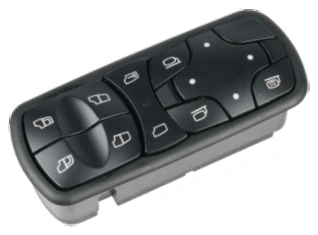
Power Window Switches
Power Window Switch — OE A9438200097
PIRANA Part No. HQ-6901 · OE: A9438200097
View product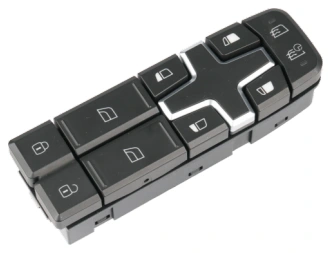
Power Window Switches
Power Window Switch — OE 22154285 / 22154235
PIRANA Part No. HQ-6913 · OE: 22154285 22154235
View product