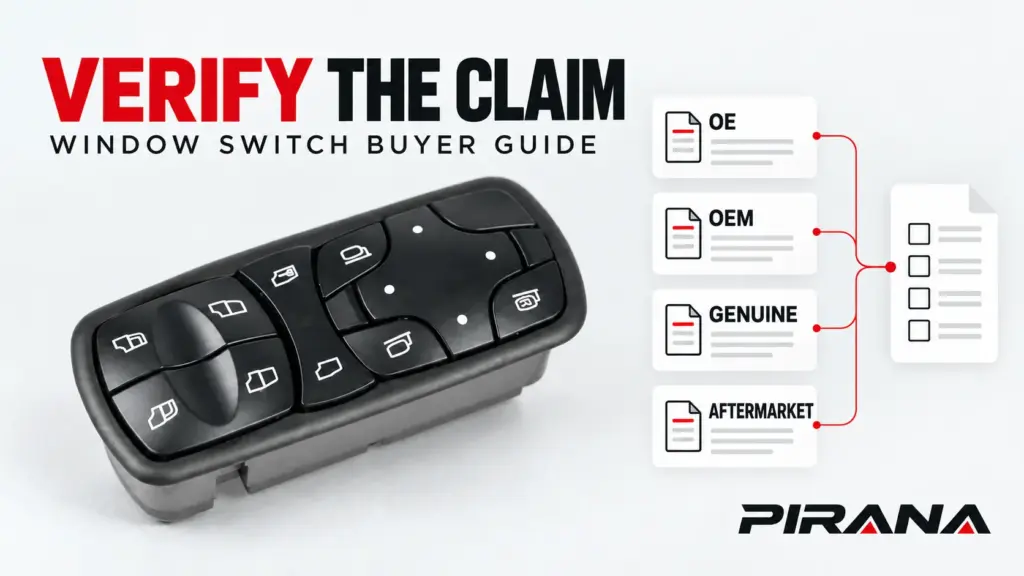
When comparing window switches labelled OE, OEM, genuine or aftermarket, start by asking what the seller means and which exact part is being offered. Then compare both candidates against the same vehicle requirement, product evidence and commercial scope. An OE reference can help identify a candidate; the reference alone does not establish that the offered switch is genuine, compatible or equivalent in performance.
The companion purchase-verification comparison sheet puts two candidates beside one buyer requirement. It keeps each seller’s claims, supporting sources, unresolved questions and next actions visible. Use it to prepare a sourcing decision; its status fields do not automatically approve a part.
Compare the claim before comparing the price
These labels can describe an original-equipment relationship, a company, a branded service part or a replacement-market offer. They are not four mutually exclusive quality grades. Ask the seller to state the exact meaning in the quotation.
| Label in an offer | Practical question | Evidence to request | What the word alone cannot establish |
|---|---|---|---|
| OE — original equipment | Is the seller identifying an original part, a vehicle manufacturer’s reference number, or an OE relationship? | Original part marking or applicable vehicle parts record; source and stated relationship of the listed number. | That the offered replacement is vehicle-branded genuine stock or fits every vehicle listed. |
| OEM — original equipment manufacturer | Which organization, part, vehicle programme and claimed supply relationship does the seller mean? | An identifiable manufacturer and an appropriate record supporting the specific claim. | That every item sold under the manufacturer’s name is the same as a vehicle-brand service part. |
| Genuine | Is the offered item a vehicle-brand service part, and how is its identity and supply source documented? | Exact vehicle-brand part number, actual packaging/part markings and traceable source or authorization where relevant. | That the item matches the buyer’s vehicle, is new, or is authentic solely because the listing says “genuine.” |
| Aftermarket | Which company brands or supplies this replacement, and what application and product evidence accompanies this exact item? | Manufacturer/brand identification, supplier SKU, application source, specifications and applicable commercial terms. | That it is automatically inferior, identical to OE, vehicle-brand approved or sourced from the original production supplier. |
An independent replacement can be offered through the aftermarket; vehicle-brand service parts are also sold as replacements. Ask about the actual sales identity and channel instead of assuming that the word “replacement” identifies the manufacturer. The US Federal Trade Commission’s Auto Repair Basics distinguishes new, remanufactured/rebuilt and salvage parts as condition categories. Those categories answer a different question from the seller’s OEM or genuine claim. This article does not assume that US warranty or disclosure rules apply to every destination.
“OEM quality” is a separate claim
“OEM quality,” “OE style,” “meets OE specification” and “same as genuine” do not all say the same thing. Ask which property is claimed, for which part revision, against which requirement, and what evidence can be supplied. A contact, connector, operating function or durability claim needs its own applicable evidence. A similarity claim supported only by a front photograph should remain a question in the comparison, not an approved specification.
Likewise, an organization may manufacture original equipment for a particular vehicle programme without that fact proving the identity or specification of every other switch it sells. If the exact product and relationship are not documented, record the claim as unverified. Do not transfer another manufacturer’s OE relationship to PIRANA or infer one from an OE-number listing.
Put both offers against the same vehicle requirement
Before collecting prices, write the applicable original reference, vehicle configuration, destination market and required switch role. Distinguish left-hand or right-hand drive from the physical side and door position. Identify whether the buyer needs a complete panel, a switch assembly or another service item, as well as the required controls and functions.
The Nissan 25401-EL30A parts record describes a left-side Versa switch-panel assembly with a production qualifier of “From 02/07.” This is a bounded example of why a buyer should retain a source’s position and production conditions along with the number. The page does not validate a PIRANA product, and its detailed fitment table does not provide a complete vehicle lookup.
For each offered switch, request the applicable source for the relationship between the buyer’s original number and the supplier’s SKU. If the document names a replacement or superseded number, retain the direction and any conditions. Several references printed together do not, by themselves, establish an unconditional two-way substitution.
Then compare the physical interface and required function against the relevant records: housing and mounting, accessible connector views, supplied-item scope, control role and any required automatic or integrated functions. A matching outline, button count or connector pin count can be a clue, but it cannot prove the electrical interface or vehicle-system behavior. The OE-number identification guide covers the identification workflow in more detail.
Read the evidence at the correct scope
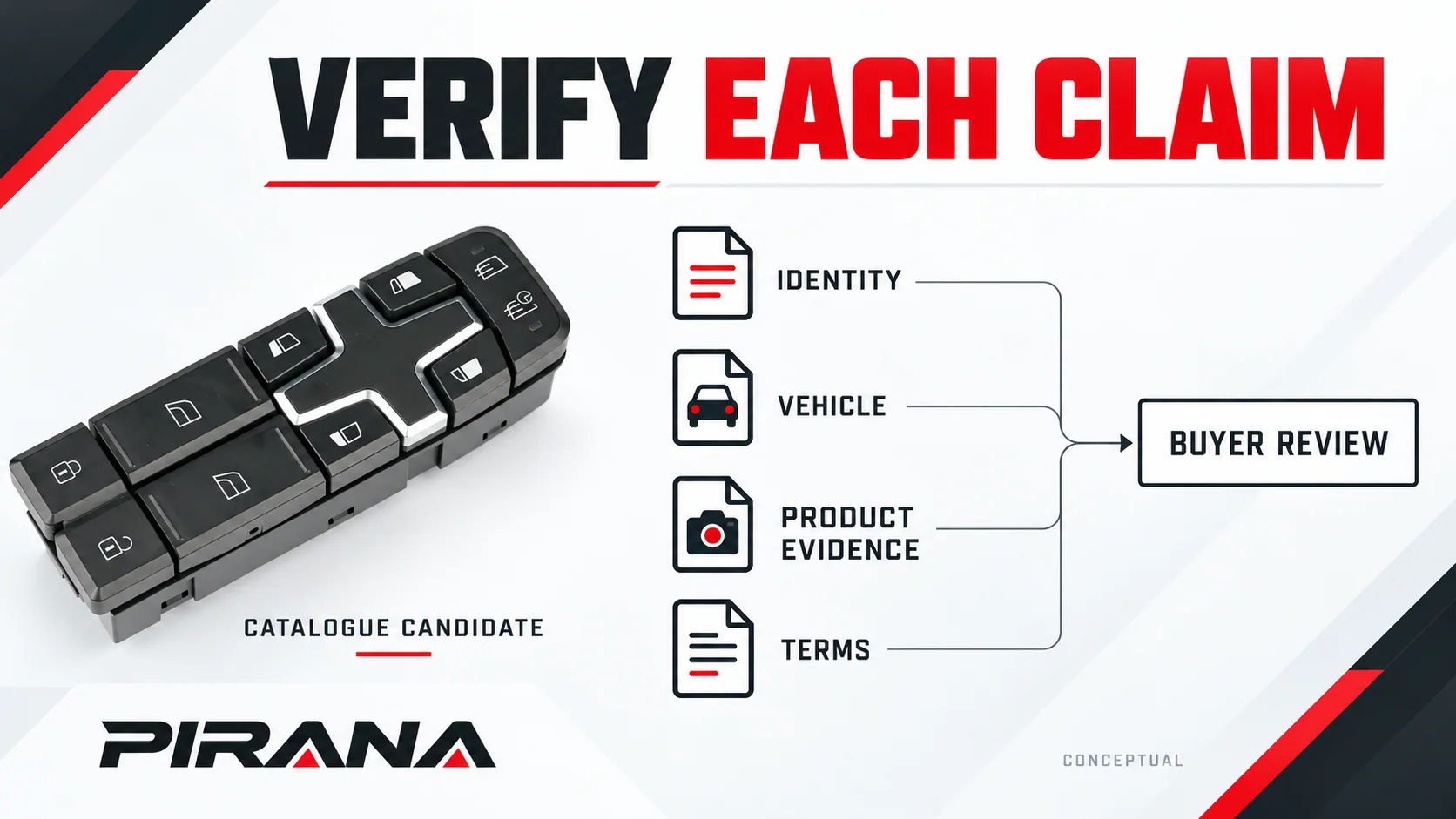
The buyer’s comparison should distinguish four records:
- Vehicle requirement: the applicable vehicle maker’s parts or service record, including its configuration and conditions.
- Offered-item identity: the exact seller, brand, SKU, revision, condition and supplied contents.
- Product evidence: the relevant drawing, specification or test report for the offered item and the property being claimed.
- Commercial record: the actual quotation, price basis, packaging, lead time, destination and agreed terms.
A report is useful when it identifies the item or sample, revision, method, test conditions, acceptance criteria and results relevant to the buyer’s question. A report for a different part or an unspecified test condition cannot automatically validate the offered switch. A brochure or product photograph may be useful identity context, but it is not a substitute for the requested test result.
A quality-management certificate is a different type of evidence. The IATF Rules 6th Edition Q&A, page 185, states that IATF 16949 certification concerns a quality management system; it is not product certification or confirmation of process capability. Check the named organization, site, scope and validity when a certificate is relevant. Do not describe a switch as product-certified or as an OE-approved item solely because a supplier provides a management-system certificate.
The supplier evaluation checklist addresses the broader supplier decision. Here, retain the exact item and question that the buyer still needs resolved.
Example: a catalogue candidate and an unknown second offer
The following is an illustrative record, not a customer quotation or a comparison of two tested switches.
| Comparison item | Candidate A: PIRANA catalogue example | Candidate B: placeholder |
|---|---|---|
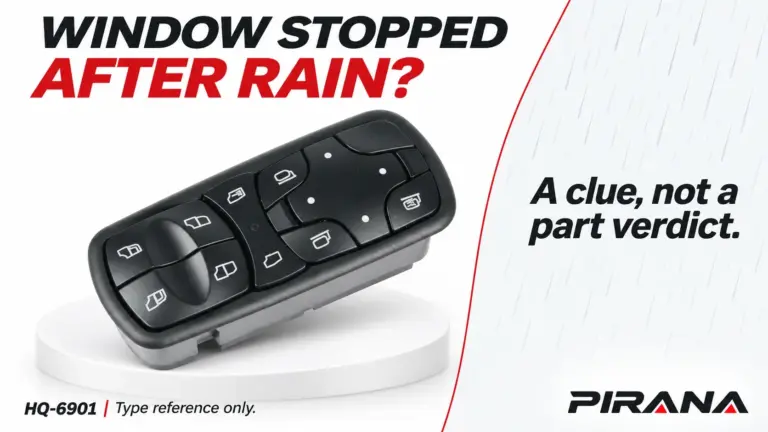
| Offered identity | The HQ-6901 catalogue page lists PIRANA part number HQ-6901. | No actual brand, SKU or seller has been supplied. |
| Listed reference | The PIRANA page lists A9438200097. | Unknown; obtain the seller’s source. |
| Buyer’s original part and vehicle | Unknown in this exercise. | The same buyer requirement remains unknown. |
| Genuine / OEM relationship | No claim of vehicle-brand genuine status or a vehicle manufacturer’s OE supply relationship is established by the catalogue listing. | No claim can be assessed until the actual offer and source are available. |
| Technical and commercial decision | Hold application and product-property conclusions pending exact evidence and actual terms. | Hold; identify the real offered item and obtain its supporting records. |
The listing is a traceable starting point, not proof that a buyer’s original switch bears A9438200097 or that HQ-6901 fits a particular vehicle. Candidate B is deliberately blank; the example does not invent a genuine competitor, price, test report or comparative result. The product page was checked October 28, 2026.
Use the purchase-verification comparison sheet
The companion Excel workbook contains Comparison and Field guide sheets. One file compares two exact candidate offers against one buyer requirement. In Comparison, row 8 contains the headings and rows 9–26 contain 18 criteria; the decision field is below the table.
For each criterion, enter the buyer requirement, each candidate’s actual statement, its status and source or reason, and the next action/owner. Record the reviewer’s decision and its basis separately. The working columns cover identity and supply chain, original and cross-reference records, vehicle configuration, interface and function, product and certificate evidence, condition, and commercial terms.
Use the status choices precisely:
| Status | Meaning in the sheet |
|---|---|
| Unverified | A decisive source or review is missing. |
| Evidence provided | A candidate statement and a source have been recorded for review; this is not an approval. |
| Conflict | The available information disagrees or does not meet the stated requirement. |
| Not applicable | The reviewer has recorded a specific reason for this exact comparison. |
The grey Entry check shows the first detected entry gap: for example, a missing source for an Evidence provided status, an unexplained Not applicable status, a conflict or an unverified candidate. A neutral “Sources recorded; review” result only means the checked fields contain entries. The sheet cannot authenticate a source, evaluate the report’s method, determine fitment or approve an order.
Start with a copy of the file, replace the training identifiers and unknown values, and keep the linked documents with the decision record. Review pasted or imported values: Microsoft explains that copy and fill can bypass Excel’s validation messages. Microsoft: More on data validation.
Decide what can advance
Use the same action rule for either candidate:
| Evidence state | Buyer action |
|---|---|
| The exact item and applicable requirements are supported, the required product evidence and actual commercial terms have been reviewed, and the designated reviewer has recorded the scope. | Advance within that documented scope under the buyer’s approval process. |
| A decisive identity, application, function, document or commercial term is unknown. | Hold and request the named evidence from the responsible party. |
| A documented requirement conflicts with the offered item or terms. | Resolve the conflict or reject that candidate for the stated requirement. |
Compare prices only when the offered unit, quantity, currency, included contents and delivery basis are understood. A lower unit price with an unresolved supplied-item scope is not yet an equivalent commercial comparison. Warranty, returns, available samples and delivery terms depend on the actual offer and applicable market; ask for the written terms rather than assuming them from a label.
For a PIRANA catalogue candidate, send the complete original reference, vehicle and position information, required functions, accessible front/rear/connector photographs, quantity and destination through the parts enquiry route. Identify which evidence remains open. Use the batch RFQ template when a transaction contains several requested lines and supplier replies.
References
- US Federal Trade Commission — Auto Repair Basics: repair-part condition categories. The source is US consumer guidance, not a global warranty rule.
- Nissan — 25401-EL30A window switch record: bounded position and production-condition example.
- International Automotive Task Force — Rules 6th Edition Q&A, July 2024, page 185: management-system certification scope.
- PIRANA — HQ-6901 catalogue record, checked October 28, 2026: catalogue identity declaration.
- Microsoft Support — More on data validation: copy/fill and validation-message limits.