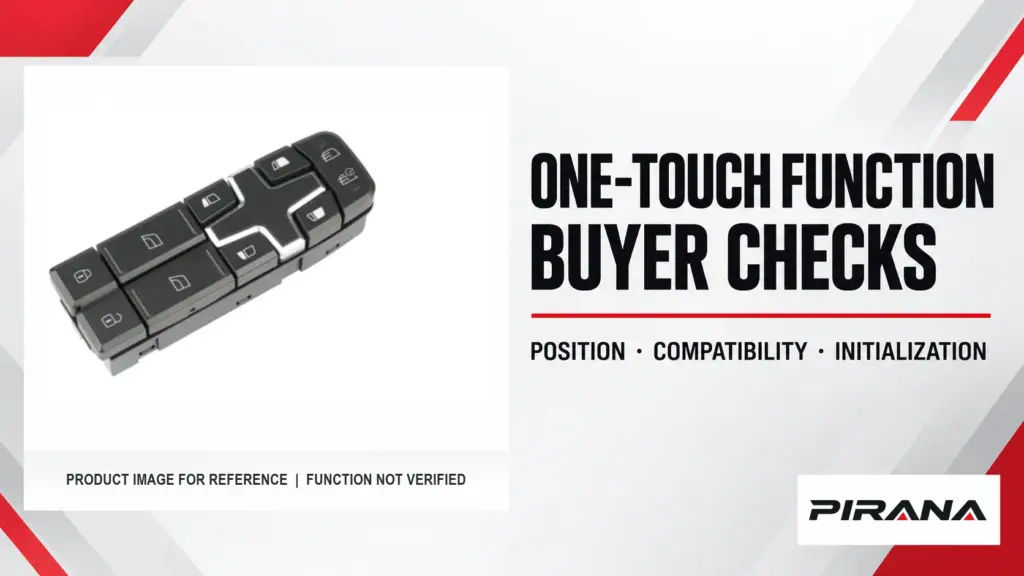
When sourcing a replacement for a vehicle with one-touch windows, verify the vehicle’s required functions and the offered switch’s documented capabilities separately. A matching part number, connector or AUTO marking is useful identification evidence; none alone establishes that a replacement retains every function. Initialization depends on the vehicle and the work event. Replacing a switch does not by itself establish that every vehicle needs the same reset.
The manufacturer examples below show why a buyer needs both the right configuration and the right document. The first concerns documented truck window-system operation; the second concerns a defined passenger-car service bulletin. Neither confirms a PIRANA switch’s one-touch capability, fitment or performance.
Make two separate evidence decisions
An order may contain enough information to identify a candidate but still lack what is needed to approve it for a vehicle’s automatic functions. Keep these questions separate:
| Buyer question | Source to check | What remains open without it | Decision |
|---|---|---|---|
| What must this vehicle do? | Applicable manufacturer’s vehicle, option and service information for the actual build. | Which windows and directions have automatic operation, and under what conditions. | Record the requirement by window and direction. |
| What part was originally specified? | Original part identity and the manufacturer’s applicable parts record, including configuration and revisions. | Which service item and reference are appropriate for the build. | Treat a catalogue result as a candidate until the applicable conditions are resolved. |
| What does the offered replacement provide? | Supplier’s traceable specification or validation for the exact SKU and revision. | Whether that item supports the commands and interface required by the vehicle. | Hold the automatic-function claim until the relevant evidence is available. |
| What happened during the work? | Applicable current service procedure and actual work record. | Whether a documented interruption or component replacement triggers a learning, initialization or other action. | Select the applicable procedure for that event; do not borrow a reset from another vehicle. |
| How is the vehicle accepted? | Applicable vehicle service information and agreed acceptance record. | Which functions and preconditions must be checked after the work. | Route the vehicle for the documented checks; do not infer success from manual movement alone. |
If the offered switch’s automatic function is unknown, that is an evidence gap, not proof that it lacks the function. Ask for the model-specific information and retain the proposed reference as unconfirmed. For a wider replacement workflow, use the truck window-switch replacement checklist.
Read a real truck manual as a system requirement
Daimler Truck’s 2014 British-English operating instructions for Actros and Antos model 963 and Arocs model 964 describe side-window operation on printed pages 71–72 (PDF pages 73–74). They provide an example of what to extract from a vehicle source before considering a replacement. They do not identify a PIRANA product, its electrical interface or a confirmed replacement part.
| Item in the manual | What the cited manual states | What a parts buyer still needs |
|---|---|---|
| Control locations | The driver’s-door controls address both side windows; the co-driver’s-door control addresses its window. | Confirm the original part’s position and service item for the actual vehicle. The vehicle function does not identify the offered switch. |
| Convenience opening | The manual describes a convenience-opening operation for the corresponding window. | Record which window and opening function the customer requires, then obtain evidence for the offered SKU and the vehicle configuration. |
| Convenience closing | The manual limits convenience closing to vehicles equipped with the enhanced central locking system. | Confirm whether that equipment is present and whether the required function is supported by the proposed item and system. Do not assume all vehicles carrying the model name have that equipment. |
| Window reset | The manual names a voltage-supply interruption or a window no longer opening or closing fully as reset circumstances. | Check the current service information and actual work history. The cited passage does not state that replacing a switch alone always triggers a reset. |
The manual also warns that, in the described situation, closing a window again immediately after it is blocked or reset involves increased force and the automatic reversing function is not active. Follow the applicable current vehicle instructions and safety precautions. Do not test an automatic reversal with a hand or another obstruction.
These are statements from a historical manufacturer’s operating manual for its named vehicle series and described equipment. They are not a universal truck procedure, a PIRANA product test or confirmation that a vehicle feature is implemented solely in the switch. For an actual order, confirm the customer’s vehicle build and obtain the appropriate current parts and service information.
Separate a switch change from a power interruption
A service record that says only “switch replaced” leaves out an important question: what else happened while the work was performed? Distinguish these events before choosing the applicable documentation.
| Recorded event | What the Actros/Antos/Arocs manual example establishes | Next step for the buyer or workshop |
|---|---|---|
| A switch was replaced; power history is unknown. | The cited reset passage does not identify switch replacement alone as a trigger. | Obtain the actual work history and vehicle-specific replacement instructions. Do not mark a reset as either required or unnecessary on this evidence alone. |
| A voltage supply interruption occurred. | The cited manual identifies an interruption as a reset circumstance for its stated vehicle system. | Confirm the vehicle and equipment, then have the appropriate technician follow current applicable OEM information and its safety conditions. |
| A side window no longer opens or closes fully. | The cited manual also identifies this condition in its reset section. | Refer the condition to the applicable vehicle procedure; an incomplete window movement does not by itself prove a failed switch. |
| The window moves manually but its automatic function is unavailable. | Manual movement does not settle the source of the automatic-function issue. | Record the affected window, direction and work history, and follow the applicable diagnostic and service information. |
The two first rows may describe the same repair if the documented work included a supply interruption. Record both events when they occurred; do not collapse them into a generic “switch change” or assume an interruption took place.
A different vehicle can require a different component decision
Mitsubishi Motors North America’s TSB-22-42A-001, March 2022 concerns a driver’s-side automatic window-control complaint in named passenger vehicles. Its affected-vehicle list includes 2019–2020 Outlander models, as well as other specified Eclipse Cross and Outlander PHEV builds; the bulletin’s full build conditions must be checked for those vehicles.
The bulletin describes conditions under which the one-touch open/close function may become inoperative and states that software inside the driver’s-side switch was changed in a countermeasure part. Its response distinguishes an inoperative automatic function from a window that does not function at all, for which it directs the technician to service information. The repair described in that bulletin includes a battery disconnection and a programming/verification step. These facts are specific to the bulletin’s vehicles, complaint and described repair; they do not establish a cause, a switch part number, a programming requirement or a replacement method for the Daimler truck example or a PIRANA SKU.
The practical contrast is useful: the Daimler manual describes vehicle operating functions and reset circumstances; the Mitsubishi bulletin describes a specific customer-complaint and component response. Neither document on its own verifies that an aftermarket switch supports a particular vehicle’s one-touch operation.
Convert the documents into a purchasing record
Use a separate record for each relevant vehicle configuration and required switch. The example below is a fictional incomplete enquiry, built to show the document boundary; it is not a customer case or a fitment recommendation.
| Field | Example record | Status / action |
|---|---|---|
| Vehicle source | Daimler Truck Actros/Antos 963, 2014 en-GB manual, printed pages 71–72. | The manual is a starting point. Confirm the actual vehicle build, market and the current applicable edition. |
| Required automatic function | Convenience opening; convenience closing only if the actual vehicle has the documented equipment and the customer requires that function. | Record the required window and directions for the customer’s vehicle. |
| Original part and location | Unknown. | Obtain the original OE reference, revision where visible, and exact control location through the applicable vehicle/parts process. |
| Offered PIRANA SKU and revision | Unknown. | Record the exact offered item once identified; do not select a SKU from vehicle name or photo alone. |
| Automatic functions supported by offered item | Unknown. | Request a traceable supplier specification or other appropriate evidence for that exact SKU and configuration. |
| Work event | Switch replacement proposed; supply interruption unknown. | Record what actually occurs and use the relevant current vehicle service information. |
| Order decision | Hold compatibility approval. | Complete the missing vehicle, product and event evidence before approving the reference. |
A supplier can use the PIRANA power window switch catalogue to begin an enquiry, but a catalogue reference must be assessed against the exact vehicle and function requirements. The OE-number identification guide explains how to preserve the original reference and distinguish a candidate from a confirmed match.
Specify acceptance without inventing a universal test
Before the work, agree who will check the vehicle and which functions must be evaluated using the applicable vehicle information. Record ordinary up/down movement and each required automatic direction separately, with the control location, relevant operating state and result. Record any required post-work learning or initialization as a documented action for the actual vehicle and event, including its completion criteria.
Do not turn the presence of an AUTO symbol, a successful manual movement or an initialization attempt into proof of complete one-touch compatibility. If a function is missing or a result is ambiguous, keep the observation separate from the cause and refer to the window-switch diagnosis guide. No universal initialization sequence or obstruction test is supplied here.
References
- Daimler Truck, Actros, Antos, Arocs 963/964 Operating Instructions, British English edition 04-14, printed pages 71–72 (PDF pages 73–74).
- Mitsubishi Motors North America, TSB-22-42A-001: Driver’s Side Window Switch Inoperative, March 2022, pages 1–3.