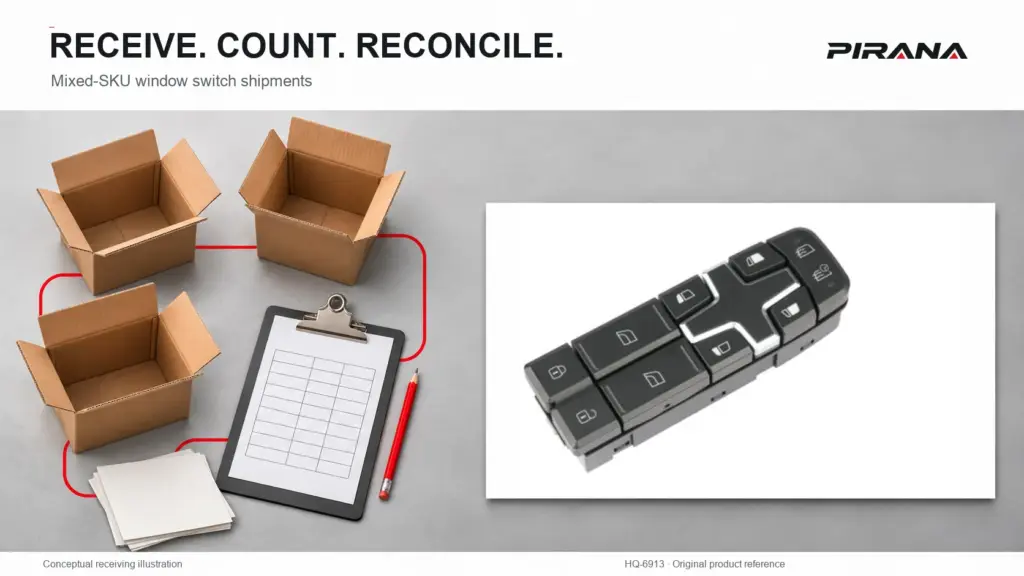
Reconcile a mixed-SKU window switch delivery against three separate records: what was ordered, what the supplier declared shipped, and what was physically received. Compare exact part identities and quantities within each carton before combining totals. A shipment can have the correct total number of pieces while containing too few of one switch and too many of another.
The result should be a receiving record with confirmed counts, unresolved discrepancies and a separate decision about stock release. Counting delivered pieces does not establish electrical performance, vehicle fitment or liability for a discrepancy. The worked shipment below is fictional; it is not a PIRANA dispatch, inventory record or customer case.
Give each document a specific job
Start with the applicable purchase order and approved amendments, the packing-list version for this dispatch, transport references and any agreed carton breakdown. Keep earlier versions rather than overwriting them when a correction arrives.
| Record | Question it helps answer | What it does not establish alone |
|---|---|---|
| Purchase order and approved changes | Which items and quantities did the buyer authorize? | Whether the full order was dispatched in this consignment. |
| Packing list and carton contents | Which items and quantities does the sender declare in this shipment, and how are they packed? | The actual contents received or product acceptance. |
| Transport record and delivery record | Which consignment and packages were handed over, and what arrival exceptions were recorded? | The exact SKU quantity inside every unopened mixed carton. |
| Commercial invoice | What commercial amounts and goods are being billed? | A verified physical count by carton. |
| Receiver’s count and identity record | Which items were actually found, where, and by whom? | Automatic release, payment approval or a confirmed cause of a mismatch. |
DHL’s comparison of commercial invoices and other documents explains the packing list’s operational role in checking package quantities and weights, distinct from the commercial invoice. Apply the actual shipment’s document requirements; the table above is a receiving workflow, not a universal customs rule.
For carton identification, use the identifiers actually provided. Where a shipment uses a Serial Shipping Container Code (SSCC), GS1 explains that it identifies the logistic unit and links it to relevant information. A carton identifier is not a switch SKU or proof of its contents. Do not assume every PIRANA shipment uses GS1 labels or that a plain carton number is an SSCC.
Preserve the carton-to-item connection
Record the delivery date, shipment reference, expected and received package count, visible carton identifiers and arrival condition. Photograph relevant labels and exceptions while the connection between the package and its contents is still clear. Do not discard packaging needed to investigate a reported difference.
Open and count mixed cartons in a controlled sequence. Keep the contents and count record attributable to each carton until reconciliation is complete. A damaged label, duplicate carton number or unexplained replacement identifier should remain an open question; assign a temporary receiving ID if needed without obscuring the original marks.
Use the unit of measure stated on the order and shipment record. “Three cartons” and “60 switches” are different observations. An assumed standard pack quantity cannot replace a count of a partial or mixed carton. If only a sample of cartons was opened, identify the sampling scope and leave the remaining contents unverified rather than reporting a full physical count.
Match the exact switch identity before assigning its count
Record the complete supplier SKU, meaningful suffix, version where provided, and the corresponding buyer code. Use the approved order and product record to resolve identity; do not allocate a visually similar switch to whichever order line is short.
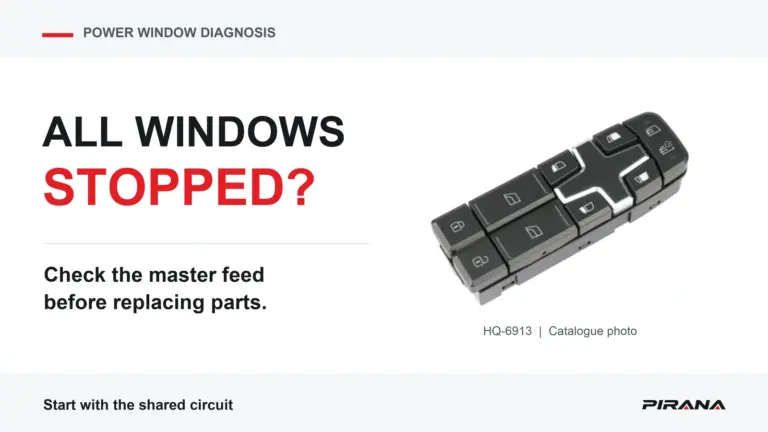
The PIRANA HQ-6913 catalogue record lists references 22154285 and 22154235. That is catalogue identification information. Multiple listed original equipment (OE) references do not mean two received variants are interchangeable, nor does a front photograph establish a rear interface or automatic-window function. This article makes no function or fitment claim for HQ-6913 or any other PIRANA model.
If a label and the visible product identifiers disagree, record both and hold the affected units for identity review. A carton marked with the expected SKU does not resolve contradictory contents. Maintain aliases and source records using the catalogue data template rather than silently renaming goods to fit the purchase order.
Work through a shipment whose grand total appears correct
The following exercise uses fictional stock codes WS-A and WS-B, which are not PIRANA models or approved substitutes. All quantities are individual switches. The order is for 100 WS-A and 60 WS-B; the supplier declares a partial dispatch of 80 WS-A and 60 WS-B in three cartons.
| Carton | Declared WS-A | Declared WS-B | Counted WS-A | Counted WS-B | Unidentified units counted |
|---|---|---|---|---|---|
| C01 | 40 | 0 | 40 | 0 | 0 |
| C02 | 40 | 0 | 35 | 0 | 0 |
| C03 — mixed | 0 | 60 | 0 | 61 | 4 |
| Shipment total | 80 | 60 | 75 | 61 | 4 |
The packing list declares 140 pieces. The receiver also counts 140 pieces: 75 + 61 + 4. That matching total hides a five-unit shortage of WS-A, one excess WS-B and four unidentified units. The unidentified units cannot be counted as WS-B merely because they were in its carton.
Use two comparisons for each exact SKU:
Shipment variance = counted matching units − declared shipped units
Quantity not declared dispatched on this order = ordered units − declared shipped units
The second expression applies here because this fictional example has one dispatch, no previous receipts, cancellations or approved amendments. In a real order with earlier shipments, reconcile the remaining order balance and all dispatch records first.
| SKU | Ordered | Declared shipped | Counted matching | Shipment variance | Not declared dispatched |
|---|---|---|---|---|---|
| WS-A | 100 | 80 | 75 | −5 | 20 |
| WS-B | 60 | 60 | 61 | +1 | 0 |
The 20 WS-A not declared dispatched and the five WS-A short against this packing list are different issues. The former may be an agreed partial delivery or an open order question. The latter needs a recount and shipment investigation. Neither automatically proves that the supplier lost or mispacked goods. Check carton identities, units, counting scope and document versions before assigning a cause.
The +1 WS-B and four unidentified units do not offset the WS-A shortage. Verify whether the extra WS-B was authorized and how it should be handled; identify the other four separately. Do not infer an approved substitution from a matching grand total.
Keep receipt status separate from stock release
Receiving staff should preserve what physically arrived even when some units cannot yet be released. Use separate fields for physically received, identity confirmed, held and accepted for stock. These states should follow the warehouse’s controlled process; do not create overlapping balances that count the same unit twice.
For this exercise, assume the relevant identity and acceptance checks subsequently release the 75 matching WS-A and 60 of the WS-B. The extra WS-B and four unidentified units remain on hold. The outcome is then:
- Physically received: 140 units.
- Accepted for stock: 135 units, comprising 75 WS-A and 60 WS-B.
- Held: five units, comprising one WS-B and four unidentified items.
This is an illustrative disposition, not a rule that all extra units must be held or a claim that counting alone authorizes release. The window-switch quality inspection guide owns product acceptance checks. Shipment reconciliation establishes identity and quantity evidence for that process; it does not replace it.
Do not use a receiving discrepancy to erase a purchase-order balance. In the exercise, the 25 WS-A difference between ordered and accepted comprises 20 not declared dispatched plus five short against the declared shipment. Reconcile those categories with the supplier before changing the remaining obligation, replacing the shipment, cancelling a balance or approving a financial adjustment.
Send an exception record that can be checked
Report observations with their source records and locations. “Order short by 25” loses the distinction that makes the WS-A example actionable. A clearer record says: “100 ordered, 80 declared in this dispatch, 75 matching units counted; C02 contains 35 against 40 declared; 20 units were not declared in this shipment.”
A practical exception record includes:
Receipt / shipment reference / receiving date:
Purchase order and amendment version:
Packing-list reference and version:
Carton ID / original labels / temporary receiving ID if used:
Exact SKU / buyer code / version / unit of measure:
Ordered balance / declared shipped / counted matching:
Unidentified or unexpected units, kept separate:
Recount person, date, scope and result:
Photos and supporting document references:
Physical receipt status / hold location / accepted quantity:
Question for supplier or carrier:
Authorized correction or disposition / approver / date:
Updated stock and order records / unresolved balance:
Preserve the original count and append a documented correction if a recount changes it. Retain both versions of a corrected packing list and record why the new version was issued. A revised document may resolve a paperwork error, but it does not itself change what was physically counted.
If damage is involved, capture the actual arrival condition and follow the applicable carrier and purchase arrangements promptly. This guide does not prescribe a claim deadline, determine responsibility or authorize a return, refund or credit. For a separate post-sale unit complaint, use the return-claim evidence guide.
Close the receipt only to the extent supported by the warehouse’s authorized decisions. Keep held goods and unresolved shipment balances visible until they have a recorded outcome. A usable result is a carton-linked quantity record that purchasing, warehouse and supplier teams can reconcile without guessing which switch or shipment a number describes.
References
- DHL, Commercial Invoice vs Other Invoices: Know the Differences, packing-list and commercial-invoice roles.
- GS1, What is a logistics unit and how is it identified?, logistic-unit identity and SSCC.
- PIRANA, HQ-6913 catalogue record, supplier-declared identification references only.